
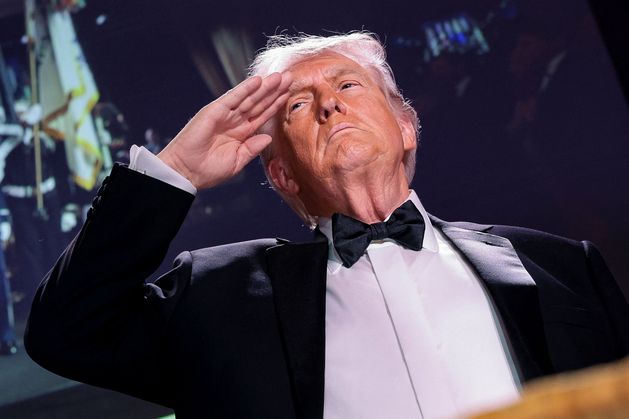
WASHINGTON – President Donald Trump has reacted with apparent indifference to an armed assault during the White House Correspondents’ Dinner on Saturday night, an event that saw a gunman attempt to storm the ballroom and send the U.S. leadership into emergency lockdown.
The breach of security at the Washington Hilton, which left one law enforcement officer injured, underscores a volatile era of American political instability that has captured global attention. Coming years after a recorded assassination attempt in Butler, Pennsylvania, in 2024, this assault on one of Washington’s most secure social traditions signals a persistent challenge for the U.S. Secret Service and highlights the deepening internal fractures within the American polity.
During a subsequent interview with CBS News, Mr. Trump stated he was “not worried” during the attack, framing the incident as a symptom of a broader societal collapse.
“I wasn’t worried. I understand life. We live in a crazy world,” Mr. Trump said.
The chaos erupted in the event’s ballroom as shots were fired nearby, prompting guests to take cover under tables. Secret Service agents executed emergency protocols to bundle Mr. Trump, First Lady Melania Trump, and other senior administration officials to a secure location.
One officer was struck during the engagement; however, the impact was absorbed by a bulletproof vest, and authorities expect the officer to make a full recovery. Law enforcement officials said there were no immediate indications of a broader operational cell, but emphasized that the incident will trigger a formal review of protective measures for large-scale events approved under the U.S. Secret Service’s mandate in Title 18 of the U.S. Code.
The Profile of a ‘Lone Wolf’
Federal authorities have identified the suspected assailant as 31-year-old Cole Tomas Allen of Torrance, California. Investigators believe the attack was specifically directed at Mr. Trump and high-ranking government figures, rather than at the media organizations represented in the ballroom.
According to law enforcement sources, Allen’s preparations included a series of communications sent to family members minutes before the assault. In these messages, he referred to himself as a “Friendly Federal Assassin” and detailed specific grievances regarding the actions of the current U.S. administration.
Details regarding the suspect include:
- Identity: Cole Tomas Allen, 31, of Torrance, California.
- Motive: Alleged political and personal grievances against the U.S. administration; self-identified as a “Friendly Federal Assassin” in pre-attack messages.
- Tactics: Attempted forced entry toward the Washington Hilton ballroom during a nationally televised, high-profile event.
- Current Status: In federal custody awaiting an initial court appearance in Washington, D.C.
Allen reportedly mocked what he described as the “insane” lack of security at the Washington Hilton, where he had been staying as a guest prior to the attack. Investigators are examining how he obtained access to sensitive areas of the hotel and whether any lapses occurred in the coordination between hotel security and federal protective teams.
Mr. Trump dismissed these claims of security failure by focusing on the suspect’s capture.
“Well, he was pretty incompetent too, because he got caught. And he got caught pretty easily,” the president said, offering no public criticism of the Secret Service or local law enforcement.
Radicalization and Political Violence
The administration has characterized the attack as the work of a “lone wolf,” though Mr. Trump explicitly stated that the gunman had been “radicalised.” He further described Allen as “probably a pretty sick guy,” noting that the suspect’s own family had expressed deep concern regarding his mental state.
Officials said investigators are now combing through Allen’s digital footprint, including social media activity and online forums, to determine whether he consumed or shared extremist content, and whether any individual or group encouraged his actions.
The event is the latest in a series of high-profile security breaches targeting the U.S. presidency. The trajectory of political violence in the United States has become a point of concern for international intelligence communities, as the normalization of threats against head-of-state figures reflects a broader trend of domestic instability and polarized public discourse.
The White House Correspondents’ Dinner, an institutional fixture designed to bridge the gap between the Executive Branch and the press, has historically been a venue for political satire and diplomatic signaling. The transformation of the event into a site of armed conflict marks a significant escalation in the risks associated with public-facing presidential engagements and raises fresh questions about how the federal government balances openness with security.
Security experts note that the dinner, designated as a National Special Security Event in some years, already operates under dense layers of coordination among the Secret Service, local police and hotel security. Saturday’s breach is expected to intensify pressure on the administration and Congress to examine whether current protocols, funding levels and oversight mechanisms remain adequate for an environment in which journalists, senior officials and the president share the same confined space. For media organizations, the episode is also likely to revive internal debates over sending large delegations to high-profile political galas.
Legal and Institutional Fallout
Mr. Allen is scheduled to appear in court on Monday. He faces multiple federal charges, including the attempted murder of a federal officer and offenses related to attempting to kill or assault a U.S. official engaged in official duties. Legal analysts say the case will test how aggressively prosecutors deploy existing federal statutes governing attacks on protected officials, rather than seeking new legislation.
President Trump has formally requested that the White House Correspondents’ Dinner be rescheduled and held within the next 30 days. A senior administration official said the request is intended to “signal institutional resilience,” but organizers will now have to weigh that symbolic value against heightened security requirements, potential attendance hesitancy, and the costs of transforming what was once a light-hearted annual ritual into an event conducted under near state-visit conditions.
As investigators reconstruct Allen’s path to the Hilton ballroom-from hotel guest to alleged would-be assassin-the attack is already prompting a broader discussion inside Washington about how the country’s foundational commitment to open civic life can endure in an era when political spectacle, armed grievance and presidential security increasingly collide.
Keep reading
