
ISLAMABAD – Iranian President Masoud Pezeshkian has formally credited Pakistan with playing a pivotal role in mediating diplomatic channels between Tehran and Washington, marking a significant shift in the regional geopolitical landscape.
The acknowledgment came during a high-profile state visit to Islamabad on Tuesday, the Iranian president’s first foreign journey since the conclusion of recent hostilities in the region. The visit signaled an effort by both nations to institutionalize a framework for de-escalation through the “Islamabad Memorandum of Understanding” (MoU), a 14-point interim accord signed on June 17 that is intended to serve as a precursor to a more comprehensive diplomatic agreement between Iran and the United States.
This diplomatic pivot positions Pakistan as a critical bridge between two adversarial superpowers, leveraging its unique strategic position as a neighbor to Iran and a long-term security partner of the United States. The emergence of Islamabad as a mediator suggests a move toward “regionalized” diplomacy, where middle powers facilitate the mitigation of risks that could otherwise trigger a wider systemic conflict in the Middle East and South Asia. The MoU, which outlines sequenced steps on de-escalation, sanctions relief and security guarantees, is framed as an interim understanding rather than a treaty, but its reference to subsequent negotiations on “a final deal” carries the weight of a political commitment by all three capitals.
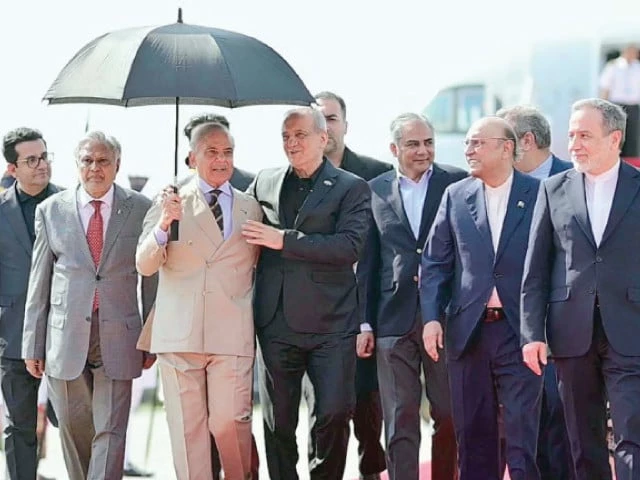
Upon entering Pakistani airspace, President Pezeshkian’s aircraft was escorted by Pakistan Air Force fighter jets, followed by a 21-gun salute at Nur Khan Airbase-honors typically reserved for the highest tier of state guests. He was received by President Asif Ali Zardari and Prime Minister Shehbaz Sharif, accompanied by a delegation that included Foreign Minister Abbas Araghchi, Iran’s chief negotiator under the MoU framework.
During a joint press conference following delegation-level talks, Pezeshkian highlighted the necessity of Pakistan’s intervention at a time of extreme regional volatility and stressed that Islamabad had acted with the tacit consent of both Tehran and Washington.
“At a critical historical juncture that the region is facing multiple challenges, the responsible and visionary role played by Pakistan in supporting discussions and negotiations aimed at de-escalation and strengthening regional stability reflects a brotherly and forward-looking approach,” Pezeshkian said.
The Iranian leader specifically praised the ability of the Pakistani government to maintain sincerity throughout a complex negotiation process. “If it was not for the efforts made by your excellency and your team, we would not have been here today,” Pezeshkian remarked, referring to Prime Minister Shehbaz.
The Missile Red Line
A central component of the visit was the need to dispel international speculation regarding the scope of the negotiations. Reports had suggested that Iran’s ballistic missile program-a cornerstone of its national defense strategy and a primary point of contention for the United States and Israel-had been a subject of the discussions.
Prime Minister Shehbaz categorically denied these reports, asserting that the missile program remained entirely outside the scope of the current diplomatic outreach and of the written text of the Islamabad Memorandum of Understanding.
“Let me say without any fear of contradiction that ballistic missiles were never a subject of discussion between Iran and the United States. It was not on the table at all and there is no mention of ballistic missiles anywhere in the MoU,” the Prime Minister stated.
President Pezeshkian reinforced this position, framing the missile capability as an existential necessity for the Islamic Republic.
“If it were not for Iran’s missile capabilities, our country would have been plundered and destroyed by the US regime and the Zionist regime. We shall never compromise on our missile capabilities and this shall never be part of any agreement between Iran and any other party.”
The refusal to negotiate on missile technology underscores the limits of the current de-escalation efforts, indicating that while Tehran is open to diplomatic frameworks to reduce immediate tensions, it will not dismantle its primary deterrent capabilities. For Western policymakers, the MoU therefore represents a narrowly focused de-escalation instrument rather than a comprehensive non-proliferation arrangement of the type once embodied in the 2015 nuclear accord.
Strategic Alignment and Security Frameworks
The visit also underscored the influence of Pakistan’s military establishment in shaping its foreign policy. Prime Minister Shehbaz credited Field Marshal Syed Asim Munir, the Chief of Army Staff and Chief of Defence Forces, for his tireless work in preventing a wider regional conflict and facilitating the ceasefire that led to the Islamabad MoU. Pakistani officials describe the MoU as operating within Pakistan’s civilian-military decision-making architecture, with the army overseeing security guarantees while the Foreign Office manages the diplomatic channel.
In a separate meeting with Field Marshal Munir, President Pezeshkian appreciated Pakistan’s “constructive and responsible role” in promoting dialogue amidst heightened geopolitical tensions. The discussions focused on regional security, border management, and the ongoing implementation of the MoU’s early-phase confidence-building measures.
The diplomatic engagement extended to the presidency, where President Asif Ali Zardari reaffirmed Pakistan’s support for Iran’s sovereignty and territorial integrity. Zardari expressed optimism that the technical-level negotiations currently underway would evolve into a durable peace agreement, while cautioning that implementation would require sustained political will in all three capitals and coordination with existing regional security mechanisms such as the Shanghai Cooperation Organisation.
The strategic partnership is further complicated by the presence of external actors. Prime Minister Shehbaz warned that the progress made via the Islamabad MoU had already drawn the ire of third-party interests that view any reduction in U.S.-Iran tensions as a constraint on their own leverage.
“There is no shortage of elements in the world that are unhappy with the gains made through the Islamabad Memorandum of Understanding. Pakistan and Iran will stand like an iron wall against those seeking to sabotage peace in the region,” Shehbaz said.
The visit concluded with a mutual commitment to expand connectivity initiatives and economic cooperation, including energy trade and cross-border infrastructure, aiming to transition the relationship from one of security management to one of shared development. Pakistani officials said any future sanctions relief envisaged under the MoU would be channeled into such projects, in coordination with U.S. licensing authorities.
Technical-level talks between Pakistani and Iranian delegations remain ongoing to finalize the transition of the Islamabad MoU into a formal, binding agreement. Under the text of the MoU, implementation of several initial provisions is a precondition for opening negotiations on a “final deal” that would codify de-escalation commitments and establish a more durable diplomatic framework between Tehran and Washington.
Worth a look
