
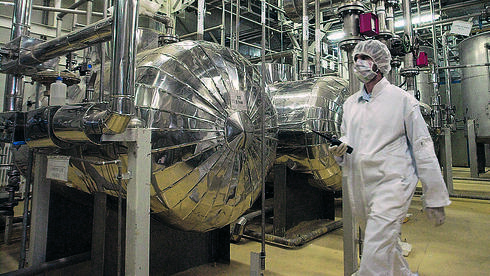
VIENNA – International inspectors estimate that Iran now possesses approximately 11 tons of uranium at various enrichment levels, a stockpile that could potentially be processed to produce up to 100 nuclear weapons, according to a report by The New York Times.
The scale of these reserves represents a critical inflection point in global non-proliferation efforts. The volume of raw material now available to Tehran significantly alters the strategic calculus for Western powers and regional rivals, as the sheer quantity of uranium reduces the time required to achieve weapons-grade concentration, regardless of current diplomatic freezes.
While only a fraction of the stockpile is currently enriched to levels approaching weapons-grade, the ability to further refine lower-enriched uranium means the total volume is now the primary metric for assessing Iran’s nuclear capability. This shift in focus-from the percentage of enrichment to the total mass of the stockpile-has become a central pillar of concern as international negotiations resume.
The Erosion of the 2015 Accord
The current stockpile marks a dramatic reversal of the conditions established under the 2015 Joint Comprehensive Plan of Action (JCPOA). Under that landmark agreement between Iran and the P5+1 powers, Tehran agreed to reduce its uranium holdings by approximately 97 percent and accepted stringent limits on both the volume of its reserves and the level of enrichment, as codified in the publicly released JCPOA text.
At the height of the JCPOA’s implementation, Iran’s remaining material was insufficient to produce even a single nuclear device, and the International Atomic Energy Agency (IAEA) maintained unprecedented access to Iranian facilities to verify compliance under a rigorous inspection and reporting regime.
The trajectory shifted in 2018 when the United States withdrew from the agreement and reimposed sweeping economic sanctions. In response, Iran began a phased withdrawal from its own commitments, systematically increasing the number of centrifuges in operation and raising the purity of its uranium, while arguing that it was exercising rights reserved under the deal’s dispute mechanisms.
- Pre-2018: Strict caps on uranium stockpiles and enrichment levels below 3.67%, with surplus material shipped abroad or blended down.
- Post-2018: Expansion of enrichment facilities, installation of more advanced centrifuge models and stockpiling of uranium enriched to 20% and 60% purity.
- Current State: Estimated 11 tons of uranium across varying levels of enrichment, far beyond JCPOA thresholds and closer to what some experts describe as an industrial-scale program.
Technical Capacity and Monitoring Gaps
The potential to produce 100 warheads is a ceiling estimate that depends heavily on Iran’s technical capacity for weaponization and the efficiency of its enrichment cycle. Some specialists assess the yield would be closer to several dozen warheads, noting that the transition from enriched gas to a viable nuclear device requires complex engineering, specialized metallurgy and, ultimately, a delivery system.
Compounding the technical risk is the uncertainty surrounding the location and configuration of the materials. Much of the uranium is believed to be stored in underground or heavily fortified facilities, which complicates the IAEA’s ability to conduct real-time monitoring and verification and has fueled calls in Western capitals for a restoration of “snap” inspections and continuous surveillance.
The use of advanced centrifuges has further compressed the “breakout time”-the duration required to produce enough weapons-grade uranium for one bomb. With a stockpile of 11 tons, the primary hurdle is no longer the acquisition of material, but the time needed to process it through the centrifuge cascades. The concern for policymakers is less about a single weapon than about the speed with which Iran could move from one device to a small arsenal before diplomacy or sanctions could alter its calculations.
Diplomatic Leverage and Constraints
As negotiations move forward, the status of these reserves is expected to be a non-negotiable focal point. For Western diplomats, a return to a stable nuclear regime would likely require not only a cap on future enrichment but a verifiable reduction or removal of the existing 11-ton stockpile, potentially under IAEA custody or monitored transfer to a third country.
The challenge remains the mechanism of disposal. Reducing the stockpile would require Iran to either ship the material out of the country or dilute it back to a level where it can no longer be easily refined, both of which require high levels of trust, technical sequencing and intrusive international oversight. Past proposals have included Russian-managed reprocessing and fuel take-back schemes similar to those used in other civilian nuclear arrangements, but these options now sit in a far more polarized geopolitical context.
The current stockpile remains under the purview of IAEA monitoring, though the agency has frequently cited gaps in cooperation and access to certain sites as obstacles to a full accounting of Iran’s nuclear inventory. For governments weighing sanctions relief, security guarantees or new regional security frameworks, those verification gaps-and the sheer scale of Iran’s uranium holdings-are likely to define whether any renewed agreement is politically defensible at home.
Worth a look
