
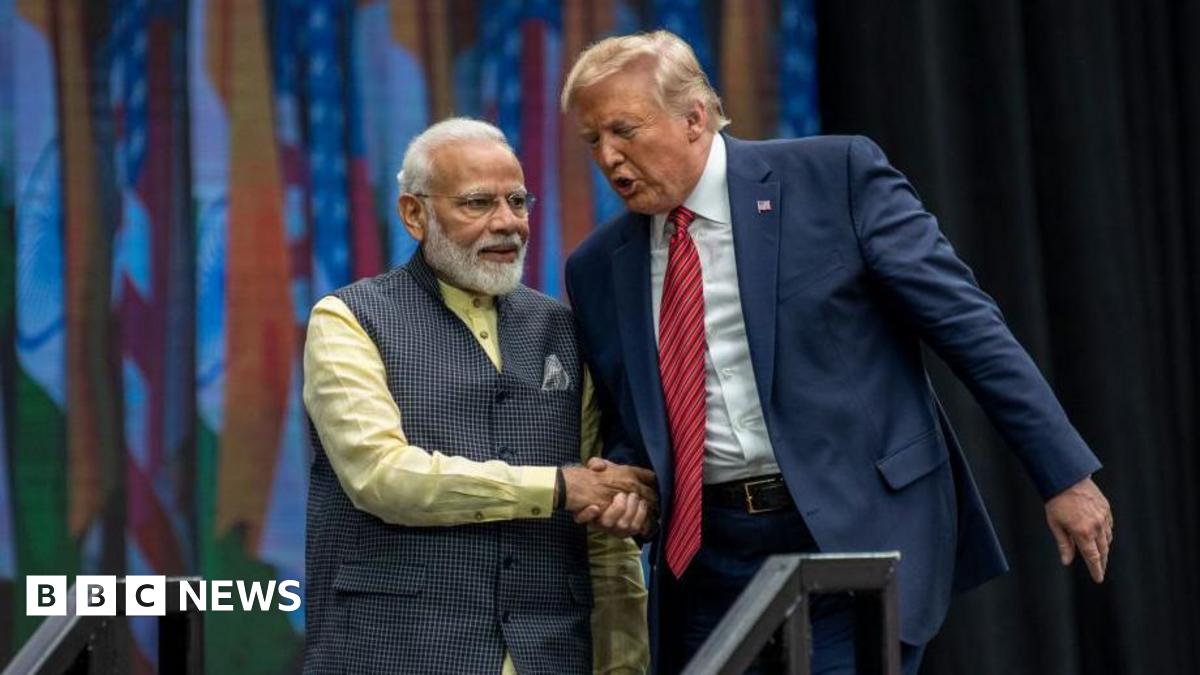
NEW DELHI – India has rejected U.S. Commerce Secretary Howard Lutnick’s claim that a long-anticipated bilateral trade deal collapsed because Prime Minister Narendra Modi declined to place a closing phone call to President Donald Trump-an assertion made by Lutnick on a podcast released Friday that immediately drew a public rebuttal from New Delhi.
“It was all set up. I said [to the Indian side] you got to have Modi call the president. They were uncomfortable doing it, so Modi didn’t call,” Lutnick said on the All-In Podcast, describing Trump’s dealmaking style as a “staircase” in which “the first stair gets the best deal.”
Foreign ministry spokesperson Randhir Jaiswal said the portrayal was “not accurate,” noting that the two governments agreed to begin negotiating a bilateral trade agreement on 13 February last year and have held “multiple rounds” of talks since. “India and the US were committed to negotiating a bilateral trade agreement as far back as 13 February last year. Since then both sides have held multiple rounds of negotiations to arrive at a balanced and mutually beneficial trade agreement. On several occasions, we have been close to a deal,” Jaiswal told reporters, adding that Modi and Trump spoke by phone eight times in 2025 on “different aspects of our wide‑ranging partnership.”
Phone‑call politics collides with high‑stakes trade
Lutnick, a former Wall Street executive who became commerce secretary in February 2025, said India was given “three Fridays” to close and that when New Delhi tried to revive the offer weeks later “the train had left the station.” He also said Washington proceeded to ink agreements with other partners, including Indonesia and Vietnam, under what he characterized as a competitive “first‑come, best‑terms” approach.
New Delhi’s pushback underscores how personality‑driven diplomacy has intersected with painstaking market‑access talks between two of the world’s largest economies. The episode comes as the Trump administration’s second‑term trade team recalibrates U.S. tariffs and deploys economic statecraft to support sanctions on Russia, tying bilateral trade incentives more tightly to broader foreign‑policy objectives.
What’s actually on the table
Neither side has published a full draft of the putative deal, and officials caution that talks remain at the level of negotiating “baskets” rather than a single consolidated text. Agriculture remains the thorniest file, with Washington pressing for greater access for U.S. “row crops” and meats and India guarding long‑protected farm sectors that are politically sensitive in several key states.
In December testimony to U.S. senators, U.S. Trade Representative Jamieson Greer called India “a very difficult nut to crack” even as he said New Delhi’s latest proposals were “the best we’ve ever received as a country.” The negotiations are formally anchored in a terms‑of‑reference document agreed in April 2025 that set objectives on market access, tariffs and non‑tariff barriers. That framework followed a 2023 clean‑up of legacy disputes at the World Trade Organization and Indian tariff cuts on select U.S. farm goods-steps intended to clear away smaller irritants before tackling a larger package.
The bilateral talks sit alongside, and are constrained by, each country’s obligations under the WTO agreements, which continue to provide the fallback rules if no deal is reached and limit how far either side can escalate tariffs without risking formal disputes under the WTO’s Dispute Settlement Understanding.
Tariffs, oil and leverage
After talks faltered last year, the United States doubled most tariffs on Indian goods to 50% in late August, including a 25% surcharge explicitly linked to India’s continued purchases of discounted Russian oil. Trump warned on January 5 that rates could go even higher if India fails to further curb those imports. Two days later, Senator Lindsey Graham said Trump had “greenlit” a bipartisan Russia sanctions bill that would authorize steep secondary tariffs and penalties on countries buying from Moscow.
Indian refiners-sensitive to sanctions risk and to the possibility of being cut off from dollar payments systems-have trimmed Russian crude purchases in recent months while increasing intake from the United States and Middle East suppliers, according to industry and trade data. Officials in New Delhi frame those shifts as commercial decisions, but U.S. lawmakers now openly treat India’s crude import mix as leverage in the trade talks.
Trade is still growing-despite the costs
Even with the new tariff wall, India’s goods shipments to the United States rose sharply in November, with exports to the U.S. up more than 22% year‑on‑year amid rupee weakness and strong demand in categories less exposed to the duties, such as pharmaceuticals and services‑linked manufactures. Indian government data show total goods exports hit $38.1 billion in November, the strongest November in a decade.
For Washington, India remains a top‑tier commercial partner: U.S. goods‑and‑services trade with India reached an estimated $212.3 billion in 2024, while the goods deficit stood at roughly $45.8 billion. Those macro numbers help explain why both sides insist they remain committed to a deal even as tactical decisions-such as whether and when leaders intervene personally-have become contested.
Why agriculture and standards loom so large
India’s applied tariffs on farm products are among the highest of any major economy, and long‑running barriers include restrictions linked to genetically modified crops, sanitary and phytosanitary rules and dairy certification. Farm‑sector protections are not just an economic issue: they touch the livelihoods of tens of millions of smallholders and are tightly bound up with India’s domestic food‑security policies.
The United States, for its part, has pressed India to pare back price controls on select medical devices, ease testing and conformity procedures and accept more U.S. standards-asks that have featured in recent U.S. deals with the United Kingdom and Vietnam. Regulatory recognition and data‑sharing would, in Washington’s view, lower behind‑the‑border barriers; Indian officials argue they must retain room to regulate in the public interest on health, safety and digital policy.
Deals elsewhere raise the temperature
Lutnick’s “staircase” metaphor reflects a sequencing strategy the Trump administration has used in recent agreements. Washington concluded a trade deal with the United Kingdom in May 2025 and announced frameworks or deals with partners across Asia-among them Indonesia and Vietnam-while holding a baseline “reciprocal” tariff structure in place.
That sequencing has raised fears in New Delhi of being pushed to later, costlier “stairs,” in which India would be asked to match or exceed concessions made by earlier partners without necessarily securing equivalent benefits in areas where it is most competitive, such as services and skilled labor mobility. Indian officials argue that any agreement must deliver visible wins at home, not just lock in access for U.S. exporters.
Politics intrudes: Kashmir and phone diplomacy
India’s foreign ministry has repeatedly dismissed suggestions of U.S. “mediation” in its dispute with Pakistan over Kashmir, stressing that New Delhi will “never accept third‑party mediation.” That message was reiterated during a fraught India‑Pakistan flare‑up in mid‑2025, even as Modi and Trump maintained periodic contact-including a birthday call on September 16, 2025, in which both leaders publicly pledged to deepen ties.
The clash over whether a single phone call could have sealed a trade agreement thus lands in a relationship where leader‑to‑leader contact is frequent but tightly choreographed, and where questions of sovereignty-from Kashmir to tariff autonomy-remain politically explosive in both capitals.
Key dates in the current round
- February 13, 2025: U.S. and India agree to launch bilateral trade talks.
- May 8, 2025: U.S.-UK trade deal announced; Washington signals a “staircase” approach to subsequent partners.
- August 27, 2025: United States doubles most tariffs on Indian goods to 50%; Indian exports to the U.S. recover in November.
- December 10-11, 2025: USTR Jamieson Greer tells senators India is a “tough nut to crack” but has made the “best ever” offer.
- January 5, 2026: Trump warns of higher tariffs if India does not further curb Russian oil purchases.
- January 9, 2026: Lutnick says the India deal stalled because Modi “didn’t call.” India publicly disputes the characterization.
As of Friday evening, January 9, 2026, the White House had not commented on Lutnick’s assertions, and both governments say negotiations toward a bilateral trade agreement remain active. For now, the question is not only whether the two sides can bridge differences on tariffs and standards, but also how much of the process will be driven by institutional trade negotiators rather than by presidential phone diplomacy.
Related reading
- Global Food Security Alliances: How Climate-Resilient Agricultural Corridors Are Stabilizing Wheat and Rice Supplies
- Cross-Border Renewable Energy Grids: North Sea and Mediterranean Subsea Cable Networks Enter Phase Two
- India vs New Zealand: Bhuvneshwar Kumar returns to India's T20I squad (globallypulse.com)
- Pavlovic Rejects €100M City Bid to Stay at Bayern, per Sky and Bild (archysport.com)
