
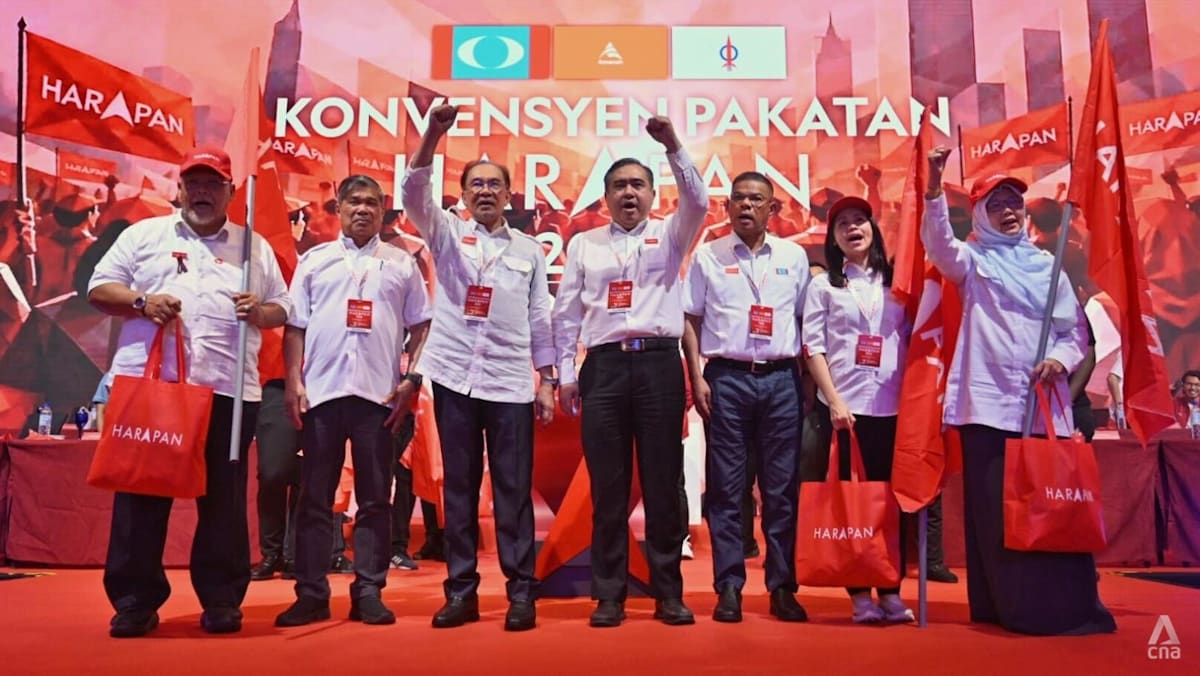
JOHOR BAHRU – Malaysian Prime Minister Anwar Ibrahim has signaled that he is considering calling a snap general election, following a decision by Barisan Nasional (BN) to contest the upcoming Johor state elections independently.
The announcement marks a significant escalation in tension within Malaysia’s fragile unity government, a coalition formed to stabilize the country after the deadlock of the 2022 general elections. The prospect of a nationwide vote suggests a potential collapse of the strategic partnership between Anwar’s Pakatan Harapan (PH) and the traditionally dominant BN at the federal level.
The rift became public after Johor Chief Minister Onn Hafiz Ghazi confirmed that BN would contest all 56 seats in the state polls, opting to bypass cooperation with its federal partners.
Addressing a Pakatan Harapan convention in Johor Bahru on Sunday, Anwar stated he was “not surprised” by the move, but warned that such a strategy could trigger a wider political confrontation.
“Now we are hearing that UMNO (United Malays National Organisation) and Barisan Nasional intend to contest all seats (in Johor). I am not surprised. But if they choose confrontation in Johor, then our answer must also be firm,” said Anwar, who serves as the PH chairman.
The Prime Minister indicated that if BN refuses to collaborate in Johor, PH is prepared to contest all state poll seats not only in the southern state but also in Negeri Sembilan, Selangor, Penang, and Pahang, effectively treating Johor as a test case for the durability of the unity administration nationwide.
“If they negotiate properly, we will remain patient and wise. But if they choose war – then we will fight seriously. In the near future, I will call Pakatan Harapan leaders to discuss whether we should consider a nationwide general election,” Anwar said.
The internal friction highlights the precarious nature of the unity government, which was established as a necessity after the 15th General Election (GE15) resulted in a hung parliament. Under Malaysia’s constitutional monarchy, a government is formed only when a coalition or party can demonstrate majority support in the Dewan Rakyat, and the King formally appoints the prime minister. Anwar’s administration, built on that post-GE15 compromise, relies on a diverse array of partners, including PH, BN, Gabungan Parti Sarawak (GPS), and Gabungan Rakyat Sabah (GRS).
PH comprises Anwar’s Parti Keadilan Rakyat (PKR), the Democratic Action Party (DAP), and Parti Amanah Negara (Amanah). BN is led by UMNO, a party that dominated Malaysian politics for six decades but has seen its influence wane in the face of rising conservative sentiment and voter volatility.
The shift toward independence by BN appears to be a deliberate strategy by its leadership to reclaim its identity and voter base after joining the unity government. In a recent interview, BN chairman Ahmad Zahid Hamidi expressed a strong preference for autonomous campaigning.
“In the coming election, I am almost certain we will go solo. But we should not dismiss the need for an understanding with other party coalitions,” Zahid Hamidi stated.
However, Anwar framed this desire for independence as a breach of trust. He characterized the move to contest alone in Johor as akin to threats that could amount to “betrayal” of the unity government partnership and its shared programme for economic recovery and governance reform.
Anwar emphasized that his administration has maintained a “constructive approach,” extending constitutional courtesy even to states governed by the opposition, but asserted that this should not be mistaken for fragility.
“Do not threaten us or move toward betrayal,” Anwar said, underscoring that the government’s willingness to cooperate on federal funding, development allocations and institutional reforms is contingent on basic coalition discipline.
The Prime Minister argued that if the partnership is no longer viable in certain regions, the most democratic solution is to dissolve the current mandate. Under Malaysia’s Federal Constitution, Parliament can be dissolved by the Yang di-Pertuan Agong on the advice of the Prime Minister, triggering a general election within 60 days of dissolution in most constituencies, as further detailed in the Federal Constitution of Malaysia.
“That is why I agree with the suggestion: if they truly believe the time has come in certain states – in Johor, Negeri Sembilan – then perhaps we should return the mandate to the people and let (them) decide,” he added. “If the unity government is truly considered tired and exhausted, then let us return to the people – not only in Johor and Negeri Sembilan, but throughout the country. I am ready.”
The Electoral Landscape
The political instability comes at a time when Malaysia is navigating a complex ideological divide. The rise of the Perikatan Nasional (PN) coalition, driven largely by the conservative PAS party, has pressured BN to pivot back toward its traditional Malay-Muslim base to avoid further losses, sharpening competition for the same voter demographic that both BN and PN seek to mobilise.
The strategic stakes of the Johor state elections include:
- UMNO Stronghold: Johor is a traditional bastion for UMNO; a failure to perform here would severely weaken BN’s leverage in federal negotiations and its claim to represent core Malay heartland interests.
- Bellwether Effect: State elections in Malaysia often serve as indicators of national sentiment ahead of general polls, shaping coalition bargaining power, policy concessions, and party leadership contests.
- Coalition Viability: The results will determine whether PH and BN can coexist as partners or if the unity government is functionally obsolete, forcing a reconfiguration of alliances in Parliament.
The Johor contest also has implications for policy continuity. A snap national vote could delay or derail key initiatives under Anwar’s economic reform agenda, including subsidy rationalisation, fiscal consolidation and investment facilitation measures, as ministries and agencies shift focus to campaigning and post-election bargaining. For investors and regional partners, prolonged uncertainty in Kuala Lumpur risks complicating longer-term planning, even as day-to-day administration continues.
While analysts have suggested Anwar’s rhetoric may be a tactical move to force BN back to the negotiating table, the threat of a snap election remains a potent constitutional tool. Under the Malaysian system, the Prime Minister advises the Yang di-Pertuan Agong (the King) on the dissolution of Parliament, and the Election Commission then administers the nationwide polls in accordance with the country’s electoral framework.
For now, the unity government remains in power as negotiations between PH and BN leadership continue. But Johor’s polls have become more than a state-level contest: they are emerging as a de facto referendum on whether the post-GE15 governing experiment can survive its first major stress test.
Keep reading
- Global Food Security Alliances: How Climate-Resilient Agricultural Corridors Are Stabilizing Wheat and Rice Supplies
- Cross-Border Renewable Energy Grids: North Sea and Mediterranean Subsea Cable Networks Enter Phase Two
- Spanish election: Pedro Sanchez calls snap election for 29 November after housing protests (globallypulse.com)
