
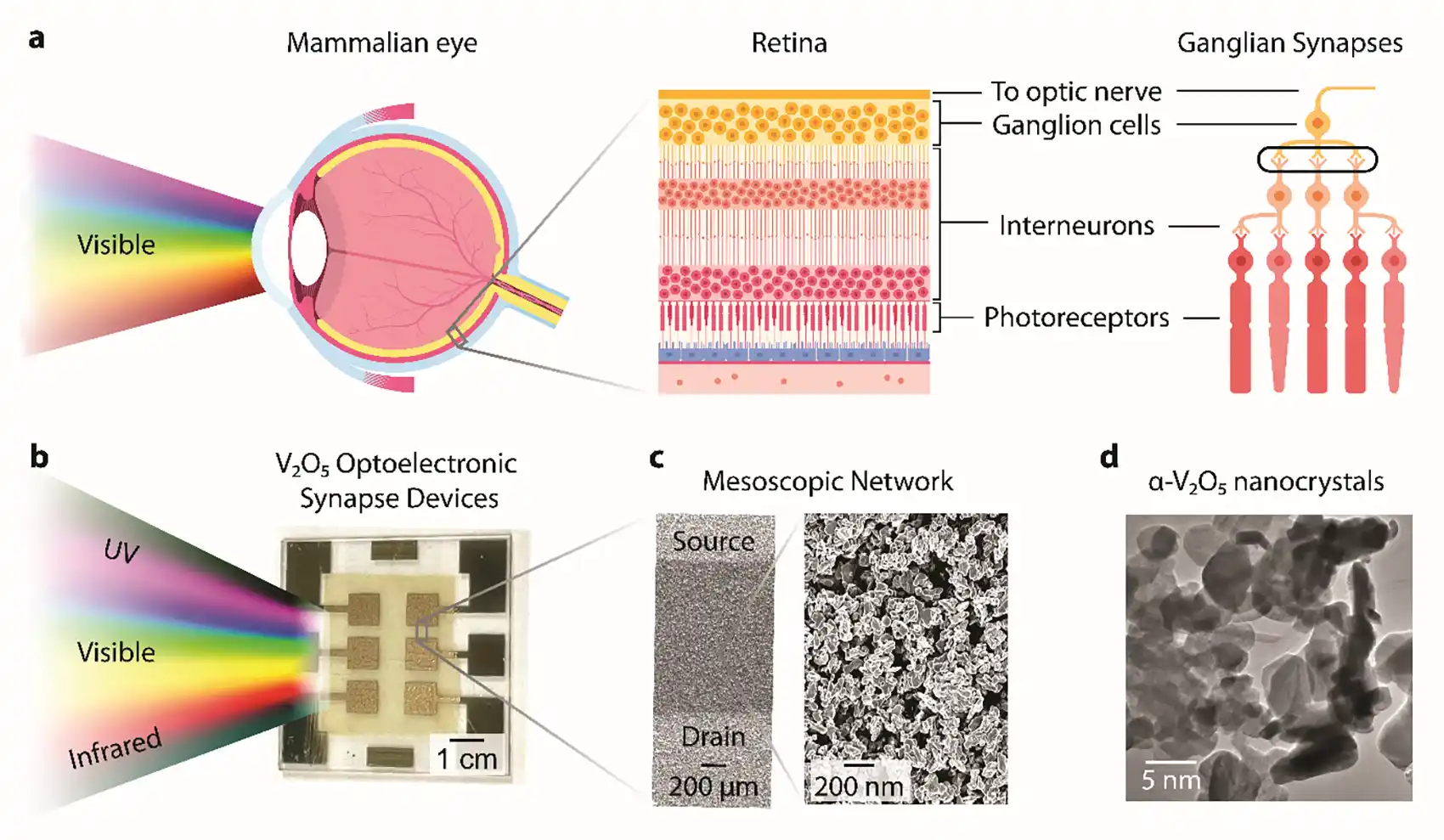
Modern artificial intelligence faces a fundamental physical limitation: the energy cost of moving data between a processor and its memory. This “von Neumann bottleneck” consumes massive amounts of power and generates significant heat, hindering the deployment of complex AI at the edge. To solve this, engineers are turning to neuromorphic computing-hardware designed to mimic the biological architecture of the human brain, where processing and memory occur in the same physical location.
A critical breakthrough in this field has emerged through the development of optoelectronic synapses using α-phase vanadium pentoxide (V2O5). By utilizing materials that can “remember” light exposure, researchers are creating vision systems that function less like digital cameras and more like mammalian eyes, integrating sensing and processing into a single, energy-efficient layer. In principle, such systems could allow cameras, sensors, and even autonomous robots to process what they “see” locally, with far lower energy budgets and less dependence on remote data centers.
The Mechanics of Artificial Memory
The efficiency of the human visual system stems from its ability to resolve images with minimal energy by trapping electric charges in cells, which the brain then interprets. The use of V2O5 crystals replicates this process through a phenomenon known as persistent photoconductivity. The key lies in atomic vacancies-specifically missing oxygen atoms-within the crystal structure.
When light hits the material, these oxygen vacancies trap the resulting charges, forming “polarons.” These polarons create a lasting electrical record of the light stimulus, effectively giving the crystal a form of inherent memory. This allows the device to maintain a state of conduction long after the light source has been removed, turning incident photons into a time-stamped, analog record that can be read out and processed directly on the chip.
| Technical Feature | Neuromorphic Implementation (V2O5) |
|---|---|
| Core Material | α-phase vanadium pentoxide |
| Mechanism | Interlayer exciton polarons via oxygen vacancies |
| Signal Persistence | Decay times exceeding 25 minutes under test conditions |
| Spectral Range | Broadband sensitivity (including infrared) |
| Physical Form | Compatible with flexible glass substrates |
Lance Wheeler, NLR scientist and contributing author, explained the significance of this mechanism: “This work builds on years of past research in optoelectronics, but it also presents a fundamental discovery of how certain atomic vacancies give rise to longer photoresponse times, which is a key to eye-like vision and applications like multispectral imaging, sensing, and communications.”
Scaling Neuromorphic Vision for Edge Intelligence
The ability to tune these crystals during fabrication allows for precise control over sensitivity and photoresponse times. This mimics long-term potentiation and plasticity in biological synapses, which are the foundational elements of learning and memory in the brain. By implementing these synapses in hardware, the need for complex, power-hungry circuitry is reduced, lowering both energy consumption and signal interference while enabling more compact system designs.
This shift is particularly vital for basic energy sciences and the development of edge electronics. Unlike traditional sensors that stream raw data to a central processor for analysis, neuromorphic sensors can perform initial data filtering and feature extraction on-device. This reduces the bandwidth required for data transmission and enables real-time decision-making in environments where latency is critical-such as industrial control systems, autonomous vehicles, and defense applications where split-second perception can shape operational and policy decisions.
For regulators and standards bodies, the emergence of such “seeing and thinking” devices raises familiar questions about safety, robustness, and accountability in AI systems. As neuromorphic sensors increasingly underpin decision-making at the edge, they are likely to fall within the scope of horizontal AI governance efforts such as the evolving rules on high-risk AI systems under the EU Artificial Intelligence Act, as well as sector-specific guidance on trusted and explainable machine perception in areas like transportation and critical infrastructure.
Potential deployment vectors for this technology include:
- Autonomous robotics: Low-power navigation and perception systems that can operate in diverse lighting conditions without continuous cloud connectivity.
- Distributed sensing: Massive arrays of sensors capable of detecting environmental changes-such as temperature shifts, gas leaks, or structural stress-without constant high-power draws or data backhaul.
- Bioengineering: Prosthetic visual interfaces that more closely emulate natural neural signaling, potentially improving fidelity and reducing latency for patients.
- Advanced surveillance: Integration of infrared capabilities for night vision and heat mapping without bulky external processors, raising parallel considerations around privacy, oversight, and proportional use in public and private spaces.
Infrastructure, Standards, and Material Versatility
Beyond the internal physics of the synapse, the scalability of the material is a primary driver for commercial viability. The compatibility of V2O5 with low-cost polycrystalline materials and flexible substrates means these “artificial eyes” could be integrated into curved surfaces, wearable tech, or foldable electronics. That design flexibility aligns with broader industry efforts to standardize interfaces and testing protocols for neuromorphic components so they can be swapped into existing manufacturing lines rather than requiring bespoke fabrication.
Jeffrey Blackburn, NLR research fellow and contributing author, highlighted the broader implications of these findings: “An important outcome of the study was identifying the role of polarons for achieving tunable persistent photoconductivity in this class of oxide materials.”
The discovery suggests that the polaron mechanism is not limited to a single material but can be exploited across a variety of oxide architectures to create a new generation of standardized neuromorphic devices. As Blackburn noted, “This insight-when coupled with areas like low-cost polycrystalline materials, scalable device fabrication methods, broadband sensitivity, and flexible substrates-opens possibilities to exploiting similar mechanisms across a broad array of materials and optically driven neuromorphic device architectures.”
For policymakers, the significance is twofold: neuromorphic vision offers a path to dramatically lower the energy footprint of AI while pushing more intelligence to the edge; at the same time, it accelerates the need for clear standards on reliability, interoperability, and responsible deployment. How quickly agencies and industry coalitions move to define those guardrails will help determine whether these eye-like devices remain confined to laboratories or become a foundational layer of next-generation digital infrastructure.
