
The Subsolar Mass Anomaly and the Mass Gap
The detection of gravitational waves has transformed the study of the cosmos from a purely visual endeavor into an auditory one, allowing scientists to “hear” the collisions of massive objects. However, a recent signal captured by the Laser Interferometer Gravitational-Wave Observatory (LIGO) has challenged the established understanding of black hole formation and reopened a long-running debate over which compact objects nature can actually make.
Standard astrophysical models suggest a “mass gap,” a theoretical threshold below which stellar evolution cannot produce a black hole. Most black holes are the remnants of collapsed massive stars, meaning they typically possess a mass several times that of our Sun. As Nico Cappelluti, an associate professor in the University of Miami’s Department of Physics, explains: “The most common black holes form as the result of a supernova, the death of a massive star. So, their masses can range from a few times the Sun’s mass to billions of solar masses.” Objects below about one solar mass are expected to be white dwarfs, neutron stars or planets-not black holes.
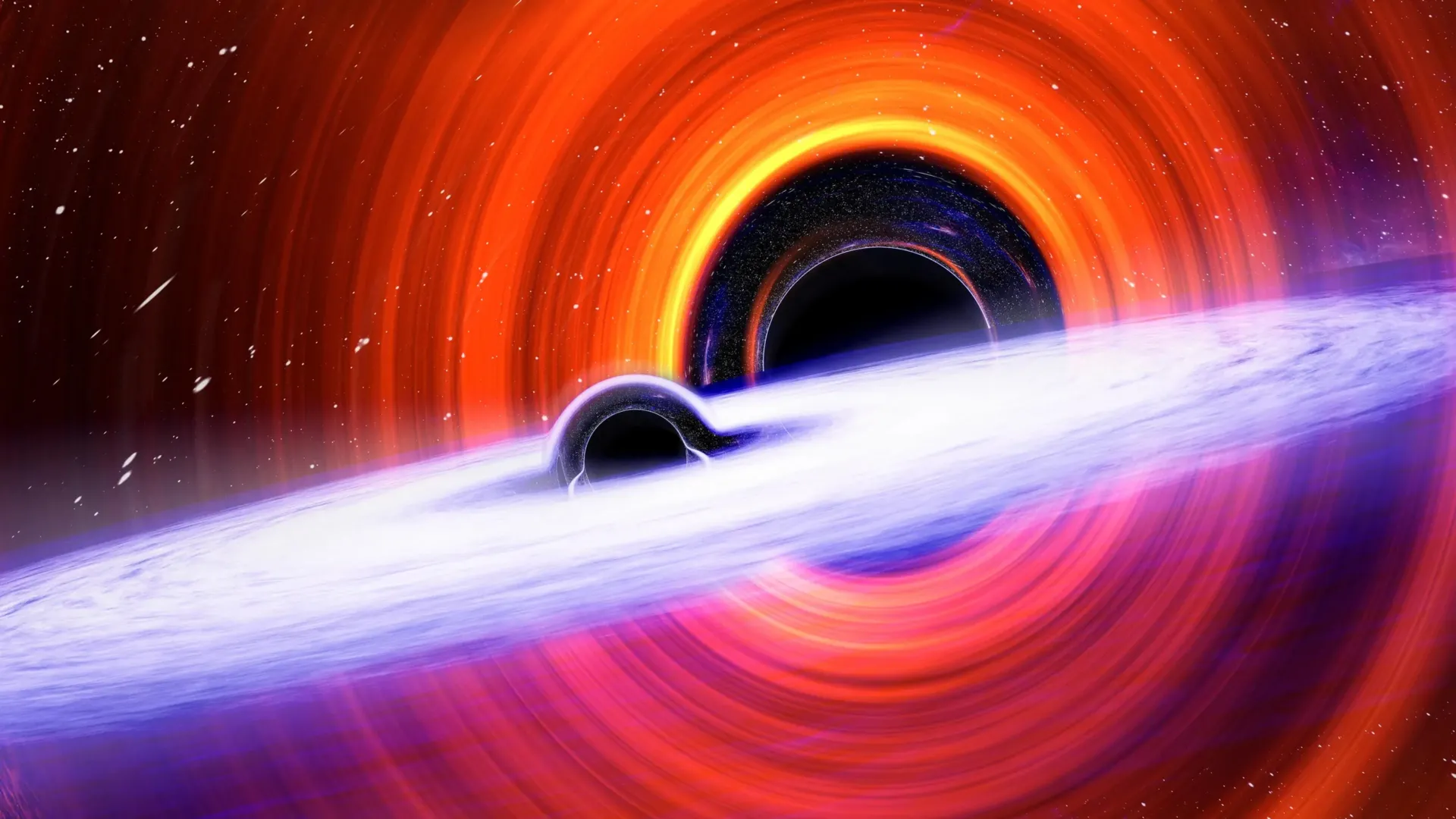
The anomaly occurs when a detected object falls below one solar mass. Such a finding suggests the object did not originate from a dying star, but rather from the extreme density fluctuations of the early universe. This points toward the existence of primordial black holes (PBHs), which would have formed in the first fraction of a second after the Big Bang and would carry an observable imprint of the infant cosmos into the present day.
Primordial Black Holes as Dark Matter Candidates
The search for PBHs is not merely an exercise in celestial cataloging; it is a potential solution to the dark matter problem. Dark matter remains one of the most significant mysteries in modern physics, acting as an invisible gravitational glue that prevents galaxies from flying apart, yet it does not emit, absorb, or reflect light and has so far eluded direct laboratory detection.
Research conducted by Cappelluti and Ph.D. student Alberto Magaraggia suggests that these ancient black holes could be the missing piece of the puzzle. “We believe our study will aid in confirming that they actually do exist,” says Cappelluti. If correct, the result would replace the need for an as-yet-undiscovered elementary particle with a population of astrophysical objects that can, in principle, be counted.
To validate this hypothesis, the team analyzed the frequency and probability of subsolar mass detections. Magaraggia notes: “We attempted to estimate how many primordial black holes may exist in the universe and how many of them LIGO should be able to detect. And our results are encouraging. We predict that subsolar black holes like the one LIGO may have observed should indeed be rare, consistent with how infrequently such events have been seen so far.”
The implications of this finding are vast. The study “suggests that the most plausible explanation for the LIGO signal, which lacks any conventional astrophysical explanation, is the detection of a primordial black hole,” Cappelluti says. “And our research indicates that these primordial black holes could account for a significant portion, if not all, of dark matter.” For policymakers and research funders, that possibility elevates gravitational-wave astronomy from a niche discipline into a cornerstone of national and international strategies on fundamental physics, high-performance computing, and long-term scientific infrastructure.
The Global Gravitational Wave Detection Network
Capturing these signals requires an extraordinary level of precision. LIGO utilizes laser interferometry, a system where laser beams are split and sent down two perpendicular vacuum arms. When a gravitational wave passes through Earth, it infinitesimally stretches one arm and compresses the other, altering the interference pattern of the lasers. The measurable distortion is smaller than the width of a proton, demanding both stable public funding and tight technical standards.
This infrastructure is not isolated. It functions as part of the LVK collaboration, a global network designed to triangulate the origin of cosmic events through synchronized data streams and shared data-analysis protocols.
- LIGO (USA): Dual observatories in Hanford, Washington, and Livingston, Louisiana, operated under U.S. national research funding frameworks and subject to federal safety and environmental oversight.
- Virgo (Italy): Enhances the network’s sensitivity and localization capabilities, anchoring European participation under the broader science policy agenda of the European Union.
- KAGRA (Japan): An underground facility designed to reduce seismic noise, showing how different regulatory environments adapt to large-scale subterranean construction and cryogenic operations.
Despite this sophistication, confirming a single PBH is difficult. “LIGO picked up what is very strong evidence that these types of black holes exist. But we’ll need to detect another such signal or even several others to get the smoking-gun confirmation that they are real,” Cappelluti says. “But what is clear is that they cannot be excluded as being real.” For governments that underwrite these observatories, that means long-term commitments to operating budgets and upgrades rather than short, announcement-driven funding cycles.
Next-Generation Cosmological Infrastructure
While current detectors are optimized for high-frequency waves from recent collisions, the next phase of gravitational wave astronomy will target the “low-frequency” regime, potentially capturing signals from the very birth of the universe. This requires moving beyond terrestrial constraints to avoid the noise of planetary activity and to operate within a more complex web of space law, launch licensing and international coordination.
The transition toward space-based interferometry and larger ground-based arrays will provide the resolution necessary to definitively map the distribution of primordial black holes. In Europe, for example, the planned Laser Interferometer Space Antenna (LISA) is being developed under the formal mandate of the European Space Agency Council, which sets programmatic rules, financial commitments and international partnership conditions through its governing convention and implementing resolutions. In parallel, future U.S.-based facilities such as Cosmic Explorer and potential complementary missions would be shaped by national budget processes, export-control rules and scientific-priority setting by agencies and advisory panels.
| Facility | Status/Timeline | Primary Capability | Strategic Objective |
|---|---|---|---|
| LIGO/Virgo/KAGRA | Operational | High-frequency detection | Stellar-mass black hole mergers; real-time alerts for multimessenger astronomy |
| LISA | Launch 2035 | Low-frequency space sensing | Early-universe epochs post-Big Bang; precision tests of gravity in a space-governed environment |
| Cosmic Explorer | Design Phase | 10x LIGO sensitivity | First-star era mergers; systematic census of compact objects to constrain dark matter models |
The theoretical framework for these discoveries was established decades ago, beginning with Soviet scientists Yakov Zeldovich and Igor Novikov. This was later expanded by Stephen Hawking, who posited that PBHs could be abundant and emit radiation. Today, the intersection of quantum physics and massive infrastructure-governed in space by the foundational principles of the Outer Space Treaty and, on the ground, by national research and safety regimes-is finally bringing these theories into the realm of verifiable data. As subsolar mass anomalies move from curiosity to potential evidence, the decisions taken in ministries, parliaments and space agencies will determine how quickly, and how definitively, humanity can answer whether primordial black holes really do fill the universe’s missing mass.
Worth a look
