
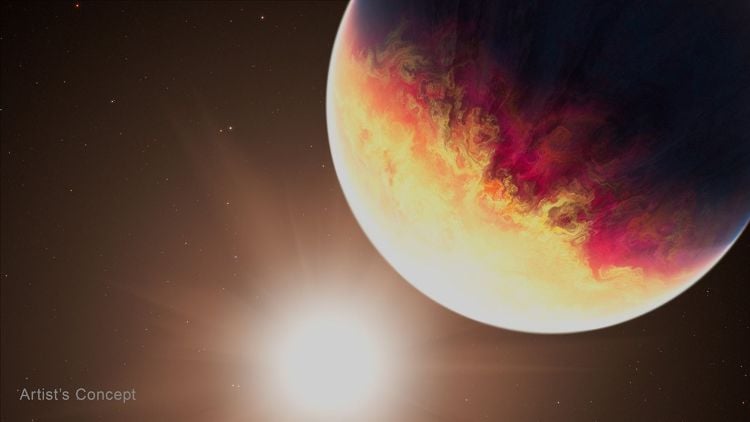
The Mechanics of Extreme Orbital Eccentricity
HD 80606 b represents a radical departure from the orbital stability found within our own solar system. While most planets follow nearly circular paths, this “hot Jupiter” exists in a state of extreme orbital eccentricity, swinging violently between the freezing depths of space and a searing approach to its host star.
Located approximately 217 light-years from Earth, the planet possesses a mass roughly four times that of Jupiter and a radius similar to the gas giant. Its orbit is not a circle but a highly elongated oval, a characteristic that exposes the planet to fluctuating levels of stellar radiation that would vaporize most terrestrial bodies. Astronomers estimate that HD 80606 b spends most of its 111‑day year far from its star before plunging inward for a brief, intense close pass that effectively “flash roasts” its atmosphere.
| Parameter | HD 80606 b | Earth | Mercury |
|---|---|---|---|
| Orbital Eccentricity | 0.93 | 0.0167 | 0.2056 |
| Closest Approach (AU) | 0.03 | 0.98 | 0.31 |
| Furthest Distance (AU) | 0.85 | 1.02 | 0.47 |
| Orbital Period | 111 Days | 365.25 Days | 88 Days |
For policymakers and research funders, HD 80606 b is a reminder that our own planetary architecture is not the norm. Planning long‑term investments in space science, including future telescopes, increasingly assumes that extreme systems like this are common-and that understanding them is central to building a coherent picture of how planets form and evolve.
Infrared Spectroscopy and Thermal Mapping
The ability to analyze HD 80606 b is driven by the advanced instrumentation of the James Webb Space Telescope (JWST), operated as an international partnership under the governance framework set out in the Outer Space Treaty. By utilizing high-resolution infrared sensors, researchers can detect the thermal signature of the planet during periastron-the point in its orbit where it is closest to its star.
At this critical juncture, the planet is blasted with stellar energy approximately 800 times greater than what it receives during other phases of its orbit, driving atmospheric temperatures to roughly 600 degrees Celsius (1,100 degrees Fahrenheit). Within a matter of hours, HD 80606 b transitions from a frigid deep-space regime to conditions that would melt many metals, giving scientists a rare, time‑compressed view of atmospheric physics in action.
This rapid heating allows scientists to observe atmospheric reactions in real time, effectively treating the planet as a natural laboratory for planetary chemistry and heat transport. For space agencies and budget committees deciding where to allocate finite telescope time, such “high‑leverage” targets are increasingly attractive: a single orbital swing can produce data that would take years to accumulate on more sedate worlds.
“Observing a planet like HD 80606 b is actually very efficient because its unusual orbit, with the corresponding swings in temperature and chemical composition, allow us to gather data under varying conditions in just hours and apply those findings to other hot Jupiters or more conventional exoplanets,” said Dr. Laura C. Mayorga, an exoplanet astronomer at the Johns Hopkins Applied Physics Laboratory and a co-author on the study.
Atmospheric Composition and Chemical Volatility
The extreme temperature swings on HD 80606 b trigger complex chemical transitions. Analysis of the planetary atmosphere has pointed toward the presence of carbon monoxide and methane, with the ratio between these two gases providing clues about the planet’s formation and migration history. As the planet races toward periastron and heats up, molecules can break apart and recombine, reshaping the atmospheric chemistry in a matter of hours; as it recedes, some of those reactions freeze in, effectively preserving a layered record of the brief inferno.
The data processing involved in these discoveries relies on infrared spectroscopy, which breaks down light into its constituent wavelengths to identify the molecular fingerprints of gases captured during different phases of the orbit. These findings build upon a body of research extending from 2023 through 2026, refining our understanding of how highly eccentric orbits influence atmospheric stability, heat redistribution and long‑term mass loss. They also provide benchmark data sets that national space agencies and academic consortia use when setting priorities for future missions focused on exoplanet atmospheres and potential biosignatures.
Implications for Exoplanetary Evolution
The study of “barbequed” planets extends beyond mere curiosity; it provides a blueprint for understanding the evolution of planetary systems that are far more chaotic than our own. The sheer volatility of an eccentric orbit offers a compressed timeline of atmospheric change that would take centuries to observe on a planet with a circular orbit, allowing models of climate and chemistry to be tested against real data within a single observing campaign.
This research has broader implications for the search for habitable environments. Some eccentric planets, such as WASP-47 c, transit in and out of the habitable zone, suggesting that the definition of “habitability” may need to account for extreme seasonal fluctuations rather than constant equilibrium. That has a knock‑on effect for how international science bodies and national space programs define target lists for life‑detection missions: worlds once dismissed as too unstable may instead be flagged as intermittently clement, and therefore worthy of scarce observing time.
Key areas of ongoing scientific focus include:
- The impact of extreme periastron heating on atmospheric escape rates and the long-term survivability of gas giants and super-Earths.
- The interaction between highly elliptical orbits and the magnetic fields of host stars, including whether repeated close passes can strip atmospheres or generate intense space-weather environments.
- The potential for transient liquid water on eccentric planets moving through habitable zones, and whether life could adapt to brief but recurring windows of surface habitability.
- The role of gravitational perturbations from companion stars or unseen planets in creating high eccentricity, and what that means for the overall architecture and stability of planetary systems.
For governments weighing sustained investment in flagship observatories and planetary missions, HD 80606 b and worlds like it underscore a strategic reality: the more we learn about extreme exoplanets, the more we refine the criteria that will eventually guide the search for truly Earth-like worlds-and the policies, budgets and international partnerships needed to find them.
Related reading
