
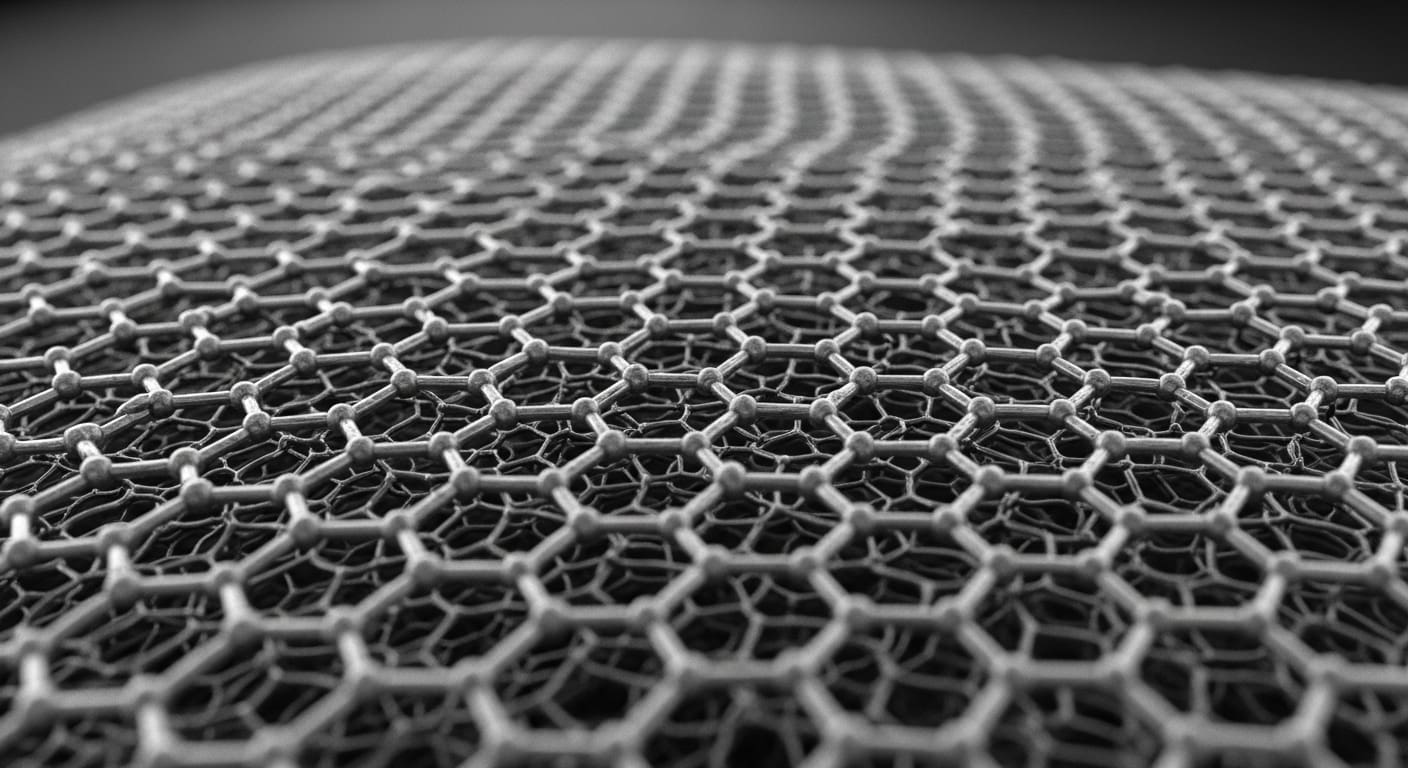
Graphene’s most celebrated trick-flattening its electronic bands near a tiny twist between two layers-has a new, more versatile control knob. A team spanning IMDEA Nanoscience and Wuhan University has built a general recipe for constructing commensurate moiré supercells in bilayer graphene under arbitrary twist and strain. By treating strain as a first‑class design variable rather than a fabrication nuisance, the researchers show how to shift where flat bands appear, toggle topological character, and moderate interaction effects-capabilities that point toward strain‑programmable quantum materials and devices.
Flat bands beyond the “magic angle”
In conventional twisted bilayer graphene, flat bands emerge near a twist of roughly 1.1 degrees. That regime-often called the “magic angle”-has been the focal point for demonstrations of superconductivity and correlated insulating states. The new analysis demonstrates that strain changes this playbook. While bandwidth tends to widen at the canonical magic angle when strain is present, there exist alternative twist values under strain where bands re‑narrow, effectively moving the flat‑band condition. The outcome depends strongly on strain type, magnitude, and direction, as well as on how the lattice relaxes, turning what used to be a one‑off geometrical sweet spot into a tunable design space.
- Shear strain reshapes the moiré geometry more aggressively than uniaxial strain, giving it outsized leverage over band flattening and topology.
- Including electron-electron interactions via a self‑consistent Hartree potential shows that strain broadens the bare bands while simultaneously reducing electrostatic renormalization effects, bringing modeled bandwidths closer to what transport experiments typically infer.
- Hybridization between the narrow and remote bands under strain drives topological transitions, offering an additional switch for device behavior and for engineering or suppressing edge channels.
A global method to build commensurate moiré supercells
Bridging theory and realistic device stacks requires commensurate supercells-repeatable building blocks that capture both twist and strain without numerical artifacts. The authors introduce a global construction method that reliably locates commensurate solutions for arbitrary twist-strain pairs, instead of relying on ad hoc searches. A small biaxial strain serves as a practical foothold for finding commensurate configurations, after which full electronic structure calculations proceed with controlled approximations rather than hidden geometric errors.
| Modeling layer | What it captures | Key outputs |
|---|---|---|
| Atomistic tight‑binding on commensurate supercells | Interlayer registry, relaxation, and strain‑modified hoppings | Band structures, densities of states, gaps between narrow and remote bands |
| Strain‑extended continuum model with gauge potential | Long‑wavelength moiré physics, strain‑induced pseudo‑fields | Bandwidth trends, topology, agreement with atomistic results under calibrated parameters |
| Self‑consistent Hartree interaction | Electrostatic screening and band renormalization | Interaction‑modified bandwidths and reduced renormalization under strain |
For institutional R&D labs and national user facilities, that hierarchy matters: it makes it feasible to define reference geometries, cross‑check continuum models against atomistic benchmarks, and then use the faster continuum layer as the workhorse for design sweeps and pre‑device screening.
Why shear dominates-and how to use it
Shear introduces anisotropic distortions that re‑tile the moiré superlattice more efficiently than simple stretching. That geometric leverage manifests as stronger control over both band narrowing and Chern‑number‑bearing phases. Because the gap between narrow and remote bands is set largely by the strain‑dependent bandwidth of the narrow bands, tuning shear offers a direct handle on isolating correlated states from their higher‑energy neighbors and on deciding whether those states are topologically trivial or non‑trivial.
| Strain modality | Primary geometric effect | Typical electronic consequence |
|---|---|---|
| Uniaxial | Directional stretch/compression | Moderate bandwidth changes; symmetry breaking that can split van Hove features |
| Biaxial (small) | Uniform area change | Practical route to commensurate supercells; baseline bandwidth shift |
| Shear | Angle‑preserving lattice skew | Strong band narrowing/topology control; larger moiré anisotropy |
In practice, that means shear is not just an experimental nuisance to be minimized; it becomes a deliberate control channel. For technology strategists, it points to devices whose operating point can be continuously tuned or even dynamically modulated through controlled shear, rather than being fixed at fabrication time.
From tear‑and‑stack to strain‑programmable devices
The framework opens a path for device engineers who need repeatable dials rather than luck during assembly. Instead of relying only on the “tear‑and‑stack” twist angle to land near a single magic configuration, teams can aim for a broader region of twist and then use calibrated strain to arrive at re‑flattened bands. Several implementation routes exist today and map cleanly onto the model’s parameters.
- Actuation: piezoelectric stacks, micro‑electromechanical clamps, and thermal‑mismatch platforms for in‑situ uniaxial or shear tuning at low temperature, compatible with dilution refrigerators and cryostats already deployed in quantum device labs.
- Encapsulation and gates: hBN encapsulation for cleanliness; dual‑gates to set displacement field; local gates to confine or pattern correlated regions that can then be selectively strained.
- Metrology: polarized Raman strain mapping, scanning probe moiré metrology, and transport anisotropy to infer heterostrain and shear, supporting feedback‑controlled tuning rather than one‑shot fabrication.
- Targeting conditions: seek twist values away from 1.1° that the model identifies as re‑flattening points under the intended strain field, then design actuation hardware and operating protocols around those targets.
For industrial roadmaps and public research funding calls, this shifts the emphasis from demonstrating isolated “hero” devices to developing strain‑programmable platforms with reproducible operating windows.
Reproducibility, standards, and measurement discipline
Reliable comparison across labs benefits from unambiguous material descriptions and strain reporting. The ISO 21356 series for graphene material specification provides a useful vocabulary and reporting structure for flake quality, layer count, and contamination, and the same discipline should extend to twist precision, strain tensor components, and relaxation protocols. As countries update their advanced materials strategies and innovation policies, the ability to map results onto common standards will matter for procurement, certification, and cross‑border collaboration.
- Report the full strain tensor (magnitude, direction, and shear) and the temperature at which it is calibrated, so that device operation and metrology are described on the same footing.
- Disclose relaxation settings in simulations and post‑stack anneal histories in experiments, enabling replication and regulatory‑grade traceability for critical applications such as quantum metrology.
- Archive moiré‑scale geometry and tight‑binding parameters alongside transport and spectroscopy datasets, ideally in institutional repositories that support long‑term reproducibility and audit.
On the policy side, the emerging standards landscape for quantum and advanced materials is likely to lean on existing metrology frameworks such as those overseen by the International Bureau of Weights and Measures, making rigorous reporting in this field a matter not just of good practice but of eventual compliance.
Engineering constraints and failure modes to watch
| Risk | Impact on electronic properties | Mitigation |
|---|---|---|
| Twist drift during thermal cycles | Unintended bandwidth changes, loss of flat bands | Mechanically stabilized stacks; minimize repeated cooldowns; monitor via Raman/STM |
| Non‑uniform heterostrain | Spatially varying phases; broadened transitions | Calibrate actuators; smaller device footprints; spatially resolved probes |
| Incommensurate patches and wrinkles | Local disorder, percolation of remote bands | Clean transfer; gentle anneal; thicker hBN encapsulation |
| Overlooked electron-electron screening | Mismatched theory-experiment bandwidths and gaps | Include self‑consistent Hartree terms; benchmark to displacement‑field sweeps |
For research managers and facilities directors, these are not just technical caveats; they translate into requirements for tool maintenance, cooldown budgets, and staff training in strain metrology, all of which feed into cost models and risk assessments for quantum‑materials programs.
Computational and infrastructure implications
Accurate treatment of large commensurate supercells and self‑consistent interactions demands scalable computation. The presented global construction reduces wasted searches for valid supercells and makes systematic parameter sweeps practical. For shared facilities, that translates into fewer iterations on cryostats and more reproducible recipes for devices that target flat‑band transport or quantized anomalous responses. It also strengthens the case for coordinated investment in high‑performance computing dedicated to materials modeling, tightly coupled to experimental beamlines and fabrication lines.
Where this could translate into products
- Reconfigurable correlated electronics in which logic or memory states are selected by strain rather than only by electrostatic gating, potentially informing future low‑power computing architectures.
- On‑chip topological channels engineered through shear‑tuned band topology, offering low‑dissipation interconnects for quantum and classical hybrid systems.
- Ultra‑sensitive strain and rotation sensors that exploit steep electronic responses near re‑flattened bands, relevant for inertial navigation, seismology, and precision manufacturing.
- Terahertz photodetectors and mixers leveraging narrow‑band dispersions tuned by programmable strain, aligning with institutional roadmaps that seek to fill the “THz gap” in communications and security imaging.
Caveats that keep the field honest
The analysis focuses on commensurate structures-even though real devices can host incommensurate regions and complex relaxation patterns. That simplification enables clean comparisons between atomistic tight‑binding and continuum treatments but leaves room for future work on disorder, stack‑order variations, and device‑scale strain gradients that may be essential in deployed systems. Policymakers and funding agencies should read current performance claims in that light: promising, but still contingent on how these real‑world complexities are engineered and standardized.
The bottom line for technologists
Twist alone is no longer the sole gateway to flat‑band physics in bilayer graphene. With a global method to design commensurate supercells under arbitrary strain and cross‑validated electronic models, strain now functions as a precise dial for bandwidth and topology. That turns a once‑fragile laboratory effect into a tunable platform with credible engineering paths to devices-and a clear roadmap for measurement rigor and reproducibility that the broader community can adopt. For institutions deciding where to place their next quantum‑materials bets, the message is equally clear: treat strain not as a side condition to be tolerated, but as a programmable resource to be governed, standardized, and ultimately deployed at scale.
