
Infrared Penetration and the NIRCam Advantage
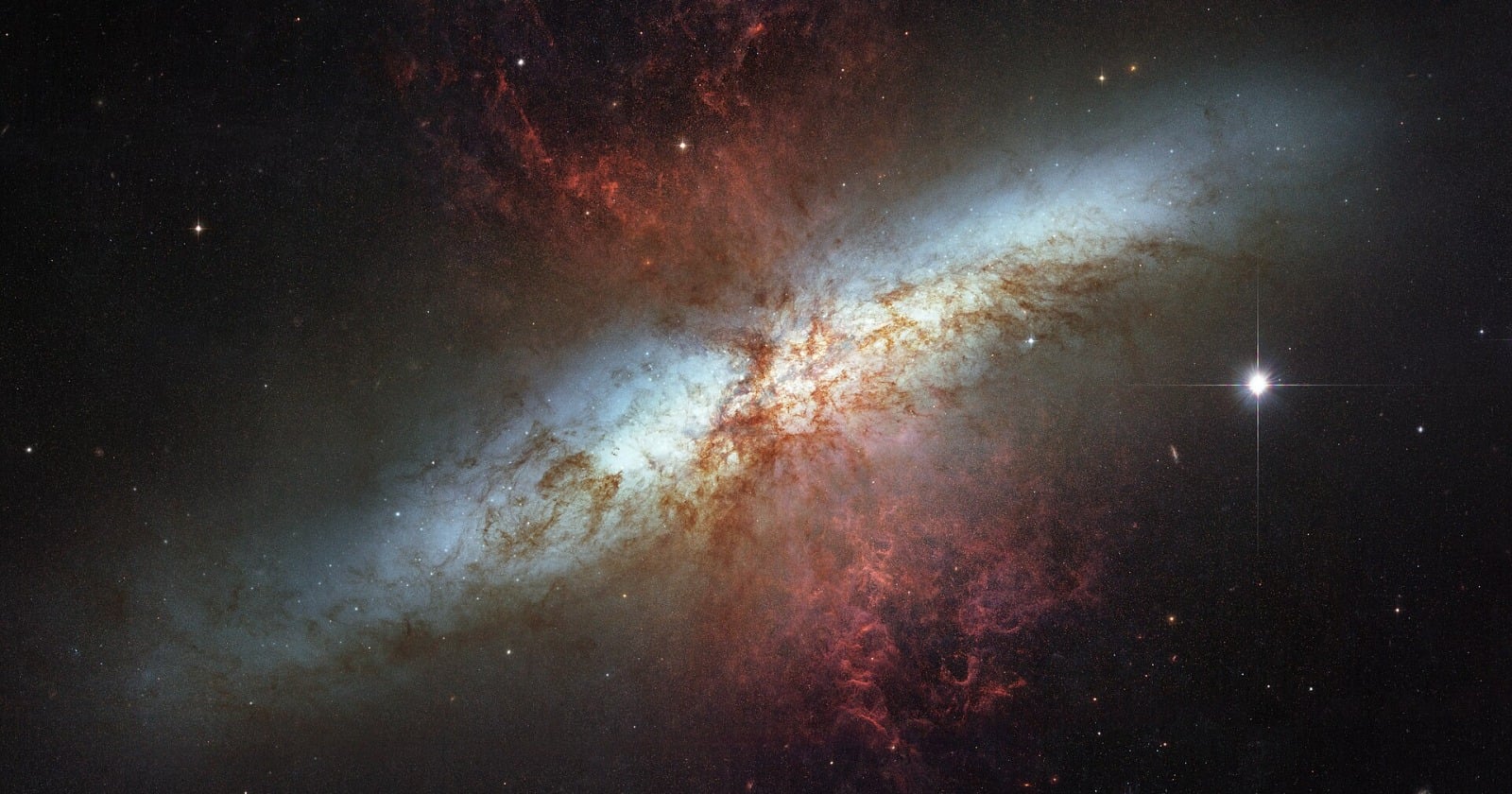
The observation of Messier 82, located approximately 12 million light-years from Earth, represents a significant leap in observational resolution. While the “Cigar galaxy” has long been a subject of study for the Hubble and Spitzer telescopes, its dense concentrations of interstellar dust historically acted as a shield, scattering visible light and obscuring the stellar populations within.
The James Webb Space Telescope (JWST) bypasses this limitation by operating in the infrared spectrum. Infrared wavelengths possess longer frequencies that can penetrate thick dust clouds, allowing the telescope’s Near-Infrared Camera (NIRCam) to capture data that was previously inaccessible. By dedicating 65 hours of exposure time to the survey-designated as “Cibola”-the telescope resolved 16.5 million individual stars, rendering them as distinct blue-white grains in the resulting imagery.
“The sheer number of stars that we were able to resolve with Webb is incredible,” said team member Benjamin Williams of the University of Washington. “It’s a whole different world from what we’ve been able to see with other telescopes. All of these stars collectively provide a detailed fossil record of the formation and evolution of M82.”
| Observation Metric | Visible Light (Hubble/Traditional) | Infrared (JWST/NIRCam) |
|---|---|---|
| Dust Interaction | Scattered and absorbed | Penetrates through dust clouds |
| Target Resolution | Obscured stellar cores | 16.5 million individual stars resolved |
| Primary Capability | Mapping gas and dust shells | Piercing the dusty disk plane |
The Mechanics of the Starburst Phenomenon
M82 is classified as a starburst galaxy, a system that converts interstellar gas into stars at a rate significantly higher than typical galaxies of its mass. In the case of M82, this process is occurring roughly ten times faster than in the Milky Way. However, this acceleration creates a systemic instability; the rapid birth of massive stars leads to an equally rapid cycle of supernovae.
These explosions generate immense radiation and kinetic energy, driving gas out of the galaxy in two massive, hourglass-shaped plumes. This process effectively exhausts the galaxy’s fuel supply, meaning the starburst phase is a temporary event, likely lasting only a few hundred million years. For public agencies that invest in flagship observatories, this makes M82 a time-sensitive natural laboratory: a rare phase in a galaxy’s life that must be captured while it is still underway.
The structural composition of these plumes reveals a layered architecture of galactic exhaust:
- Inner Layer: Ionized gas closest to the galactic disk, tracing where the most intense feedback from young stars is occurring.
- Outer Layer: Polycyclic aromatic hydrocarbons (PAHs), carbon-based molecules used as tracers for interstellar material being swept out into circumgalactic space.
That layered outflow helps mission planners and science agencies refine models of how galaxies grow and lose matter over cosmic time-inputs that increasingly inform national space strategies, climate models that factor in solar and cosmic radiation environments, and the long-term roadmaps of publicly funded observatories.
Decoding Galactic History via Structural Asymmetry
The physical geometry of M82 provides critical evidence regarding its evolutionary trajectory. The galactic disk is notably lopsided, with one side extending further than the other. This asymmetry is a characteristic signature of a gravitational interaction, suggesting that M82 suffered a near-collision or merger with a neighboring galaxy.
Such an encounter creates tidal forces that funnel gas toward the center of the galaxy, essentially igniting the starburst frenzy. By analyzing the distribution and age of the resolved stars, astronomers can reconstruct the timeline of this interaction and test theories of how mergers reshape galaxies. Those reconstructions, in turn, feed into the science cases that national space agencies use when justifying billion-dollar missions to legislators and oversight bodies.
“M82 is a mess, but it’s a beautiful mess. We don’t fully understand what’s going on, especially concerning its evolutionary history,” said principal investigator Adam Smercina, a NASA Hubble Fellow at the Space Telescope Science Institute and an incoming assistant professor at Tufts University. “What could have triggered such an elevated rate of star formation? How long has this galaxy been driving plumes of material away from its center?”
Answering those questions is not just an academic exercise. They help determine which follow-on instruments should fly, what orbits they require, and how international partners coordinate access and data rights under the high-level exploration policies set out in frameworks such as the NASA Advisory Council’s science policy guidelines.
The Architecture of Multi-Mission Data Synthesis
The resolution of 16.5 million stars is not a comprehensive census of M82, but rather a baseline of what is currently detectable. A vast majority of the galaxy’s stars remain invisible, either too faint or too deeply embedded in dust for even the most advanced infrared sensors to isolate. To build a complete model, scientists rely on a synthesis of data from multiple orbital assets and ground-based observatories.
The final imagery is a composite, merging JWST’s infrared data with Hubble’s visible-light mapping. This multi-wavelength approach is essential for understanding the interplay between the stars and the gas clouds they inhabit, and it mirrors a broader institutional shift toward mission portfolios that are designed from the outset to interoperate scientifically and technically.
“At first glance, the disk of the galaxy may seem less spectacular because Webb sees through the dust,” said team member Eric Bell of the University of Michigan. “But M82 is a delightfully complex system. Webb’s observations will help us address some ongoing mysteries, such as how star formation has moved within M82 over the last few billion years.”
This collaborative data model ensures that the weaknesses of one instrument are mitigated by the strengths of another, a necessity when probing the deep, dust-rich regions of distant galaxies. It also aligns with how major observatories are now funded and governed: as long-lived, interoperable assets whose combined output must justify sustained public investment under national and international space policies.
“Galaxies are such intricate ecosystems that if you truly want to understand them, you have to pull datasets from different missions together,” said team member Kristen McQuinn of the Space Telescope Science Institute. “One mission cannot fully answer all of the questions we have about M82. Combining the data collected by different telescopes, like Webb and Hubble, is powerful. When you marry the datasets, you expand what you can probe, and the questions that you can pose are even more complex.”
For policymakers and research agencies, M82’s “beautiful mess” is therefore more than a striking image. It is a proof of concept for the kind of coordinated, multi-mission astronomy that future budget cycles, international partnerships, and regulatory frameworks will increasingly be built around-where each telescope is designed not as a standalone icon but as part of a tightly integrated global observatory system.
