
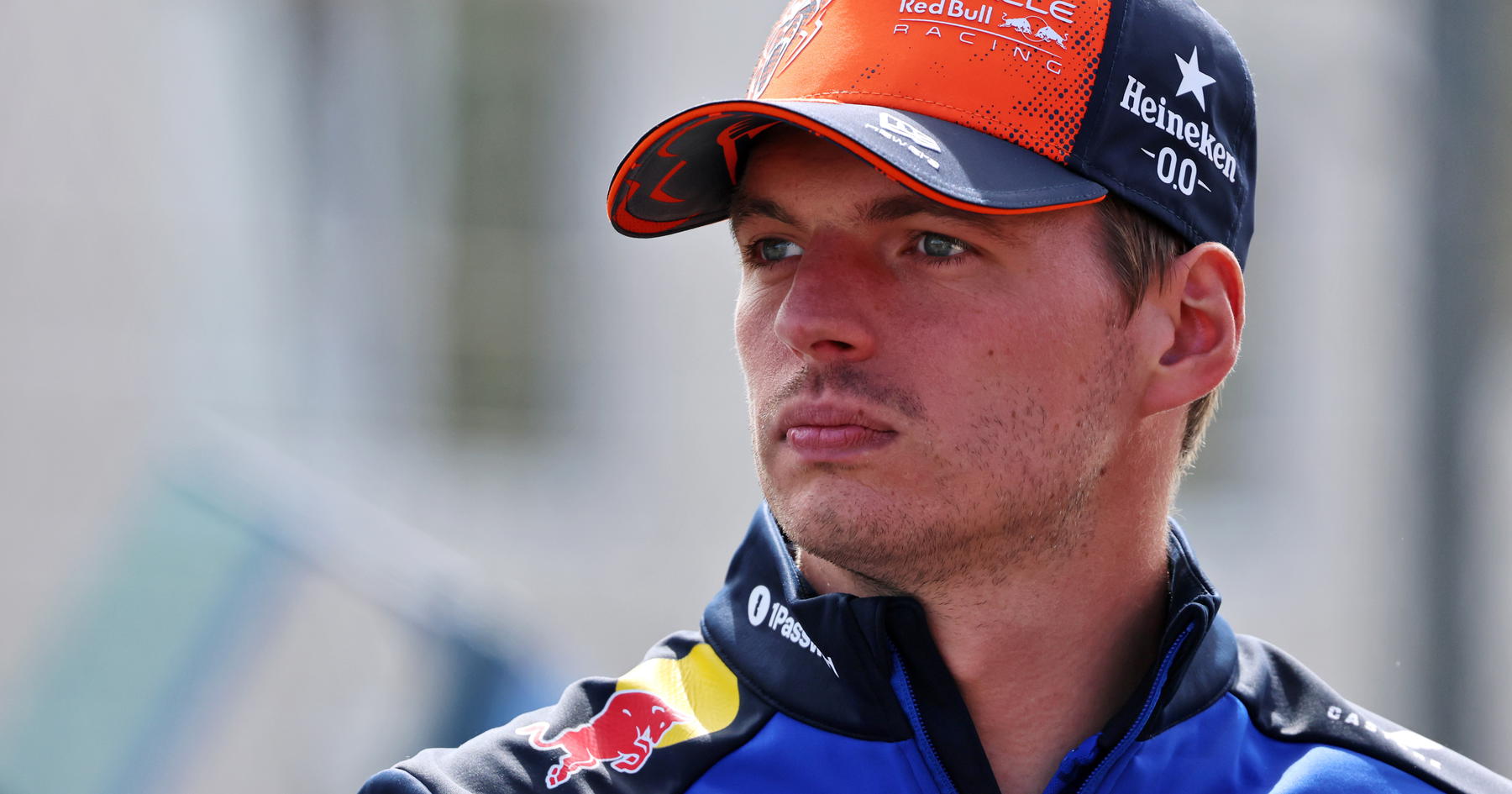
Verstappen rejects team-game tactics as Monza slipstream stakes rise
Red Bull star not seeking Lawson tow despite qualifying power of the slipstream
Max Verstappen does not expect Red Bull to deploy Liam Lawson as a qualifying “tow” at the Italian Grand Prix, even with slipstreaming set to play a significant role around Monza’s high‑speed layout.
The four-time Formula 1 drivers’ champion stresses he does not request such support from the Milton Keynes-based team and has no plans to change that approach this weekend. Lawson is standing in for Verstappen’s regular team-mate Isack Hadjar, who continues to feel the effects of the wrist injury that ruled him out of the Dutch Grand Prix.
Slipstreaming – using a car ahead to punch a hole in the air and reduce drag – remains a potent tool on long straights, but is far less central to race and qualifying strategy in modern F1 than in previous eras. The trade-off between turbulent air in the corners and straight‑line gain means teams now rarely sacrifice one driver’s clean lap purely to pull the other along.
Monza, however, is the outlier. The “Temple of Speed” rewards straight‑line efficiency more than almost any other circuit, and qualifying sessions there have repeatedly turned into finely balanced games of timing and track position as drivers hunt for a tow down the long straights.
New energy rules sharpen the Monza slipstream
This season, the effect is expected to be amplified by updated regulations. On the power‑sensitive Monza layout, the FIA has set the maximum energy harvesting limit at 5 MJ in qualifying and 7 MJ in the race, a relatively low ceiling on a circuit where cars spend so much time at full throttle.
The reduced allowance has two major consequences:
- Top speeds are expected to be lower than they would be with more generous energy deployment.
- Cars running in the slipstream will need to use less of their available battery to reach competitive terminal speeds, potentially freeing up deployment for acceleration zones elsewhere on the lap.
That combination means following closely could be even more valuable than in recent years, particularly in Q3 when the fight for pole is typically settled by thousandths of a second. Strategically pairing team-mates to trade tows could, in theory, offer a measurable advantage over a single, clean-air run.
Verstappen wary of “mess” and focused on clear laps
Despite the potential upside, Verstappen is reluctant to engage in elaborate slipstream set‑ups on his flying laps. Asked whether he expected drivers to routinely run within a second or even half a second of one another in qualifying to capitalise on the tow, the Dutchman played down any appetite to lean into those games.
“Not sure within a second, [but] maybe a bit closer than what you have seen in the last few years,” he said. For Verstappen, the risk of getting caught in traffic and losing tyre and brake preparation time remains too high.
“It’s also so easy to put yourself in a s****y place on track. We’ve seen it a few years ago, when it was a big mess,” he reflected, alluding to previous chaotic Monza qualifying sessions in which drivers tripped over one another while jostling for a tow.
He made clear that his priority remains executing his own laps rather than choreographing complex tow scenarios: “Honestly, I just think with what we are doing at the moment, I’m not really looking for that; I just want to do my laps and try and get the car in a good window.”
No special brief for Lawson in Q3
Verstappen also pushed back on the notion that Lawson should be dedicated to supporting his pole attempt, should both Red Bulls reach the final qualifying segment.
“And the 28-year-old has no intention of having Lawson’s focus be helping him achieve his lap times when the fight for pole reaches Q3,” the piece notes of Verstappen’s stance. Asked directly whether he had considered using Lawson for that purpose, the 71-time grand prix winner was blunt: “Honestly, no, I haven’t really thought about that.”
The Dutchman framed such coordination as something more likely in exceptional circumstances than as a default plan. “If you’re fighting in a championship battle, or you really try and do something special… but they [the team] want two cars trying to do well, but let’s see,” he said, presenting the decision as one for Red Bull’s sporting management rather than for him as a driver.
“I never ask things to the team, and I leave it up to them for these kinds of things. I think that’s best.”
Strategic balance for Red Bull and Lawson
That approach underlines an important trade-off for Red Bull. Monza’s slipstream dynamics and the current energy regulations create a clear incentive to coordinate runs, but Verstappen’s preference is to avoid the kind of finely tuned pack-running that has, in past years, tipped qualifying into disarray.
For Lawson, stepping in for Hadjar, the stance also carries competitive implications. With no explicit expectation to serve as a tow car, he retains the opportunity to focus on maximising his own qualifying performance rather than sacrificing laps to support Verstappen. At the same time, the team will still have scope to manage out-laps and gaps to ensure neither driver is compromised by traffic.
How aggressively teams choose to exploit the slipstream on Saturday at Monza will be shaped not only by the benefits of a tow but also by their trust in drivers to manage congestion and the regulatory framework that governs minimum lap times and unsafe impeding. Verstappen’s insistence on prioritising clean, self‑contained laps offers a clear benchmark of how one of the grid’s most successful drivers intends to navigate that balance at the sport’s fastest circuit.
Worth a look
