
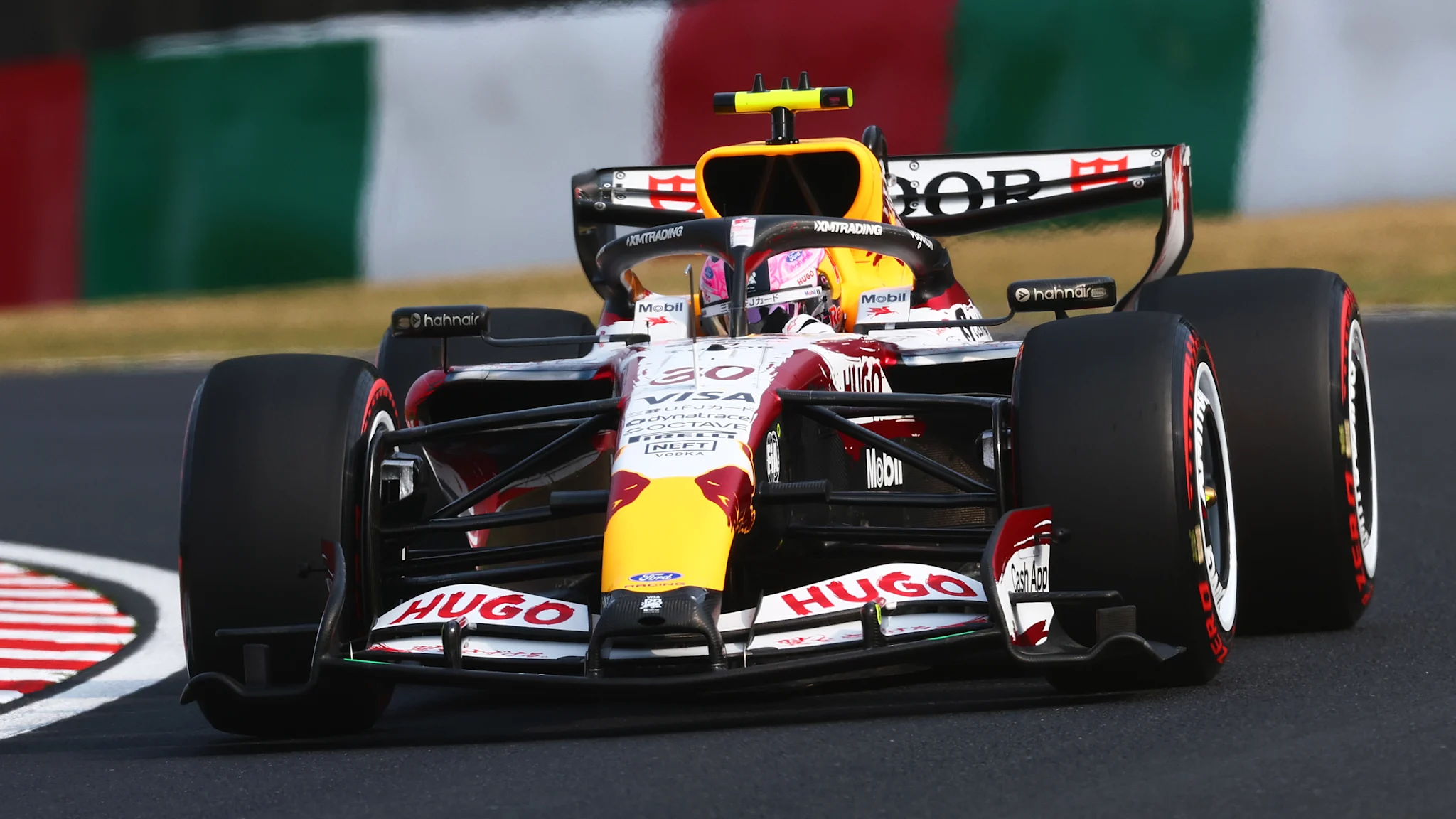
Lawson banks P9 as Safety Car swing shapes Racing Bulls’ mixed Suzuka; Lindblad home in P14
Racing Bulls left Suzuka with both encouragement and frustration after a Japanese Grand Prix that hinged on mid-race Safety Car timing and the fine margins of modern Formula 1 race control. Liam Lawson converted a P14 start into P9 to secure more points for the Faenza-based team, while rookie Arvid Lindblad slipped to P14 on Sunday despite reaching the final segment of qualifying and showing early top-10 pace in his first competitive outing at the circuit.
Race recap at a glance
- Event: Japanese Grand Prix, Suzuka Circuit, 53 laps
- Liam Lawson: P9 from P14, sole pit stop taken under the mid-race Safety Car
- Arvid Lindblad: P14, reached the final qualifying segment; missed Free Practice 2 with a technical issue; first race start at Suzuka
Strategy window turns Lawson’s afternoon
Lawson’s points came from a disciplined stint profile and timely execution when the Safety Car compressed the field and reduced the time loss of a stop-an inflection point that often decides midfield outcomes under the FIA Formula One Sporting Regulations. From P14 on the grid, the New Zealander cycled forward with his single stop under caution, crucially avoiding the track-position penalty that under green-flag conditions can strand cars in dirty air, and managed the closing phase to ninth with measured tyre and energy management.
“From where we started, the doubts we have with obviously the balance we went into Qualifying yesterday, I think we’ve done a pretty good job to rebalance the car and have a strong race,” Lawson said. “It was definitely difficult and we got very lucky with the Safety Car today. Obviously a good result, we’ll take the points and try and improve things going forward.”
The result extended Lawson’s run of returns to three consecutive points-scoring outings. He previously finished seventh in both the China Sprint and the Grand Prix, and he believes there is still performance to unlock from the VCARB 03. “I think to be honest we haven’t actually been that fast but still managed to come away with three points finishes,” he said. “So I think when we get a really quick car we’ll obviously be in a much better place and if we keep making the decisions we’re making I think it’s quite exciting.” That blend of strategic clarity and driver candour underlines how Racing Bulls’ race-day execution is compensating for a car that remains a work in progress.
Lindblad’s first Suzuka race shows the learning curve
Lindblad’s weekend contained strong markers-progress to the final part of qualifying and early top-10 running-offset by operational setbacks and the same Safety Car timing that boosted his teammate. The Briton also lost valuable mileage after a technical issue curtailed Free Practice 2, a notable handicap on a circuit that rewards rhythm, precise energy deployment and confidence through its high-speed esses.
“I think I was running P8 after a lap or two and then I think there were a few things I could have managed better on the energy side and the battery side with Max [Verstappen] and Esteban [Ocon] on that first stint,” he said. “So I lost those two place and then I was settling in to a nice rhythm before the stop, did the stop which was a bit slow, so I lost a place to Isack [Hadjar] and then the Safety Car came out and I lost another three or four [places]. It’s a bit of a shame but I think regardless, there’s still a lot to learn, still a lot for me to improve on so I’m going to focus on that.”
For a driver still building his reference laps at one of the calendar’s most technically demanding venues, the Suzuka debut doubled as a live tutorial in how race-control interventions, pit-stop execution and energy targets interact. Lindblad’s comments point to an internal debrief focused less on the headline result and more on process-battery usage against rivals, delta management behind the Safety Car and the time loss associated with even a marginally slow stop.
Why this matters for Racing Bulls’ trajectory
Points from ninth underscore how marginal calls can redefine a midfield grand prix: a stop under Safety Car compresses strategy variance, protects track position, and can swing multiple places once everyone cycles through a mandatory tyre change. In contrast, a slow stop or being on the wrong side of the caution window compounds losses that are difficult to recover at Suzuka, where overtaking typically demands sustained battery deployment and precise tire management through the high-speed “S” curves and Degner complex.
For the team, Lawson’s sequence-seventh in the China Sprint, seventh in the China Grand Prix, and ninth at Suzuka-cements a pattern of extracting returns even when outright pace is still being chased. That consistency stabilizes the constructor’s early-season foundation while the VCARB 03’s competitiveness is refined, and it matters in a cost-cap era in which every point influences prize-money distribution and future investment headroom. For Lindblad, reaching the final segment of qualifying and logging his first race distance at Suzuka provide tangible building blocks; the learnings around energy use, pit execution, and Safety Car positioning directly translate to future weekends, including Sprint events where format and parc fermé constraints heighten the value of every lap. For context, Formula 1’s current Sprint format awards points to the top eight finishers and can reshape a team’s cumulative haul across a race weekend under the commercial and governance structure defined in the sport’s Concorde-style agreements.
The competitive picture from Suzuka
– Lawson’s P9 confirms the car-and-driver package can convert from deeper on the grid when strategy aligns, the team reacts decisively to race-control windows, and balance issues are addressed between qualifying and the race.
– Lindblad’s Sunday highlighted fine margins: early-track-position gains, a costly slow stop, and a Safety Car that flipped the midfield order. With more representative practice running, refined energy targets and sharper pit execution, the pace glimpsed in qualifying offers a credible platform for regular points contention as the season’s development race accelerates.
Keep reading
- Harry Kane Claims Ballon d’Or, Ending 25-Year English Drought as Bayern Munich and England Star
- INDYCAR Returns to Europe with Inaugural Grand Prix of Barcelona at Iconic Circuit de Barcelona-Catalunya
- China Sports Lottery Draw 26212 Results Released, says Wenzhou Evening News (archysport.com)
- Jim Marous says banks must evolve past efficiency to survive AI agents (archyde.com)
