
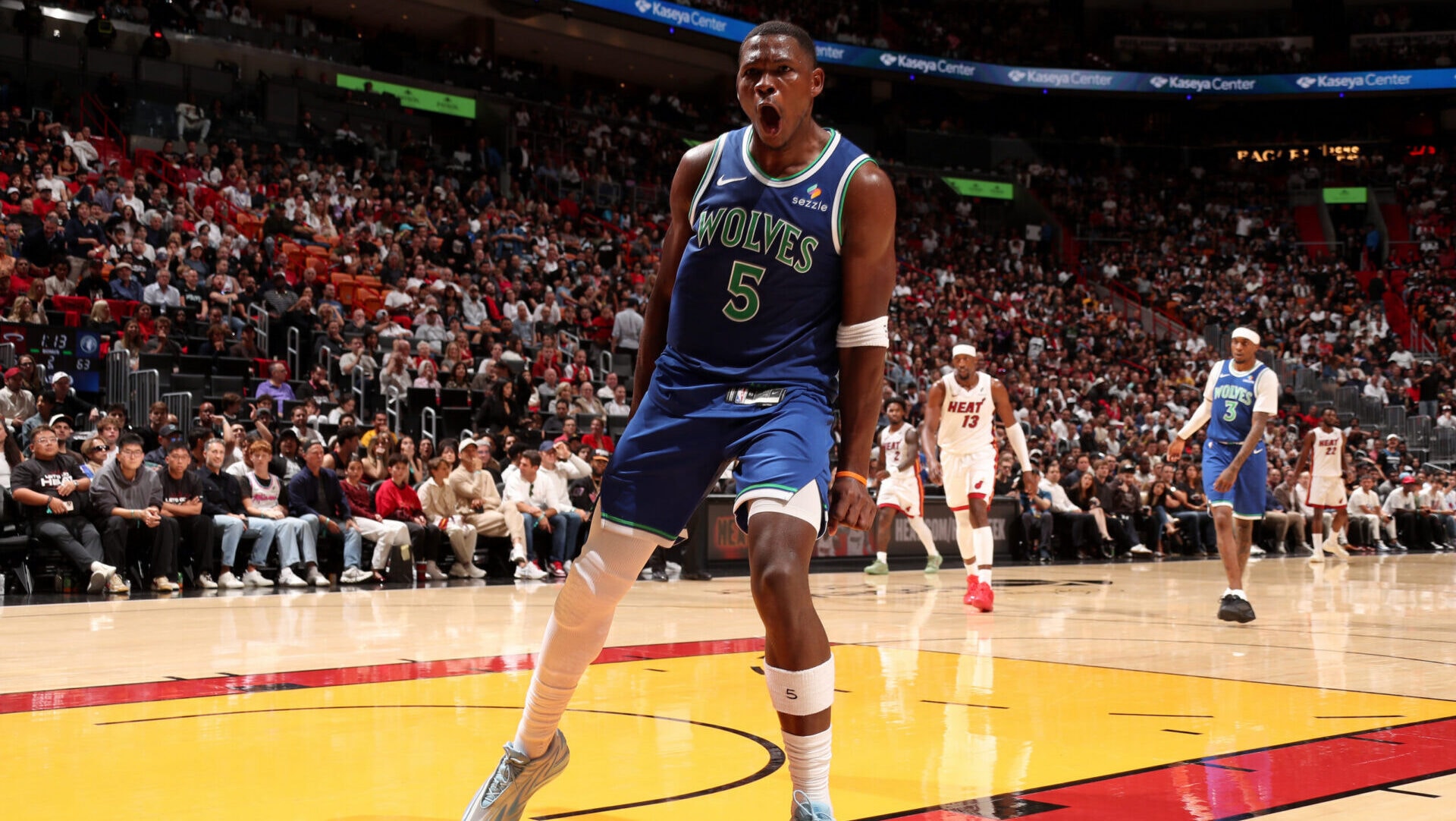
NBA Opening Week, Night 2: Edwards erupts, Suns stumble and late-round centres reshape the fantasy board
One game in, fantasy managers who selected Anthony Edwards are pretty happy.
The second night of the 2026-27 NBA season delivered an 11-game schedule and an early stress test for fantasy basketball rosters around the world. With so many teams in action under the rules and calendar set by the NBA’s official competition framework, opening week always produces sharp market corrections in fantasy formats.
From established All-Stars reaffirming their status to late-round bigs forcing waiver-wire decisions, Night 2 offered a first meaningful look at usage, roles and rotations that will shape both real and fantasy outcomes across the regular season.
Headline performances: Anthony Edwards and Ty Jerome seize early momentum
Anthony Edwards set the tone for the night with a dominant season opener, lighting up Miami for 45 points on 16-of-29 shooting, including 9 made 3-pointers in 33 minutes. He added 10 rebounds, 3 assists, 2 steals and a block for 66.5 fantasy points, the highest total on the slate.
The scoring profile matters almost as much as the raw volume. Edwards scored 23 of his 45 points unassisted and finished with a 40.2% usage rate, underlining his centrality to his team’s half-court offense. For fantasy managers, that level of on-ball responsibility supports preseason expectations that he could contend for the scoring title and finish inside the top 12 in standard 9-category formats, provided efficiency holds over the long grind of an 82-game season.
If Edwards’ explosion was anticipated in many drafts, Ty Jerome’s was anything but. The guard delivered a career-best 45 points on 17-of-25 shooting in a win over Utah, good for 64.4 fantasy points. He added 7 rebounds, 6 assists, 5 3s and a block in 32 minutes.
The underlying indicators were just as striking as the box score: 14 of Jerome’s 17 field goals were self-created, showing he was more than a spot-up option and instead functioned as a primary scorer for Memphis on the night. For fantasy purposes, that shot creation and usage profile is significant. Jerome’s average draft position outside the top 100 in many Yahoo leagues left him widely available; if he can stay healthy and maintain a similar role, he has the potential to become one of the season’s best value picks, particularly for managers seeking efficient guard scoring with supplementary assists.
Haliburton and Lillard show star guards can still drive winning fantasy builds
Tyrese Haliburton opened his campaign with the kind of balanced, high-impact line that underpins early first- or second-round fantasy investment. He finished with 23 points on 8-of-15 shooting, a perfect 5-of-5 at the line, 12 assists, a steal and 3 turnovers in 34 minutes, totalling 43.4 fantasy points in a 123-120 victory over New Orleans.
Seven of Haliburton’s eight made field goals were unassisted, reinforcing his role as a dual threat who can both create his own shot and orchestrate for others. His 12 assists generated 26 points for Indiana, illustrating his importance within the team’s offensive structure. In late-game situations he remained the primary decision-maker, converting two driving floaters in the final two minutes to help close out the win. With Pascal Siakam contributing 30 points, Ivica Zubac adding 16 points, 15 rebounds and 2 blocks, and Obi Toppin scoring 20 off the bench with 4 made 3s, Haliburton operated as the clear offensive hub of a multi-weapon attack – a profile that justifies his draft range at the top of most guard builds.
Damian Lillard’s performance was shorter in minutes but equally reassuring for managers concerned about his fit alongside Ja Morant in Portland’s backcourt. Lillard produced 25 points on 7-of-12 shooting, going 6-of-10 from beyond the arc and adding 6 assists, 3 rebounds and a steal in just 23 minutes of a blowout win over Phoenix.
The context matters. With multiple ball-handlers and creators sharing the floor, Portland consistently pressured the Suns inside and on the perimeter, dominating the paint and hitting 19 3-pointers at a 40% clip. Even with potential competition for touches from Morant and Jrue Holiday, Lillard’s efficiency and playmaking on opening night indicated that his role remains secure and that he is capable of approximating his pre-Achilles production in both real and fantasy terms. For managers who built around an older star guard, this kind of start provides early validation of their draft strategy.
Walker Kessler’s perfect Lakers debut and the changing role of the rim-running big
Free-agent centre Walker Kessler could not have scripted a cleaner start in his first game as a Laker. Facing a small Golden State frontcourt, Kessler went 12-of-12 from the field for 26 points, 9 rebounds and 2 blocks in 29 minutes of a 127-105 win. Eight of his 12 made baskets came from feeds in the paint by Luka Dončić or Austin Reaves, underscoring his function as a vertical spacer and target around the rim rather than a self-creating scorer.
The way Kessler navigated the lane and remained available as a lob and dump-off option suggests a path to an elite field-goal percentage over the course of the season, particularly if his shot diet remains heavily weighted toward high-percentage attempts. With frontcourt efficiency a scarce commodity in fantasy formats that count field-goal percentage and blocks, his debut hints at top-tier positional value if the volume and defensive production sustain.
The supporting cast offered further reassurance for fantasy builds anchored in Los Angeles. Dončić contributed 28 points on 7-of-18 shooting, going 5-of-12 from 3 and 9-of-9 at the line, while adding 8 rebounds, 7 assists and 3 steals. Reaves added 23 points and 6 assists while going 10-of-10 at the free-throw line. Their ability to repeatedly generate advantages off the dribble created an efficient environment for Kessler in the pick-and-roll.
On the other side, Golden State’s issues were harder to ignore. Stephen Curry scored 23 points in 21 minutes on 7-of-15 shooting, but the rest of the roster struggled to find rhythm. Over an 82-game schedule, that places added pressure on Curry’s durability; for fantasy managers, it raises the question of how much usage and late-season workload the veteran guard can realistically carry without increased risk, particularly in leagues that extend through the final weeks of the regular season.
Phoenix’s collapse highlights early structural concerns
The night’s most lopsided result came in Phoenix, where the Suns fell behind 21-0 to Portland and did not score until 5:54 remained in the opening quarter. Phoenix ultimately lost 124-83 and trailed by as many as 52 points. The Suns shot 36% from the field and 6-of-31 from 3-point range.
Within that context, Devin Booker stood out only by comparison. He posted 34.8 fantasy points on 23 points, 4 rebounds, 2 assists, a steal and a block in 29 minutes. All seven of his made field goals were unassisted, and he finished with a -43 plus-minus. From a structural standpoint, that is notable: a primary scorer generating all of his own looks with limited playmaking support is a concern both for offensive sustainability and for fantasy managers who rely on efficiency and assist contributions from a high-usage guard.
Around him, the supporting cast struggled. Dillon Brooks finished with 10 points on 4-of-11 shooting, Miles Bridges added 8 points on 3-of-11 while going 0-of-5 from distance, and Jalen Green had 10 points on 4-of-12. Collin Gillespie missed all eight of his 3-point attempts. Blowout conditions can distort individual stat lines, but the inability of this group to score effectively against a Portland team led by Lillard and Morant underlines early questions about spacing, shot creation and lineup balance. For fantasy managers, it is a reminder that even talented scorers can be limited by team construction, particularly in categories dependent on efficiency and assists.
Two rookies also endured difficult first outings. Chicago’s Caleb Wilson finished with a plus-minus of -45, tying the second-worst mark in Bulls franchise history. He scored 16 points on 7-of-21 shooting and committed 9 turnovers – a statistical line more commonly associated with Summer League than a regular-season contest. In Sacramento, Darius Acuff Jr. shot 5-of-24 (20.8%) and 0-of-7 from 3-point range. That field-goal percentage represents the second-lowest in an NBA rookie debut among players with at least 20 attempts, with only Sidney Wicks’ 18.5% in 1971 ranking lower. Acuff did contribute 3 steals and 3 assists for 25.1 fantasy points, offering some peripheral production despite the shooting slump.
For both franchises, these debuts are unlikely to alter long-term development plans on their own, but they do highlight the adjustment curve rookies face when stepping into immediate responsibility under regular-season defensive schemes.
Late-round, rim-protecting bigs force early waiver-wire decisions
Among the most actionable fantasy developments from Night 2 was the performance of three late-round centres: Yves Missi, Moussa Diabaté and Jaxson Hayes. All three delivered lines that intersect closely with modern fantasy priorities for big men – rebounds, shot-blocking and defensive “stocks” (steals plus blocks).
Yves Missi finished with 13 points, 14 rebounds, 5 assists, 2 steals and 3 blocks in 30 minutes of a loss to Indiana, generating 51.3 fantasy points. Crucially, he remains available in the majority of leagues, presenting an early opportunity in shallow formats for managers seeking across-the-board big-man production.
Moussa Diabaté, drafted around pick 115 in many Yahoo leagues, outperformed that price in his season opener. He posted 17 points, 8 rebounds and 5 steals for 42.1 fantasy points. That combination of scoring, rebounding and high-end steals from the frontcourt is rare enough to affect roster-construction strategies in both category and points formats if the role proves repeatable.
Jaxson Hayes added another wrinkle to the centre market by blocking 6 shots in 26 minutes as Utah’s starting big man. With that level of rim protection, he is positioned to keep starting while Jusuf Nurkić is sidelined. Managers in need of blocks may find his profile particularly appealing, even if scoring and rebounding fluctuate.
In terms of priority, Diabaté (33% rostered) currently projects as the strongest add from this trio, followed closely by Missi (31% rostered) and then Hayes (3% rostered). All three are athletic, rangy centres who contribute defensive stats at a position where that category can swing weekly matchups. For franchises, strong early returns from low-cost bigs provide roster flexibility and depth across an 82-game schedule; for fantasy managers, they offer a path to rebalancing builds that left the draft thin at centre.
Quick hits from an 11-game slate
-
Anthony Davis and Trae Young (Wizards) both opened with double-doubles. Davis delivered 34 points and 12 rebounds in his debut for 60.4 fantasy points, reaffirming his capacity to anchor frontcourts in both real and fantasy contexts when healthy. Young produced 20 points and 13 assists for 44.5 fantasy points, underlining his continued value as a high-volume playmaker in formats that reward assists and scoring volume.
-
Darius Garland, now running the offense with the Clippers, scored 30 points on 11-of-19 shooting with 4 assists in 32 minutes, totalling 37.2 fantasy points in a 121-96 win over Sacramento. The shot volume and efficiency suggest he is positioned as the primary perimeter option, a role that can support sustained top-tier guard value if usage remains consistent against stronger opposition.
-
Cooper Flagg produced 32 points while going 11-of-13 from the free-throw line, finishing with 4 turnovers and 49 fantasy points. The combination of scoring aggression and frequent trips to the line is particularly relevant in formats where free-throw volume can outweigh a modest turnover count, and it offers an early indication of a high-usage role within his team’s offensive structure.
-
Giannis Antetokounmpo scored 35 points, hitting 9-of-14 from the free-throw line and operating with a 40% usage rate before fouling out in 30 minutes, finishing with 43.7 fantasy points. Seven of his 13 made field goals were assisted, highlighting a balance between self-created offense and play-finishing within his team’s system. For fantasy managers, that sustained combination of high usage and efficiency keeps him in the upper tier of multi-category contributors.
-
Julius Randle opened his season with 33 points and 7 assists for Brooklyn in a loss to Charlotte, generating 52.1 fantasy points. His blend of scoring and playmaking from the forward position remains integral for fantasy builds that seek to diversify assist sources beyond point guards, particularly in leagues that reward volume counting stats across multiple categories.
With only one night of data, overreaction remains a risk in both real and fantasy evaluations. Yet within the structure of an NBA season governed by a long regular schedule and playoff qualification rules, opening-week usage, rotations and roles often provide some of the clearest signals teams send all year. Managers who can separate sustainable trends – such as Edwards’ central offensive role, Haliburton’s dual-threat playmaking and the emergence of late-round rim protectors – from one-off shooting performances will be best placed to turn Night 2’s information into lasting advantage.
Worth a look
