
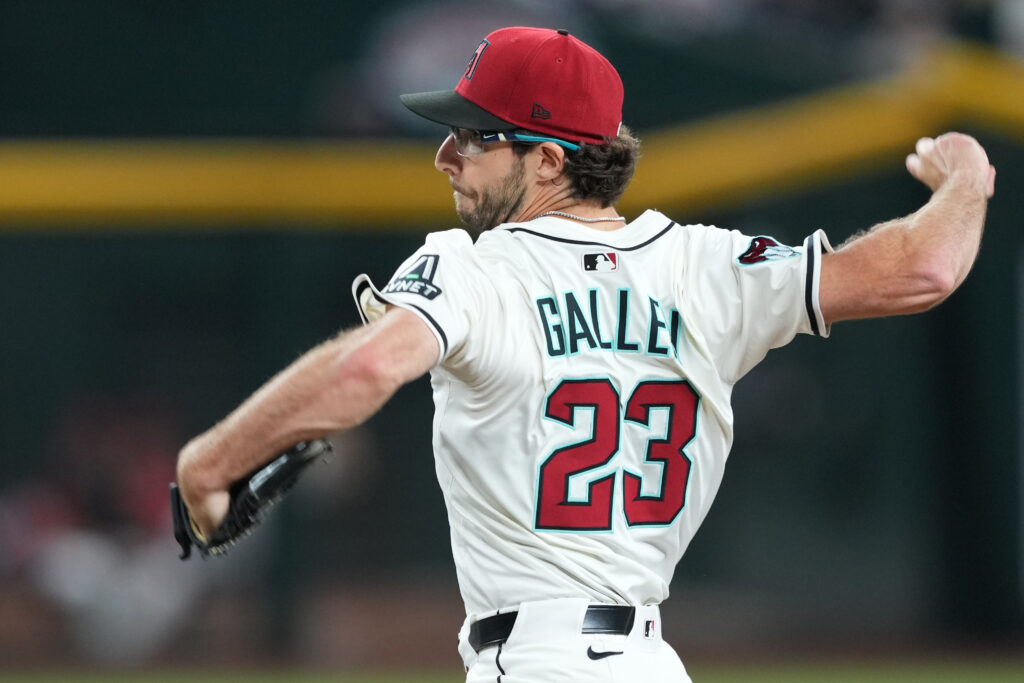
Diamondbacks move to reunite with Zac Gallen on one-year deal; $22.025 million guaranteed with heavy deferrals
Arizona is closing in on a one-year agreement to bring Zac Gallen back to the rotation, with the deal pending a physical. The guarantee is $22.025 million—the value of this offseason’s qualifying offer—with roughly $14 million reportedly deferred across future years. The structure points to a short-term bet on a frontline-caliber arm rediscovering his level after an uneven 2025 while giving the club immediate payroll relief.
8:23pm: It’s a $22.025MM guarantee, reports Ken Rosenthal of The Athletic. That matches the price of the qualifying offer Gallen declined at the start of the winter. However, roughly $14MM of the salary is deferred, Rosenthal adds, turning what is nominally top-of-market annual value into a more modest year-to-year cash commitment.
8:10pm: It’ll be a one-year contract, reports Nick Piecoro of The Arizona Republic. The signing is still pending a physical.
8:08pm: The D-Backs are closing in on a deal to re-sign Zac Gallen, reports Steve Gilbert of MLB.com. The veteran righty has had an extended stay on the open market after declining a qualifying offer at the beginning of the offseason, a choice that initially positioned him among the upper tier of this winter’s starting-pitching class.
Terms signal a measured reset after a down year
Gallen entered last season positioned for a long-term free-agent payday but saw his market recalibrate after a step back in performance. In 2025 he made all 33 turns through the rotation but posted a career-high 4.83 ERA and a career-low 21.5% strikeout rate. A one-year arrangement at the qualifying-offer level keeps the upside outcome in play—for both player and team—without binding the club to multi-season risk.
The heavy deferrals effectively spread the payout across future club budget cycles. For a mid-market franchise that works within a soft-cap environment shaped by the league’s competitive balance tax, that matters: the Diamondbacks secure a familiar No. 2/3 starter profile for 2026 while preserving room to address remaining late-winter roster needs in the bullpen and at the back of the rotation.
How Arizona judged the deadline—and why a reunion now makes sense
By July, with a 5.60 ERA across 127 innings and a 5.40 mark at the All-Star break, Arizona became aggressive sellers, moving Josh Naylor, Eugenio Suárez, Merrill Kelly and Shelby Miller. The club held Gallen, valuing both the compensatory draft pick attached to his rejected qualifying offer if he signed elsewhere and the stability of his innings for a staff that sought not to overwork young arms late in the year.
That calculus was part competitive, part institutional risk management. Keeping Gallen’s workload in-house helped steady a rotation that had just lost multiple veterans, while the qualifying-offer framework meant Arizona could still recoup a draft asset if he departed. The choice ultimately kept the Diamondbacks in the Wild Card picture into the final weekend and preserved optionality: they now retain him on a one-year commitment without surrendering future control or prospects.
What the 2025 performance actually showed
- Finish strong: Quality starts in eight of his final 11 outings and a 3.32 ERA over his last 65 innings suggested that in-season adjustments were taking hold.
- Strikeouts dipped: A 21.5% strikeout rate for the year—and roughly 20% during the late-season upswing—remained below his 25–29% range from prior peak seasons, limiting true ace-level impact.
- Some good fortune: A .232 average on balls in play aided the late run, hinting that the improved results slightly outpaced the quality of contact he was allowing.
- Whiffs moderated: A 9.5% swinging-strike rate marked the second-lowest of his career, reinforcing that hitters were making more frequent contact even as run prevention improved.
- Stuff held: His fastball averaged 93.5 mph, in line with his career norm, but opponents have had more success against the heater over the last two seasons, narrowing his margin for error in the zone.
- Secondaries steady: The knuckle-curve and changeup remained his most reliable weapons, while sporadic use of the cutter, slider and sinker continued to be the primary sources of damage.
- Pitch-mix tweak: Four-seam usage trended down late, with more changeups featured as Gallen and the coaching staff looked for a path back to weak contact and earlier-count outs.
- Under-the-hood indicators: A 4.28 expected ERA and 4.24 SIERA paint a picture of a roughly league-average starter in 2025, with enough structural stability in the arsenal to leave room for a bounce-back but not to assume it.
Implications for the 2026 race
For a club that shed veteran pieces at midseason, securing Gallen on a one-year horizon shores up the rotation’s floor while preserving financial and roster flexibility. His presence reduces pressure on younger arms and gives manager and front office alike a known quantity at the front of the staff.
If his late-2025 adjustments stick, the profile supports mid-rotation reliability with upside to re-approach prior peak levels that had him in Cy Young discussions earlier in his career. If the strikeout rate and fastball effectiveness remain muted, the one-year term limits downside exposure. Either outcome keeps Arizona aligned with a wider National League field where incremental gains in starting depth and run prevention at the margins often decide Wild Card positioning and, by extension, the revenue and political capital that come with October baseball in a publicly visible, stadium-dependent business.
Qualifying-offer and draft context—why the mechanism mattered
Under the Major League Baseball collective bargaining agreement, declining a qualifying offer ties a subsequent signing to draft-pick compensation for the player’s former club and potential international bonus-pool adjustments for the signing team. Arizona’s decision to hold Gallen through the deadline leveraged that framework: retaining his innings in the short term while maintaining the fallback value of a compensatory selection if he departed in free agency.
Re-engaging now on a one-year pact allows the Diamondbacks to convert that theoretical value into concrete rotation stability without triggering additional draft penalties or sacrificing future options. Should Gallen rebound and test the market again next winter, the club will face a new decision on whether to extend another qualifying offer under the same制度—one that now sits at the center of how front offices balance performance risk, payroll planning and long-range talent pipelines.
What Arizona gains—and what remains to prove
- Immediate stability: A durable starter who just shouldered 33 starts returns to a rotation that sought innings protection late last year and still lacks certainty behind its top arms.
- Budget flexibility: Significant deferrals ease 2026 cash demands as the front office assesses late-winter pitching depth, monitors the trade market and retains room to respond to injuries during the season.
- Ceiling vs. certainty: Expected metrics point to league-average potential if 2025 trends hold; meaningful upside depends on sustained strikeout recovery and renewed fastball effectiveness against increasingly contact-oriented lineups.
Pending completion of the physical, the 30-year-old’s return becomes a targeted recalibration: short-term cost certainty and institutional familiarity for Arizona, and a platform year for Gallen to reprice his long-term market if performance rebounds enough to reestablish him among the National League’s upper-tier starters.
Keep reading
