
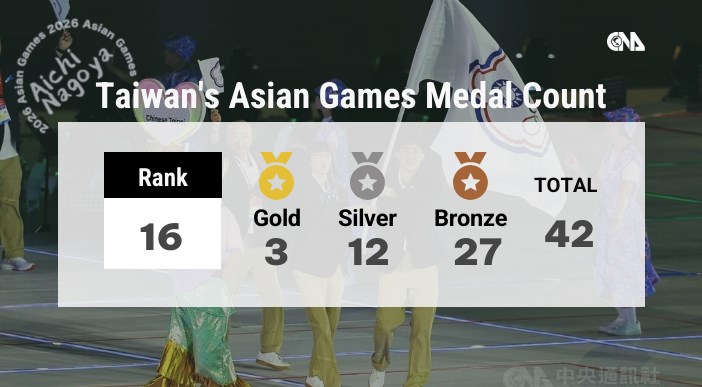
Chinese Taipei Reaches 42-Medal Mark as Aichi-Nagoya Asian Games Enter Final Stretch
Taipei, Oct. 1 – Taiwan, competing under the name of Chinese Taipei, has pushed its medal tally to 42 at the 2026 Aichi-Nagoya Asian Games, underlining the delegation’s consistency at one of the world’s largest multi-sport events.
As of 8:30 p.m. Thursday, the team had collected 3 gold, 12 silver and 27 bronze medals at the 20th edition of the Asian Games, held in Japan’s Aichi Prefecture and Nagoya from Sept. 19 to Oct. 4.
Current Medal Return in Context
The running total at Aichi-Nagoya comes against a long competitive history for Taiwan at the Asian Games, which are staged under the governance of the Olympic Council of Asia. Taiwan first appeared at the continental event in 1954 and, through the end of the 2022 Hangzhou Games, had amassed 586 medals – 118 gold, 164 silver and 304 bronze.
The 42 medals so far in Japan sit within that broader record, reflecting both the depth and breadth of the current delegation. With the event still ongoing, the tally shapes expectations around whether Chinese Taipei can approach or surpass some of its most productive campaigns of the past three decades.
| Edition | Host city | Gold | Silver | Bronze | Total medals |
|---|---|---|---|---|---|
| 1998 | Bangkok | 19 | – | – | 77 |
| 2010 | Guangzhou | – | – | – | 67 |
| 2018 | Jakarta | – | – | – | 67 |
| 2022 | Hangzhou | 19 | 20 | 28 | 67 |
The 19 gold medals secured in Hangzhou in 2022 matched the team’s best-ever gold return from the 1998 Bangkok Games. The 67 total medals in Hangzhou also equalled the haul from Guangzhou 2010 and Jakarta 2018, standing as the second-highest total in Taiwan’s Asian Games history behind the 77 medals in Bangkok.
This record provides the benchmark against which the Aichi-Nagoya performance will ultimately be judged, informing future funding decisions, athlete development priorities and selection strategies for Olympic cycles.
Large Delegation, Broad Sporting Footprint
Taiwan has sent 482 athletes to Japan this year, spread across 34 sports. The scale of the delegation underlines the Asian Games’ role as a critical testing ground for Olympic events, emerging disciplines and regional specialties.
For national sports authorities, fielding athletes in such a wide range of sports serves several purposes:
- measuring competitiveness against leading Asian nations in Olympic and non-Olympic disciplines;
- assessing younger athletes in a major multi-sport environment ahead of future global championships;
- adjusting long-term resource allocation across sports based on medal potential and depth of talent.
The composition of the team – with established names leading key squads – also reflects a deliberate blend of experience and continuity. Performances here can directly influence athlete positioning for upcoming world championships and Olympic qualification pathways, especially in sports where Asian competition is among the strongest globally.
Key Squads and Established Leaders
Table Tennis: World-Level Pedigree at the Core
The table tennis team is being led by Lin Yun-ju (林昀儒) and Cheng I-ching (鄭怡靜), two of the most recognisable names in Taiwanese table tennis in recent years.
At Asian Games level, table tennis sits at the intersection of continental and global competition, featuring world-class opposition from regional powers. Strong performances from Lin, Cheng and their teammates typically have implications beyond the medal table, affecting world rankings and selection dynamics for upcoming international events run under the framework of the sport’s global governing structures.
Boxing: Proven Names in a Deep Asian Field
The boxing team includes Huang Hsiao-wen (黃筱雯), Lin Yu-ting (林郁婷) and Chen Nien-chin (陳念琴), all athletes with significant experience on the international stage.
In boxing, the Asian Games function as a major benchmark event in a region that consistently produces world and Olympic medallists. For Taiwanese boxing, competitive results against top Asian opponents can influence future seeding, international invitations and the evaluation of national training programmes.
Badminton: Veteran Campaigners Anchor the Squad
The badminton team includes five-time Asian Games participant Chou Tien-chen (周天成) and three-time participant Wang Chi-lin (王齊麟), underscoring the continuity of high-level representation in one of Asia’s flagship sports.
Badminton is a marquee discipline across the continent, with Asian athletes dominating the global rankings. Multi-Games representation by Chou and Wang highlights both durability and sustained national reliance on experienced performers. Their campaigns in Aichi-Nagoya will form part of the broader assessment of how Taiwan is placed against regional rivals in the lead-up to future Olympic and World Championships cycles.
Swimming: Building on Hangzhou Breakthrough
The swimming team is led by Wang Kuan-hung (王冠閎), who delivered Taiwan’s first Asian Games medal in the men’s butterfly events at the Hangzhou Games in 2022.
That breakthrough marked an important milestone for Taiwanese swimming, traditionally overshadowed in the region by powerhouses in the pool. Wang’s status at Aichi-Nagoya signals a continued emphasis on converting isolated podiums into more sustainable competitiveness in events where Asian standards are exceptionally high.
Asian Games Stage and Institutional Significance
The Aichi-Nagoya event, running from Sept. 19 to Oct. 4, is the 20th edition of the Asian Games, one of the largest multi-sport events globally in athlete numbers and scope. For Taiwan, each edition offers a structured comparison with regional competitors under a common rules framework that closely tracks the wider Olympic system.
Results in Japan will feed into internal reviews of performance across the 34 sports represented by the 482-strong delegation. Medal distribution by discipline, the balance between established stars and emerging athletes, and trends relative to the 586 medals already accumulated since 1954 are likely to shape strategic decisions for the next Asian Games cycle and for major world events that follow.
With competition in Aichi and Nagoya still ongoing, the 42-medal return – 3 gold, 12 silver and 27 bronze – sets a clear statistical base line. How far Chinese Taipei can build on it in the final days will determine where the 2026 campaign ultimately sits within the country’s seven-decade Asian Games record.
Keep reading
- Aidan Forker Retires: Armagh’s All-Ireland Winning Captain Ends 15-Year Inter-County Career
- Oilers Evaluate Roster Depth Amid Potential Player Move and Preseason Assessments
- Mohsin Naqvi not to attend the Asian Games final (globallypulse.com)
- COSPN secures second Madagascar N1A basketball title, beating RBC Boeny 74-68 (archysport.com)
