
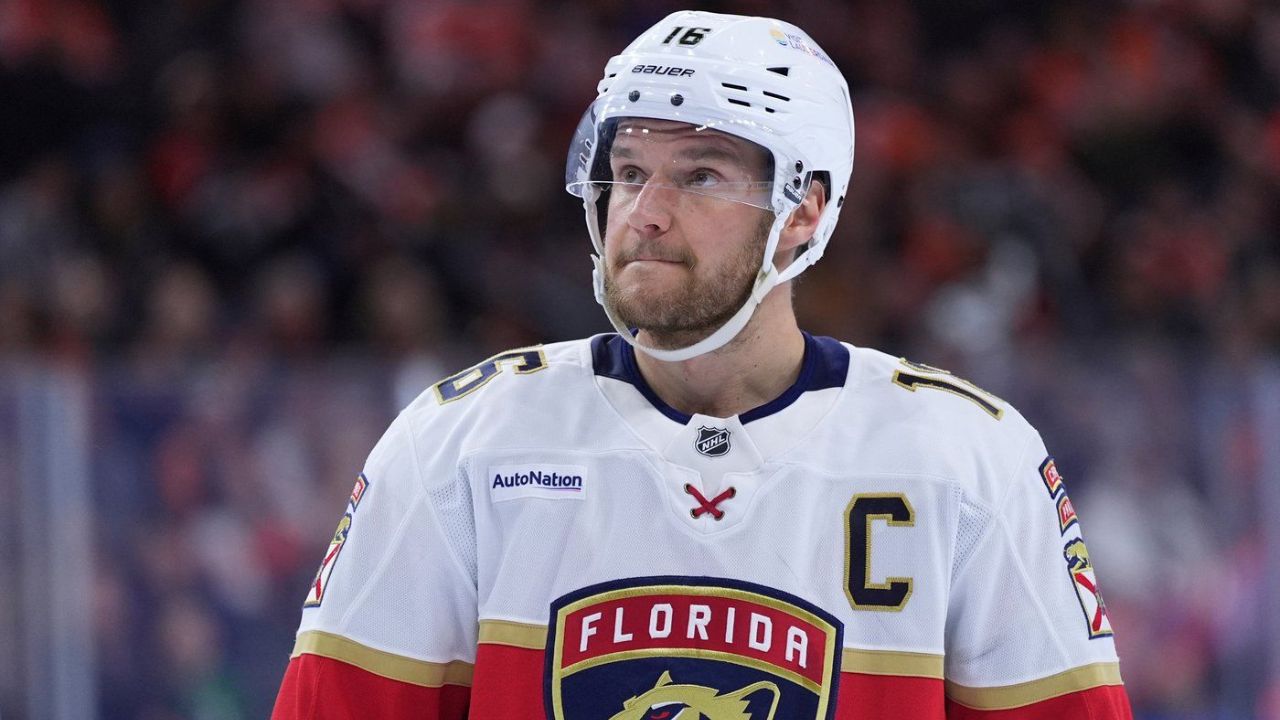
Panthers Captain Aleksander Barkov Exits Game After Awkward Fall, Raising Fresh Fitness Concerns
Florida Panthers captain Aleksander Barkov exited Thursday’s matchup against the San Jose Sharks after an awkward fall along the boards in the second period, a moment that immediately raised concern for one of the franchise’s central figures.
The incident occurred when the Panthers centre appeared to get tripped up and fell backward, landing heavily on his left ankle and knee. Barkov got to his feet quickly but was clearly in discomfort, heading straight to the locker room while limping and slamming his gloves in frustration on the way off the ice.
Setback Arrives Just as Barkov Returned From Major Knee Injury
The timing of the fall is particularly troubling for Florida. Thursday’s contest marked only Barkov’s second game back after he missed all of last season with a torn ACL and MCL in his right knee, an injury suffered during training camp.
That long-term absence had already forced the Panthers to reshape their forward depth and leadership structure for an entire campaign. His return was meant to stabilize both areas, restoring a two-way centre who has been central to the club’s recent championship run.
At 31, Barkov is in what are typically considered prime years for an elite NHL forward, but consecutive seasons disrupted by serious knee issues on opposite legs would naturally raise questions about workload management and how the Panthers balance short‑term competitiveness with the long‑term health of their captain.
From Cup Leader to Early-Season Frustration
Before the knee injuries, Barkov had been at the heart of Florida’s modern era of success. The Panthers’ captain helped lead the team to back-to-back Stanley Cup titles in the years prior, anchoring the top six and setting the standard for the club’s two‑way play.
In the 2024-25 season, he registered 20 goals and 51 assists for 71 points in 67 games, production that underlined his status as a high-end playmaker and reliable offensive driver. Those numbers also reflected his importance to Florida’s special teams and late-game situations, areas where coaches often lean on experienced centres.
This season, however, Barkov has yet to record a point. For a player with his résumé, that early statistical silence will be seen less as an indictment of form and more as a sign of a disrupted rhythm-hardly surprising after a full year out and a demanding return to NHL pace. Still, for a Panthers team with ambitions of contending again, getting their captain fully integrated offensively remains a critical objective.
Implications for Florida’s Competitive Outlook
In the context of the National Hockey League, where postseason seeding can hinge on a handful of points, the health of a top-line centre can materially shape a team’s season. Barkov’s status influences:
- Lineup balance: His presence down the middle allows Florida to spread responsibilities across its forward group, easing pressure on secondary centres and wingers who might otherwise be forced into tougher matchups.
- Special teams deployment: As a key figure in both power-play and penalty-kill structures, any absence or limitation forces tactical adjustments and increases the minutes for depth players.
- Game management: In tight games-common over an 82‑game schedule-coaches often rely heavily on their captain in key defensive-zone draws and late-game situations.
Should Barkov miss additional time, Florida would again be asked to redistribute those responsibilities in a league where marginal edges often decide playoff berths and positioning.
Contact, Officiating and Player Safety Context
The play that led to Barkov’s departure stemmed from apparent contact that caused him to be tripped up near the boards, a recurring risk area in elite ice hockey. Under the NHL rulebook, tripping and other forms of lower‑body interference are closely monitored infractions designed to reduce exactly these types of falls, particularly when players are close to the boards and at speed.
While the specific on-ice call in this instance is not detailed, episodes like this inevitably sit within a broader conversation about player safety, officiating consistency and the challenges of policing contact in a fast, collision-heavy sport. For franchises with championship aspirations, keeping star players available across a long regular season and playoff run is not only a medical issue but a competitive one, influencing roster planning, cap strategy and in-game tactical choices.
Panthers Face Familiar Uncertainty Around Their Captain
For Florida, the immediate priority now is straightforward: clarity on the condition of Barkov’s left leg after his exit against San Jose. Beyond that, the organisation faces a more complex equation-how to manage the minutes and responsibilities of a 31-year-old captain who has already endured a torn ACL and MCL in his right knee and is now dealing with fresh concern on his left side.
As the season unfolds, the Panthers’ ability to navigate that balance between urgency and caution with their most influential skater will play a central role in determining whether they can sustain their recent standard as a Stanley Cup-winning club.
Keep reading
