
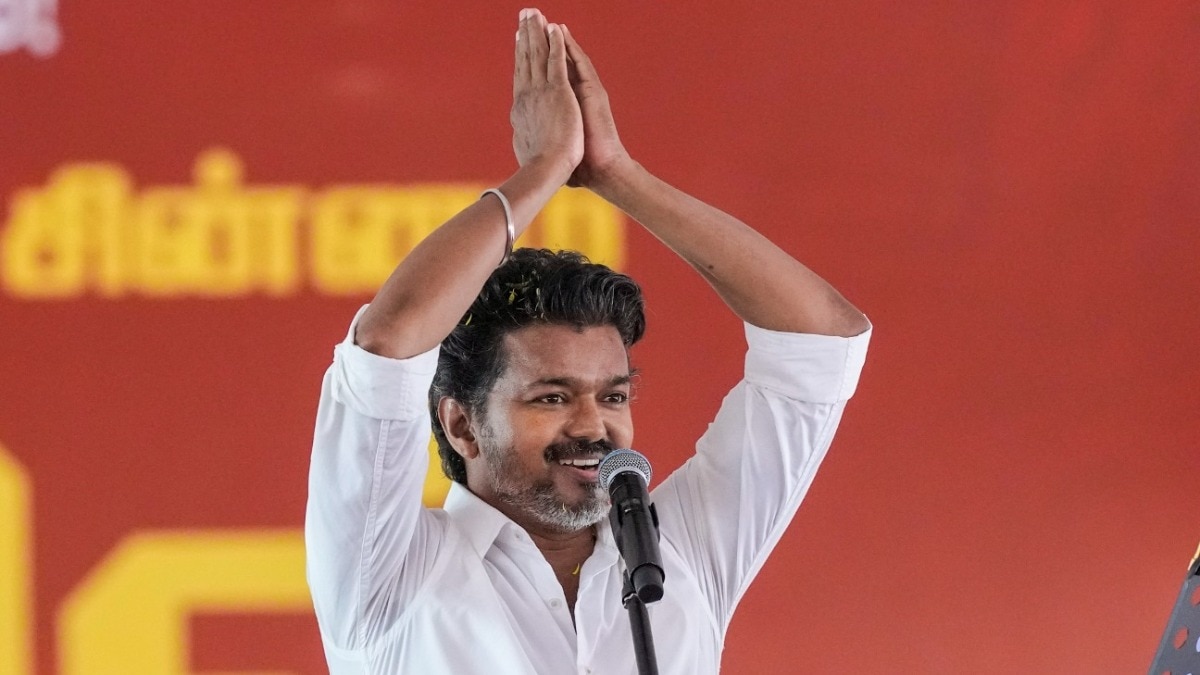
CHENNAI – Actor-turned-politician Vijay’s Tamilaga Vettri Kazhagam (TVK) has emerged as a significant disruptor in the 2026 Tamil Nadu Assembly elections, according to exit polls suggesting the party has broken the state’s long-standing two-party dominance.
The projections indicate that TVK has forced a three-cornered contest in its first electoral outing, challenging the established grip of the DMK and AIADMK. Depending on the survey, the party is positioned as either a major third power center or a potential contender for the single largest party in the 234-member Assembly, where 117 seats are required for a simple majority under the framework of the Election Commission of India.
Electoral Projections and Seat Estimates
Two major exit polls provide differing scales of success for the debut party, though both agree on TVK’s role as a decisive force in the next government formation.
The Today’s Chanakya exit poll projects a strong entry for the party:
- Estimated seats: 63 (with a margin of 11 seats on either side)
- Estimated vote share: approximately 30% (with a possible variation of 3%)
This scenario places TVK behind the DMK-led alliance but establishes it as a third pole capable of reshaping the state’s electoral equations, particularly in closely contested constituencies where small swings can influence policy direction and coalition arithmetic.
In contrast, Axis My India presented a more dramatic projection on April 29, 2026. That survey places TVK within striking distance of the 117-seat majority mark:
- Projected seats: 98-120
- Estimated vote share: around 35%
According to Axis My India, this vote share puts TVK on par with the DMK-led bloc and significantly ahead of the AIADMK-BJP alliance, raising the prospect of either a TVK-led government or a coalition in which the party could exercise substantial leverage over cabinet formation and legislative priorities.
While exit polls in India have a mixed record of accuracy, the convergence on TVK as a major actor signals that, at a minimum, the party is set to influence opposition strength, leadership of key assembly committees, and negotiations over welfare and development agendas.
Demographic Shift and Voter Coalition
The rise of TVK is attributed to a broad social coalition that cuts across traditional caste lines, long seen as the backbone of Tamil Nadu’s Dravidian politics.
Data from Today’s Chanakya highlights the following support levels:
- Scheduled Castes and Christians: 34%
- Backward Classes: 29%
- Most Backward Classes: 27%
Despite this broad appeal, the party continues to trail the DMK among Muslim voters, where the ruling bloc maintains a clear advantage, potentially preserving DMK strength in segments of northern and central Tamil Nadu.
The party’s momentum is heavily driven by youth and urban demographics. TVK has drawn significant support from first-time voters and individuals under 30, as well as students and the unemployed. For policymakers, such a profile suggests that any TVK role in government or as a powerful opposition could sharpen focus on job creation, education, skills, and urban infrastructure in subsequent state budgets.
Political Precedents, Governance Stakes and Leadership Appeal
The rapid ascent of Vijay from a cinematic icon to a political contender has drawn comparisons to historical figures in Indian politics.
Pollster Pradeep Gupta likened Vijay’s rise to that of M G Ramachandran in Tamil Nadu and N T Rama Rao in Andhra Pradesh, both of whom successfully converted mass popularity into executive political power and left enduring marks on welfare policy, subsidy regimes and the style of state leadership.
This personal appeal is further reflected in leadership preferences. Projections show Vijay running close to Chief Minister M K Stalin as the preferred choice for the state’s top post, indicating that voters are not only evaluating party symbols but also contrasting two distinct models of governance – an entrenched Dravidian party apparatus versus a new, personality-driven movement.
The combined data suggests that TVK is not only eroding the AIADMK’s traditional base but is also challenging the DMK in several key segments. A stronger third force in the Assembly could complicate legislative negotiations on issues such as state finances, social welfare schemes, and relations with the Union government, particularly on matters like fiscal devolution and language or federalism debates.
For now, TVK’s policy platform remains under scrutiny from business groups, civil society and bureaucrats seeking clarity on how a Vijay-led formation would approach investment, industrial policy and public services. The scale of TVK’s final tally will determine whether those discussions take place from the Treasury benches or across the aisle.
Official results to be declared by the Election Commission of India will determine if TVK emerges as a kingmaker, a robust opposition anchor, or the primary governing power in the state. Until then, Tamil Nadu’s political establishment and New Delhi’s policymakers alike are bracing for a recalibrated balance of power in one of India’s most politically influential states.
Worth a look
