
TEHRAN – Iranians are facing a period of profound uncertainty and exhaustion as Donald Trump alternates between threats of renewed military action against Iran and claims that a lasting ceasefire is imminent.
The current instability follows a conflict that began on February 28, characterized by foreign military strikes and a severe domestic crackdown. While a nearly 90-day internet shutdown has been partially lifted, the return of connectivity has exposed the scale of civilian and economic devastation and allowed rights groups to resume documenting potential violations of international humanitarian law.
The fragile ceasefire, reached in principle between Washington and Tehran but not yet translated into a durable political agreement, has not eased fears of state repression. Rights organizations report a systemic campaign of violence against anti-government protesters who first took to the streets in December, accusing the authorities of breaching obligations under the International Covenant on Civil and Political Rights, to which Iran is a state party.
Domestic Crackdown and Militarization
Security forces have responded to national protests with lethal force and mass incarcerations, in what analysts describe as one of the most severe domestic clampdowns since the 2009 Green Movement. Data from monitoring groups indicates the following:
- Casualties: Thousands reported killed by security forces.
- Arrests: More than 50,000 individuals detained, according to the US-based Human Rights Activists News Agency (HRANA).
- Executions: At least 226 people executed this year, according to the Norway-based Iran Human Rights NGO (IHRNGO).
Rights advocates say the scale of arrests and executions points to the use of counterterrorism and national security courts to fast-track prosecutions of protesters and dissidents, often in closed hearings with limited access to legal counsel.
Parallel to the crackdown, the Iranian government has initiated civilian militarization in the capital. Military training booths have been established in Tehran to instruct civilians in the use of Kalashnikov rifles, a move officials defend as “defensive preparedness” but which critics see as deepening a climate of fear.
Elnaz, a Tehran-based rights activist, reported that the state has broadcast images of children and teenagers holding machine guns and participating in checkpoint inspections.
“Not everyone supports the system or is interested in war. The use of children and teenagers in checkpoint inspections, as well as the broadcast of weapons training on television, has caused widespread concern,” Elnaz said. “Many child rights activists have protested, arguing that war should not be normalised.”
Child protection experts warn that such imagery risks normalizing the presence of small arms in public life and blurring the line between civilian and combatant, in direct tension with long-standing international norms on the protection of minors in conflict.
Civilian Infrastructure and Human Cost
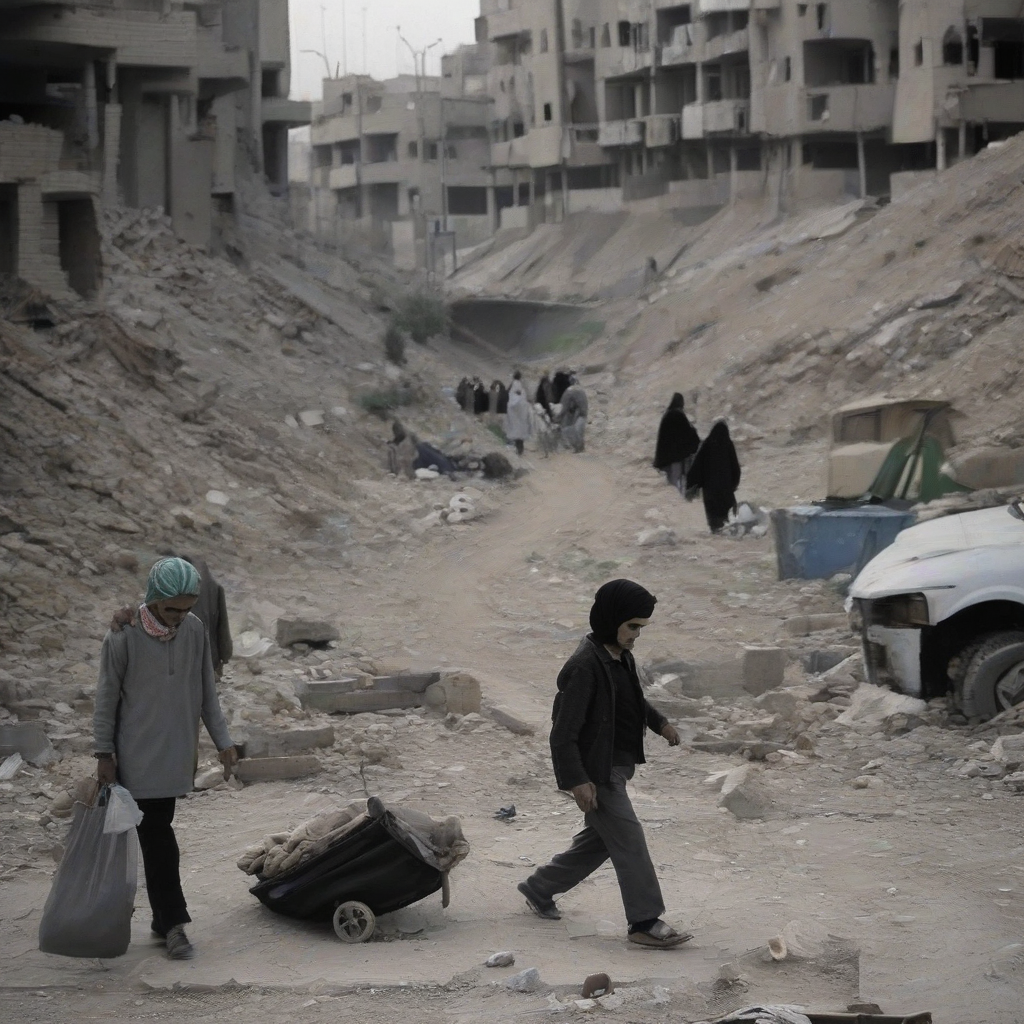
The US-Israeli military campaign has resulted in significant damage to non-military targets, despite repeated statements from US officials that strikes are aimed at degrading Iran’s military capabilities. Residents have used social media to document the destruction of residential homes, hospitals, universities, and research centers.
Hamed Mirzaei, a resident of Tehran, reported through Instagram that a strike on his home killed 12 family members, including his parents, wife, cousins, their children, and brother-in-law.
Similarly, Hamidreza Afarideh, a co-founder of a music academy in east Tehran, documented the ruins of his school, which was destroyed during a strike on a nearby military base. He described students arriving at the site days later to find instruments and classrooms buried under rubble.
Ro, a 42-year-old musician in Tehran, condemned the military aggression, stating: “Which country has ever achieved freedom through military invasion? Afghanistan, Iraq, Syria? As an Iranian musician, I condemn the military aggression of the United States and Israel against my country.”
Ro further alleged that the attacks “bombed schools, hospitals, research centres, universities, petrochemical facilities and residential homes,” which he says has exacerbated poverty and medication shortages and left many districts of the capital dependent on volunteer networks to deliver basic supplies.
Diplomats and legal experts say the pattern of strikes and the reported use of explosive force in densely populated areas are likely to feature prominently in any future UN or independent inquiries into the conduct of all parties to the conflict.
Economic Collapse and Social Division
The combination of military strikes and a prolonged internet blackout has pushed the Iranian economy toward a breaking point. The loss of livelihoods and soaring prices for groceries and essential medicine have left many unable to meet basic needs, compounding years of sanctions and mismanagement that had already eroded household savings.
Noor, a 39-year-old cafe owner in Tehran, warned that the current stability is illusory.
“It will take years to recover from the emotional and economic devastation caused by January’s massacre and the war,” Noor said. “Even if this ceasefire holds, in a few months I think we will be in such economic hell that people will come back to the streets simply out of desperation.”
Economists note that small businesses like Noor’s are particularly exposed: repeated closures, disrupted supply chains, and banking restrictions have hollowed out the urban middle class that once served as a buffer against political radicalization.
The crisis has also created generational rifts within families. Saeed, a protest participant using a pseudonym for security, described sharp disagreements with older relatives who rely on state media.
“Some of the elderly members in my family seem to think we [young protesters] are brainwashed and have brought shame to the country,” Saeed said. “They believe everything said on state TV and don’t realise the regime has been executing young people just because they were out protesting. They think they were spies.”
Social researchers say this divide reflects two competing information ecosystems: one shaped by state broadcasters and official Friday sermons, the other by encrypted messaging apps and diaspora media that young Iranians access whenever connectivity returns.
Disillusionment with Foreign Intervention
The volatility of US policy has left some Iranians feeling used as geopolitical leverage, particularly as Washington weighs military escalation against parallel back-channel talks. Amir, a business owner from Mashhad, stated that he previously hoped for US intervention to spark political change, but now views the situation as a betrayal.
“I feel humiliated,” Amir said. “This is not a ceasefire. It’s a never-ending auction between the US and the Islamic Republic over our lives and our blood.”
Amir specifically cited the impact of Trump’s previous rhetoric regarding bombing Iran “back to the stone ages,” noting that treating the conflict like a business deal while shifting promises has been “humiliating to watch.”
Saeed echoed this sentiment, arguing that the US attacked with promises of rescue but left the population without a definitive plan or clear pathway to political reform.
“The economy is worse than it was on 28 December [when the protests began] and with the number of raids, arrests and executions daily, we have been left with an emboldened regime,” Saeed said. “We are truly in a fucked up situation.”
Regional diplomats say both governments are under pressure: Iran faces a population demanding accountability and economic relief, while the US confronts questions in Congress about the objectives, legal basis and exit strategy of its campaign under existing war powers and defense authorizations.
Iranians remain in a state of survival as they await the outcome of ceasefire negotiations and any follow-on agreement that might move the conflict from the battlefield to the negotiating table. For now, families across the country are adjusting to a new normal defined by grief, uncertainty and a deepening mistrust of both their own rulers and foreign powers.
Keep reading
