
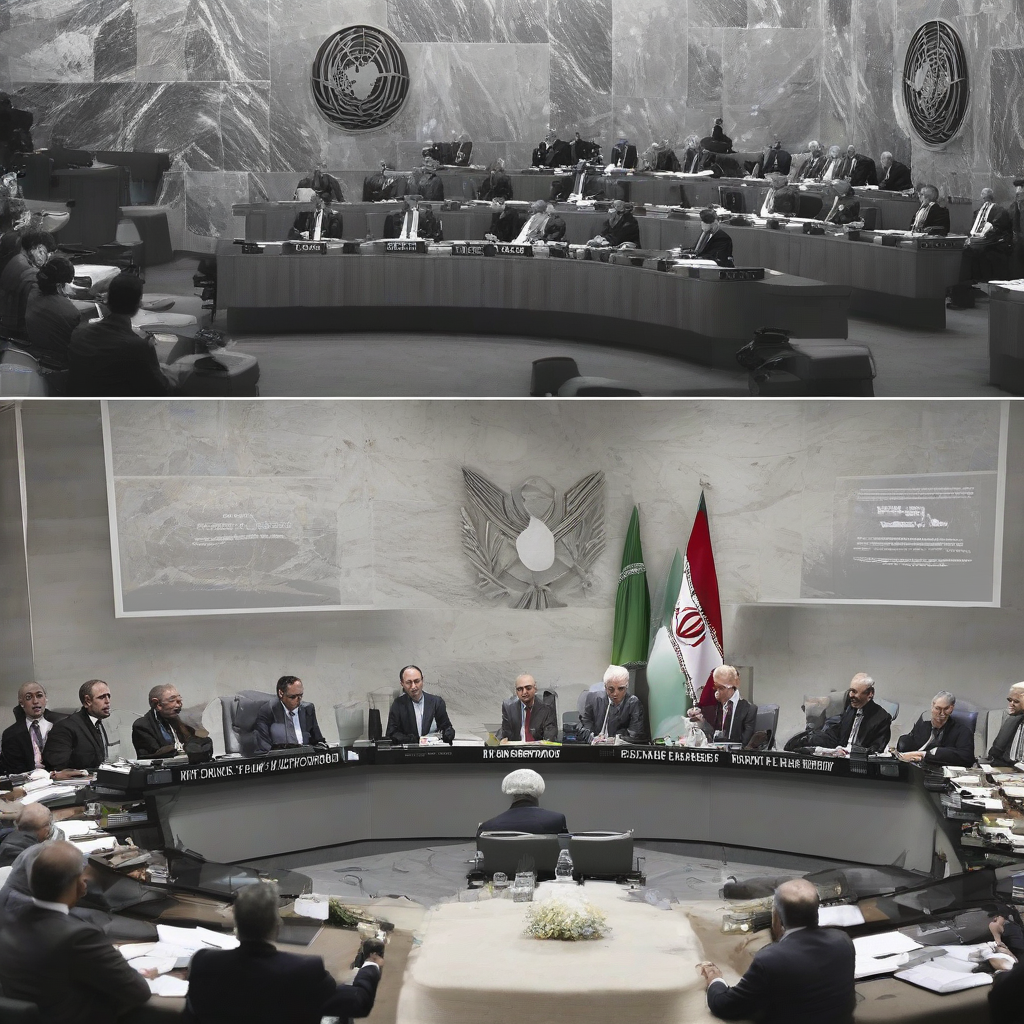
NEW YORK – The United Nations Security Council convened an emergency session to address the resumed military confrontation between the United States and Iran, warning that the failure to implement a recently brokered peace deal could lead to full-scale hostilities.
The session followed a series of drone strikes on commercial shipping and reciprocal military attacks across the Gulf region. Diplomats warned that the current volatility threatens global energy security and the stability of neighboring sovereign states.
The conflict has centered on the Strait of Hormuz, a critical maritime chokepoint through which a significant portion of the world’s petroleum passes. The disruption of this narrow waterway has triggered warnings from the UN regarding the economic stability of developing nations and the integrity of the rules-based order governing international straits.
Timeline of Recent Military Escalation
The current cycle of violence follows a pattern of strikes and failed ceasefires that has repeatedly undercut mediation efforts by regional and international actors:
- February 28, 2026: The United States and Israel launch military strikes on Iran; Tehran responds by attacking U.S. army bases in the Gulf.
- June 25, 2026: Iranian drones strike the Singapore-flagged cargo vessel Ever Lovely and the Panama-flagged tanker Kiku near the Strait of Hormuz.
- June 26-27, 2026: The United States conducts two waves of strikes against Iranian coastal military infrastructure.
- June 27-28, 2026: Iran launches drone attacks on Bahraini territory and targets U.S. military infrastructure, including a naval headquarters in Bahrain and an air base in Kuwait.
- June 28, 2026: Both nations agree to cease attacks under a fragile understanding that has since been repeatedly tested.
Maritime Security and Global Economic Risk
The United States informed the Council that Iran has effectively closed the Strait of Hormuz, stopping all vessels regardless of their origin or cargo. Council diplomats noted that the waterway is one of the world’s most critical energy corridors, with disruption quickly transmitting price shocks through global oil and gas markets.
Citing a UN finding, the U.S. representative stated that this closure will have lasting effects on 61 developing economies, many of which are already burdened by high debt and food insecurity. The representative framed the issue as a direct challenge to the principle of freedom of navigation and to the international legal regime codified in the UN Convention on the Law of the Sea, which protects transit passage through straits used for international navigation.
“It didn’t matter if the ship was carrying fertilizers to farmers in Africa, aid to Sudan, fuel to Japan” or “whether they were involved in this conflict or not,” the U.S. representative said, arguing that Iran’s actions amounted to collective punishment of states far removed from the battlefield.
Panama’s representative specifically condemned the attack on a Panama-flagged vessel carrying 2 million barrels of oil, describing the event as a “grave threat to international maritime security” and warning that registry states would be forced to reassess risk and insurance costs for commercial shipping in the Gulf.
To counter these disruptions, France and the United Kingdom are currently leading a multinational defensive mission to protect freedom of navigation in the waterway, coordinating naval escorts and air surveillance with Gulf partners to keep at least a partial corridor open for commercial traffic.
Impact on Bahrain and Kuwait
Bahrain, which requested the emergency session, provided data on the scale of attacks it has endured since February 28. Minister for Foreign Affairs Abdullatif bin Rashid al Zayani reported that Bahrain has suffered 808 attacks, comprising 605 drones and 203 ballistic missiles, calling the campaign an unprecedented test of the country’s air defenses and civil protection systems.
Al Zayani rejected Iranian claims that strikes were limited to military targets, citing a drone strike on April 5 that hit an ammonia storage tank in a densely populated residential area. He stated that the event “could have resulted in a ‘catastrophic humanitarian disaster’ had it not been emptied as a precautionary measure,” and urged the Council to treat such incidents as violations of international humanitarian law.
Kuwait’s representative reported similar patterns of hostility, citing 893 drone attacks and 873 ballistic-missile strikes against the country. He maintained that Kuwait has not permitted its territory, airspace, or waters to be used for hostilities against any other nation, positioning Kuwait as a non-belligerent state whose sovereignty and critical infrastructure are nonetheless being drawn into the confrontation.
Diplomatic Deadlock and the Veto Power
The Security Council remains divided on how to enforce regional stability and uphold the non-use-of-force principles enshrined in the UN Charter. While the Council previously adopted resolution 2817 (2026) to condemn attacks against Gulf States, a subsequent resolution aimed at deterring interference with navigation in the Strait of Hormuz was vetoed by China and the Russian Federation, underscoring the limits of collective security mechanisms when permanent members clash over root causes and attribution.
Russia’s representative argued that Iran has the right to self-defense under the UN Charter, stating that the root cause of the escalation was aggression by the United States and Israel. Moscow warned against what it described as attempts to use the Council to legitimize unilateral military coalitions.
Iran’s representative described the accusations from Western members as “baseless allegations” and “unfounded accusations.” He claimed the United States and Israel “betrayed diplomacy twice and launched two wars of aggression against Iran,” referencing attacks in June 2025 and between February and April 2026, and insisted that Iran’s actions were calibrated responses to prior violations of its sovereignty.
The U.S. representative dismissed Iran’s claims of self-defense, calling the actions a “cynical, sad and sick attempt at global blackmail” that weaponized energy markets and commercial shipping.
“Let me remind you where you are. This is not Tehran, this is the United States of America – this is the United Nations Security Council – [and] you will not silence this body.”
The exchange highlighted an entrenched diplomatic deadlock: the Council can serve as a stage for sharp public messaging and competing legal narratives, but remains, for now, unable to agree on binding measures to constrain the parties.
The Doha Negotiation Track
Despite the rhetoric in New York, indirect talks between the U.S. and Iran began in Doha on June 30, facilitated by Qatar and Pakistan and supported quietly by several Council members. Diplomats describe the Doha channel as the only functioning venue where the two sides are exploring step-by-step de-escalation options, including limitations on drone activity and assurances for commercial shipping.
Elizabeth Spehar, Assistant Secretary-General in the Department of Political and Peacebuilding Affairs, warned that the current situation is fragile. “Each new strike, each new interception [and] each new maritime incident increases the risk of miscalculation,” she said, adding that a return to full-scale hostilities would have “catastrophic consequences” for regional security and for the credibility of international conflict-prevention efforts.
Representatives from Colombia, Liberia, Somalia, and the Democratic Republic of the Congo urged all parties to protect the political space emerging from these talks, stressing that the Council’s responsibility is not only to react to violations but also to shield nascent diplomatic channels from collapse.
Indirect negotiations in Doha remain ongoing, with Council members signaling that any durable ceasefire in the Gulf – and any reopening of the Strait of Hormuz to normal traffic – will likely depend on whether this parallel track can be translated into verifiable security arrangements acceptable to both Washington and Tehran.
