
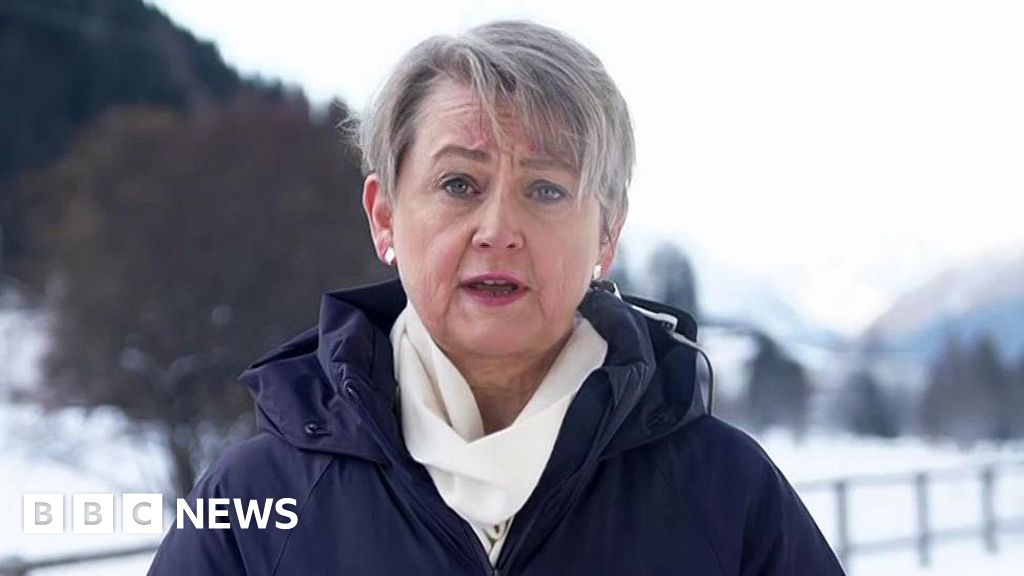
DAVOS – The United Kingdom will not sign on Thursday, January 22, 2026, to U.S. President Donald Trump‘s newly launched Board of Peace, Foreign Secretary Yvette Cooper said, citing concerns over Russian President Vladimir Putin’s potential participation and the legal breadth of the treaty unveiled at the World Economic Forum in Switzerland.
 BBC
BBCCooper said the U.K. had been invited but “won’t be one of the signatories today” at the Davos ceremony. She described the U.S.-drafted charter as a “legal treaty that raises much broader issues” than its initial framing around ending the war in Gaza, stressing that any new body must sit alongside – rather than cut across – the United Nations system and existing international law frameworks such as the UN Charter.
The decision places the U.K. alongside the other permanent members of the UN Security Council – China, France and Russia – which have not committed to join. Trump, who launched the body at a signing ceremony with leaders and representatives from multiple countries, said he does not intend it as a UN replacement and called it a vehicle to forge “everlasting” Middle East peace, echoing language used when the initiative was first trailed in U.S. peace proposals for Gaza. [1]
U.K. stance and stated concerns
Cooper voiced support for Trump’s 20‑point plan to halt the war in Gaza and said Britain wants to “play our part in phase two of the Gaza peace process.” But she drew a clear line between backing elements of the peace plan and endorsing the new institution itself.
She cited unease about any role for Putin while Russia continues its invasion of Ukraine, saying Moscow has shown no sign of committing to peace and warning that Putin’s participation could undermine the credibility of a body explicitly focused on conflict resolution.
“We won’t be one of the signatories today because this is a legal treaty that raises much broader issues. And we do also have concerns about President Putin being part of something that’s talking about peace when we’ve still not seen any signs from Putin that there will be commitment to peace in Ukraine.”
She added that the U.K. would keep up international discussions “including with our allies,” signalling that London wants to remain engaged in shaping the Board’s remit, governance and relationship with the UN and other multilateral institutions even while staying outside it for now.
What the charter sets out
According to the text described by officials, the charter goes beyond Gaza reconstruction and creates a standing international organization empowered to act in conflict zones, with its own governing board and funding model. Key provisions include:
- Mandate: “Promote stability, restore dependable and lawful governance, and secure enduring peace in areas affected or threatened by conflict,” language that would, in principle, allow operations far beyond the Middle East.
- Entry into force: The treaty becomes effective once three states formally agree to be bound by it, a low threshold compared with many multilateral accords.
- Membership: Renewable three‑year terms, with permanent seats available to states contributing $1 billion (£740 million), giving major funders formal structural advantages.
- Leadership and powers: Trump serves as chairman and separately as the U.S. representative, with authority to appoint executive board members and create or dissolve subsidiary bodies, a concentration of powers that has drawn scrutiny from diplomats wary of limited checks and balances. [2]
- Founding Executive Board (named Friday, January 16, 2026): U.S. Secretary of State Marco Rubio; Middle East envoy Steve Witkoff; Jared Kushner; former U.K. Prime Minister Tony Blair, among seven initial members.
Trump said the board “had the chance to be ‘one of the most consequential bodies ever created'” and pledged, “We’re committed to ensuring Gaza is demilitarised, properly governed and beautifully rebuilt.” He also said that once the board is fully formed, “we can do pretty much whatever we want to do,” adding, “But we’ll do it in conjunction with the United Nations” – remarks that have fuelled questions over how far the new entity might overlap with or bypass existing multilateral structures.
Who signed – and who held back
At the Davos ceremony on Thursday, Trump appeared with leaders and representatives from a number of states as he signed the founding charter.
- Countries present for the signing included: Argentina, Hungary, Morocco, Saudi Arabia and Turkey.
- Additional governments that have said they will join: Pakistan, Egypt and Qatar, according to U.S. officials and participants. [3]
- Not committed so far: China, France, Russia and the U.K., the other permanent members of the UN Security Council, a collective absence that leaves the Board’s claim to global legitimacy in question at launch.

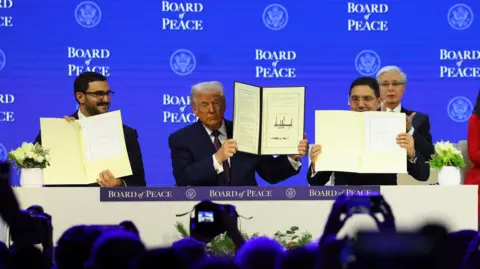 Reuters
Trump said Putin had accepted an invitation to join the initiative. The Kremlin has not confirmed that; earlier, Putin said Russia was still studying the offer. According to Russian state news agency TASS, Putin said the use of Russian assets frozen in the U.S. as a contribution to the board would be discussed with representatives of the Trump administration later on Thursday, January 22, 2026.
Greenland dispute clouds transatlantic ties
Relations between Washington and key European partners had been strained after Trump threatened tariffs on European nations if his demand to transfer control of Greenland to the U.S. was not met – a move that alarmed NATO allies and raised questions over the use of economic pressure in territorial negotiations.
He later appeared to back down, saying after talks with the NATO alliance that the U.S. was exploring a potential deal on Greenland, dropping planned tariffs on eight European countries and ruling out the use of force to take the island.
Cooper welcomed the apparent climbdown and said the U.K. and European allies had tabled “positive, constructive proposals” on Arctic security, casting the episode as a reminder that transatlantic cohesion remains fragile even as Western governments try to coordinate policy on Gaza and Ukraine.
Gaza and Ukraine: where the initiatives intersect
Officials initially described the board as part of a plan to rebuild Gaza and shape its future governance. The charter text presented by the White House does not mention Gaza, while critics say the board appears designed to duplicate or replace some UN functions, including mediation, reconstruction oversight and sanctions coordination.
Trump said the effort would ensure Gaza is “demilitarised, properly governed and beautifully rebuilt.” For London and other European capitals, the question is whether those goals are pursued through, or in parallel to, existing multilateral mechanisms.
On Ukraine, Cooper linked London’s hesitation directly to Putin’s conduct in the war. The U.K. has backed Kyiv and, together with France, signed a declaration of intent to deploy troops to Ukraine if a peace deal is reached with Russia, tying any future security presence to a negotiated settlement rather than unilateral initiatives.
Trump reiterated his view that Putin and Ukrainian President Volodymyr Zelensky were close to a deal and is due to meet Zelensky in Davos on Thursday, January 22, 2026. For now, however, the U.K.’s refusal to sign the Board of Peace underlines a broader divide among allies over how far to invest authority in a new U.S.-driven body while major powers remain at war.
- Urban Infrastructure Resilience: How European and Asian Megacities Are Adapting to Extreme Climate Oscillations in 2026
- UN General Assembly 2026 Framework on Autonomous Systems: International Diplomacy Faces Algorithmic Governance
- Why Rural Voters Are Turning Against Donald Trump in Farm Country (archyde.com)
- Trump endorses embattled Netanyahu ahead of Israeli election (globallypulse.com)
