
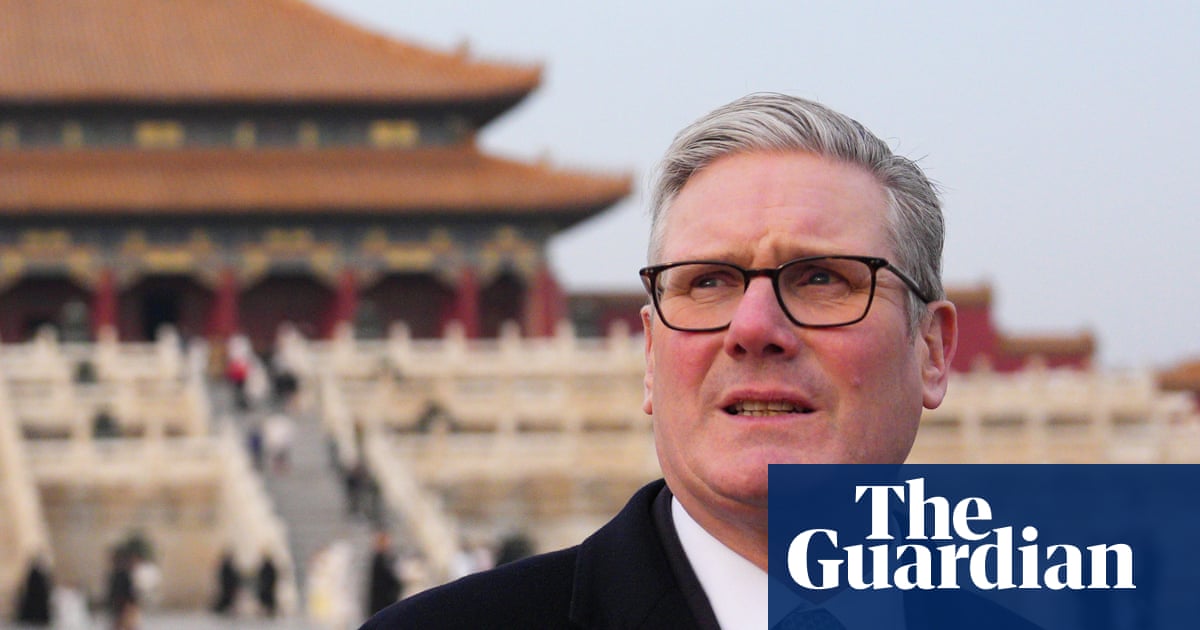
BEIJING – Keir Starmer, the United Kingdom’s prime minister, met Chinese leaders in Beijing on January 29, 2026, in a visit that Chinese state-linked outlets cast as a pragmatic push for economic ties. He traveled with a delegation of 50 business and cultural leaders, making him the first British prime minister to visit China since 2018.
Chinese platforms characterized the trip as an economics-first engagement and highlighted the absence of open confrontation on geopolitical flashpoints. Starmer, speaking to reporters in Beijing, said he wanted a “more sophisticated” relationship with China, signalling a shift from the more openly adversarial tone that has marked parts of the UK’s China policy in recent years under the country’s statutory “foreign state threats” framework.
Beijing’s coverage stresses commerce over confrontation
State-affiliated commentary framed the trip as an effort to prioritize trade and investment while keeping disagreements on security and human rights largely in the background. Chinese outlets portrayed the visit as London recalibrating its approach after years of sanctions, investment screening and tit-for-tat diplomatic measures on both sides.
– A social account linked to Beijing Daily wrote: “If the Sino-British relationship in the past few years has been characterised by ‘politics taking precedence and economics taking a backseat’, then this time it is more like a reordering of ‘economics taking precedence and politics taking a backseat’.”
– The site Guancha emphasized that Starmer did “not take the bait” of western journalists seeking to steer the visit toward pressure on President Xi Jinping over ties with Russia.
– An account affiliated with China.org.cn argued the engagement reflected practical needs rather than a return to the 2015 “golden era” branding.
That account set out the economic case in unusually explicit terms:
“Against the backdrop of heightened global economic uncertainty, strengthening pragmatic cooperation between China and the UK aligns with the practical needs of both sides.
“China is advancing high-quality development and high-level opening up, and British companies have significant opportunities in this process.
“Starmer’s visit to China is not an ideological shift, but rather a rebalancing choice under economic pressure. For the UK, it means capital, orders, and growth momentum; for China, it means stable expectations, mutually beneficial cooperation, and strategic leverage over Europe.
“Both sides understand that security and other issues will not disappear, but neither intends for them to dominate the agenda.”
The same account also said: “What is certain is that London has begun to recalculate its relationship with China, and this calculation is not entirely based on Washington’s approach.”
The Chinese coverage made only limited reference to the UK’s own red lines on technology transfer, security vetting and critical infrastructure, treating those instead as a manageable backdrop to a renewed focus on market access, finance and higher education links.
Who was at the table and what was said
Chinese commentary focused on the size and makeup of the UK delegation, presenting it as evidence that Starmer’s government is seeking a commercial reset rather than a purely symbolic diplomatic stopover.
– Delegation: 50 business and cultural leaders accompanied Starmer, including figures from finance, advanced manufacturing, higher education and the creative industries, according to Chinese reports.
– Messaging: Starmer told reporters he wanted a “more sophisticated” relationship, language that Chinese outlets interpreted as a move away from binary “partner or rival” framing and towards compartmentalised cooperation in areas such as climate, trade and financial services.
– Media interpretation: The “not take the bait” remark was used to underline the absence of a public push on Xi Jinping over his relationship with Russia’s Vladimir Putin, even as UK officials stressed privately that security and Ukraine remained part of the agenda.
Chinese state media highlighted announcements on easing certain regulatory frictions for British firms – including commitments to streamline approvals and expand licensing in sectors such as consumer goods and professional services – while downplaying unresolved disputes over data security, outbound investment controls and research collaboration.
Where the visit sits in recent UK-China relations
The portrayal of an economics-first agenda comes after a decade of sharp swings in UK-China relations and a tightening of the UK’s formal China policy.
– 2015: London heralded a “golden era” in relations under then-Prime Minister David Cameron, with Chinese state investment sought in UK nuclear power, infrastructure and real estate.
– 2018: The most recent prior visit to China by a British prime minister, before relations soured over Hong Kong, Xinjiang and security concerns around Chinese technology companies.
– Subsequent years: Relations were strained by policy and security disputes – including sanctions, the exclusion of Huawei from the UK’s 5G core networks and new screening of inward investment – even as trade and investment links persisted and China remained one of the UK’s largest single-country trading partners.
Starmer’s trip was framed in Beijing as an attempt to move beyond crisis management towards what Chinese commentators called “managed competition plus cooperation”. In London, it will be read alongside the government’s China strategy and commitments to allies in NATO and the G7, testing how far the UK can pursue economic engagement while maintaining a more hawkish security posture.
Commentary linking the trip to U.S. politics
Some Chinese voices connected the UK’s outreach to shifts in Washington and uncertainty over the durability of U.S. security guarantees.
– Yin Zhiguang, a professor of international politics at Fudan University’s school of international relations and public affairs, was reported as saying: “This diplomatic adjustment by Britain was forced by reality, both to hedge against the external risks brought by the Trump administration and to resolve the internal predicament of a sluggish domestic economy and weak governance.”
– Hu Xijin, a former editor-in-chief of the state-owned Global Times, also suggested the UK’s outreach was a reaction to recent behavior on the global stage by Donald Trump, rather than the result of Chinese lobbying.
Those arguments position Britain as a mid-sized power seeking room for manoeuvre between Washington and Beijing at a time of contested U.S. leadership. They also reflect a long-standing Chinese narrative that European governments are increasingly willing to diverge from U.S. preferences when domestic economic pressures mount.
Starmer told reporters in Beijing he wanted a “more sophisticated” relationship and announced economic agreements to make it easier for British businesses to “grow their footprints in China”. How those pledges intersect with existing UK controls on sensitive sectors, and with allied coordination on China policy, will be a key test of the government’s ability to balance commercial opportunity with the security and values commitments set out in its own strategic documents.
Keep reading
