
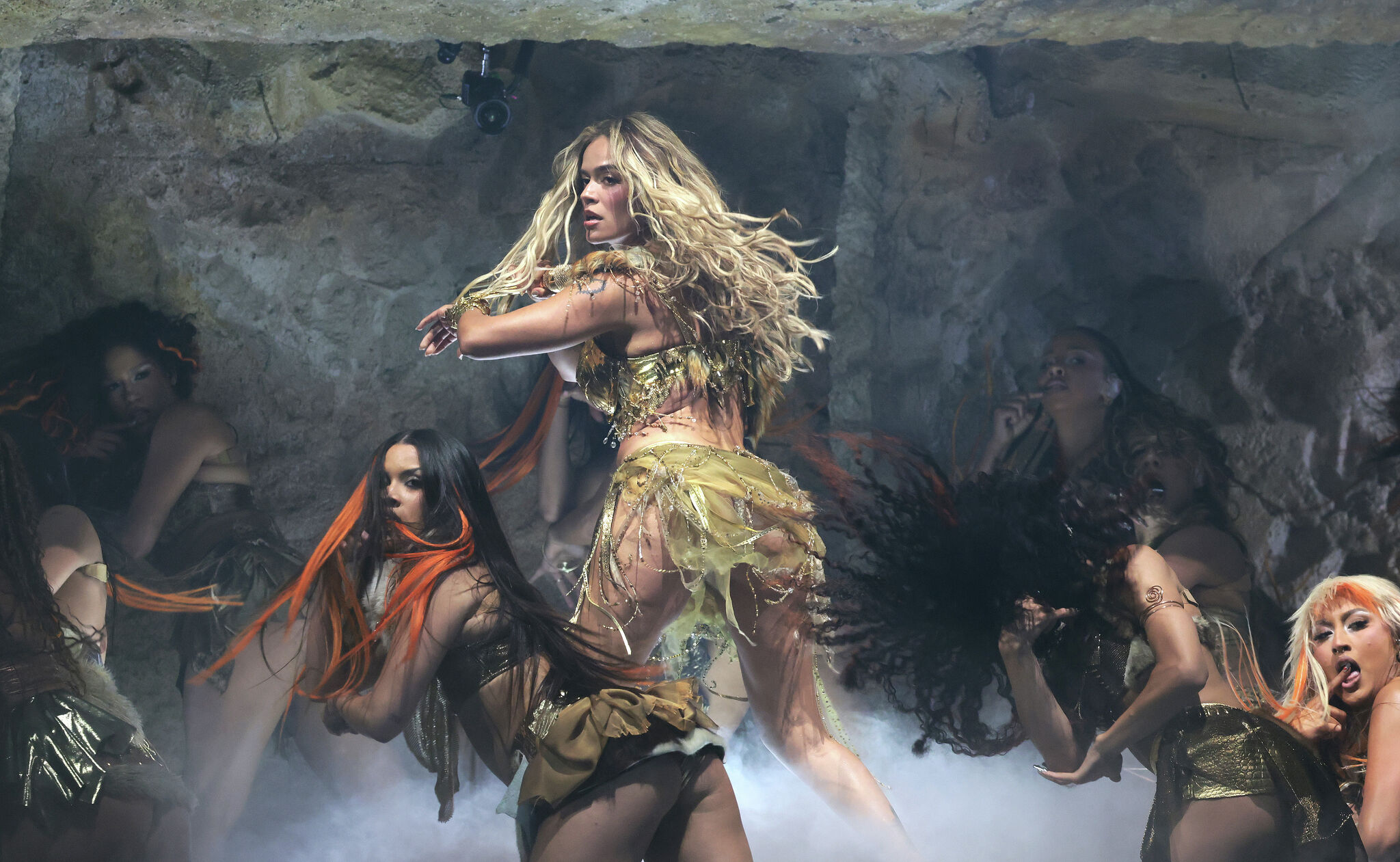
INDIO, California – Karol G became the first Latina artist to headline the Coachella Valley Music and Arts Festival on Sunday night.
The performance marks a significant shift in the festival’s programming history regarding Latin music representation. Giraldo’s appearance reflects the expanding commercial reach of genres such as reggaeton, mariachi, and merengue within the global festival circuit, while also highlighting the regulatory pressures associated with international artist visas.
Production and Logistics
The Sunday set, closing out the festival’s final night, faced initial technical delays, with crew members visible on stage and the use of ladders during the lead-up to the performance. The show commenced approximately 30 minutes after the scheduled start time, an unusually visible hiccup for Coachella’s tightly managed main stage.
Giraldo opened the set with the song “LATINA FOREVA,” performing within a stage production designed as a massive cave with various alcoves, framing her as the focal point of an underground, almost mythic landscape. The production later featured an extended dance routine in a shallow pool, using water, lighting, and camera angles to turn the main stage into a reflective surface for both choreography and crowd shots.
The performance consisted of a 25-song set that moved rapidly through her catalogue while nodding to earlier eras of Latin pop. Technical disruptions occurred between several acts, during which the stage and screens went black, temporarily halting the momentum of the show and prompting chants from the crowd before the system was restored.
Collaborations and Genre Integration
The set integrated various Latin styles and featured several guest performers, underscoring how far Spanish-language music has moved from Coachella’s margins to its headline slot. Giraldo performed “EL MAKINÓN” with Mariah Angeliq and “MAMIII” with Becky G, treating their appearance less as surprise cameos and more as a statement on women’s authorship in contemporary reggaeton.
The production included an all-female mariachi troupe that performed two standards of the genre during a costume change, briefly turning the main stage into a traditional plaza setting before the show pivoted back to club-ready reggaeton. Additionally, Puerto Rican reggaeton artist Wisin appeared as a guest, performing several classic tracks, including “Rakata,” linking Karol G’s headlining moment to an earlier generation that helped globalize the genre without ever commanding this type of U.S. festival billing.
The performance concluded in accordance with the city of Indio’s mandated midnight curfew, a fixture of Coachella’s operating agreement with local authorities that leaves little flexibility for overrun even on history-making nights.
Regulatory Constraints and Cultural Themes
Giraldo used the platform to address the historical lack of representation for Latino artists in headlining positions, pointing out that she was benefiting from groundwork laid by artists who were never offered the same marquee slot.
“I’m very happy and very proud about this, but at the same time, it feels late,”
she told the crowd, stating that her position was made possible by the Latino artists who preceded her but were not granted similar opportunities.
The set included a cover of Gloria Estefan’s “Mi Tierra,” a song about exile, belonging, and the pull of home. This selection coincided with reports that Giraldo had been warned against speaking out against U.S. Immigration and Customs Enforcement (ICE) to avoid risking her visa status under the framework of the U.S. temporary “O” and “P” performance visas that govern most high-profile international tours. Giraldo did not explicitly name the agency but made an oblique reference to fellow Latinos “struggling in this country lately,” subtly tying a celebratory festival set to the more precarious legal realities facing many in her audience.
From the stage, she encouraged attendees to display their national flags, wearing the yellow, blue, and red colors of Colombia on her sleeves and amplifying a sea of flags from across Latin America and the diaspora. She told the audience, “Please don’t feel scared, feel proud,” and added, “Raise your flag,” turning a headline performance into a live referendum on visibility and belonging at one of the world’s most influential music festivals.
The performance concluded upon the expiration of the city’s curfew, with festival organizers cutting sound and lights on schedule even as the crowd continued to chant her name-a reminder that even a barrier-breaking cultural moment is ultimately constrained by municipal rules and the risk calculations that shape who gets invited back.
Worth a look
- Interactive Storytelling and Immersive Audio: How Next-Gen Gaming Engines Are Transforming Contemporary Television Production
- Independent Cinema’s New Distribution Paradigms: How Direct-to-Consumer Micro-Premiers Are Shifting Box Office Dynamics
- Why Cold Weather Makes You Sleepy, and Why It's Really the Dark (daybreakwire.com)
