
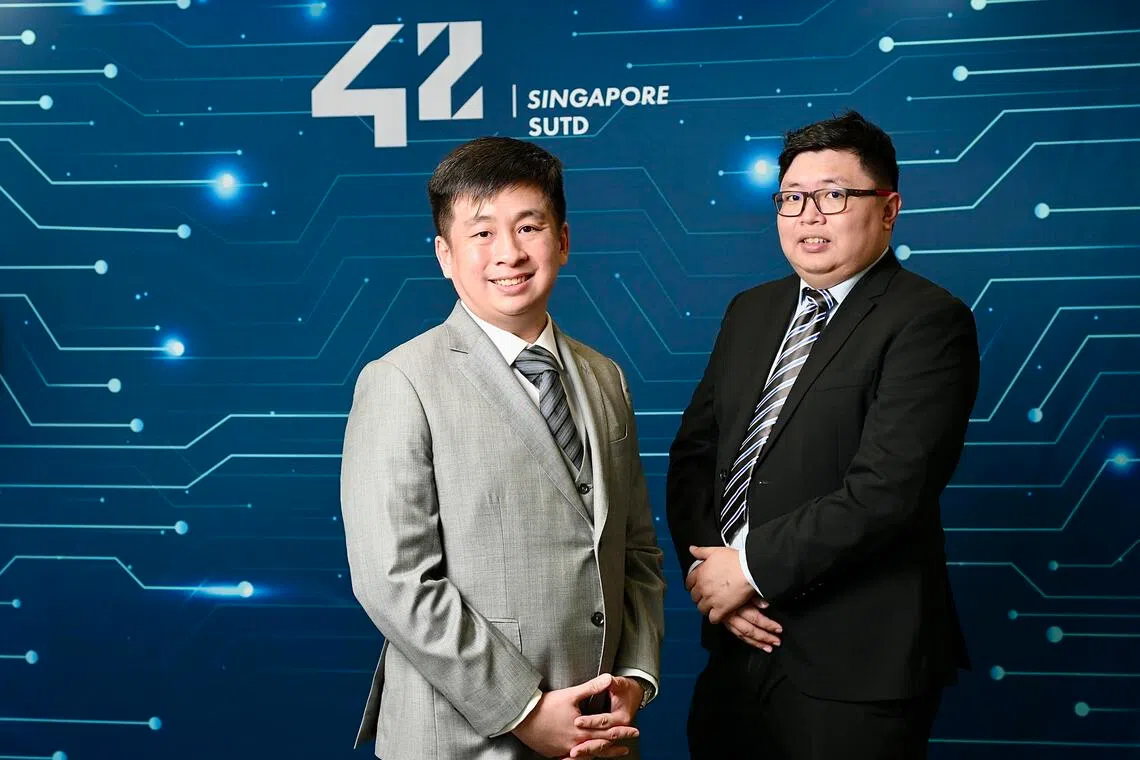
SINGAPORE – Two Singaporeans have reached the top certification tiers of 42 Singapore (42 SG), the tuition‑free coding school housed at the Singapore University of Technology and Design (SUTD), marking a milestone for the young programme known for its rigour and high attrition.
Mr Brian Young, 36, was awarded the RNCP Level 7 certificate in October, a French qualification registered on the country’s national vocational framework and widely regarded as equivalent to a master’s degree in the European Qualifications System. The RNCP – France’s national directory for professional certifications – is overseen by the government’s employment and training authorities, giving 42’s top‑level awards formal recognition in Europe under public standards for skills and employability. Mr Jeffrey Goh, 35, completed 17 levels in July to earn RNCP Level 6, equivalent to a bachelor’s degree, and is on track to finish all 21 levels by August 2026.
Their ascent underscores how difficult 42 SG’s pathway can be. Of the 320 students in the first two cohorts at SUTD, just 40 have graduated after completing nine levels, and about 100 from the first cohort in 2023 have quit.
Two paths to the top
For Mr Young, the journey began more than a decade ago. He was the first Singaporean to enrol at Ecole 42 in Paris in 2014, after leaving a computer science degree at the National University of Singapore six months in. Despite failing 15 projects, he completed all 21 levels of the Paris curriculum in four years – a feat achieved by fewer than 2 per cent of Ecole 42 students worldwide.
Mr Young returned to the 42 network through SUTD in 2024 to complete requirements for RNCP Level 7. From May to August 2024, he spent weekends and some weeknights on campus working through projects to secure the credential. “It was a way to close the chapter properly and honour the many people who helped me along the way. It’s a personal milestone rather than a career move,” said Mr Young.
A lifelong learner, he also obtained a Master of Science in cybersecurity management from the University of Warwick at the Singapore Institute of Management in 2023. He described the two credentials as complementary: the 42 curriculum trained him to build systems from the ground up, while postgraduate studies sharpened how such systems can be managed. “Both the experiences strengthen each other and have shaped how I approach my work today,” he said. Mr Young now works as a cybersecurity engineer at the Defence Science and Technology Agency, a statutory board under Singapore’s Ministry of Defence that supports the country’s defence technology ecosystem.
Mr Goh’s rise was rapid. Part of the first intake of 190 students at 42 SG, he completed the first nine levels out of 21 in just 10 months, placing him among the top 50 students worldwide to reach that stage in under a year. In July 2024, he was also among the fastest students globally to complete the programme’s common core, which is equivalent to a diploma certification.
Balancing a full‑time job with the course required strict discipline. Mr Goh said he often studied two to four hours each evening after work, making personal sacrifices. He is an internet‑of‑things engineer at a start‑up developing water monitoring systems. “There are many instances that people fail for various kinds of mistakes. But at 42, you are allowed to try again as many times as you need to pass,” he said.
A different kind of school
Launched in September 2023 and modelled after Ecole 42 in Paris, 42 SG offers a free, open‑access route into software training for anyone aged 18 and above. The model is intentionally non‑traditional: there are no teachers, no structured lessons and no academic prerequisites. Learning is peer‑driven, fully hands‑on and project‑based in a gamified environment.
Admission starts with a two‑hour memory and logic test that requires no coding knowledge. Those who clear it proceed to “The Piscine” – an intensive second test designed to assess persistence and problem‑solving.
The school’s approach dovetails with Singapore’s national skills strategy, in which the government has pushed adult learners and employers towards modular, stackable credentials through initiatives such as the SkillsFuture movement and the continuing education mandate in the SkillsFuture Singapore Act. Within that ecosystem, 42 SG functions as a niche pathway for self‑directed learners who may not fit conventional admissions profiles yet can thrive in demanding technical roles.
Mr Koh Chye Soon, head of 42 SG, said the programme is not meant to replace traditional universities but to support Singapore’s broader push towards lifelong learning. Framing it as a free and flexible model in which students can leave as soon as they meet their personal goals – often employment – he added that the school is deliberately searching for unconventional candidates. “We are looking for outliers. These are like the gems, the diamonds in carbon form, who have not found success or their footing yet.
“On a day-to-day basis, this programme grinds, shapes and sharpens you. Under pressure, if the carbon is indeed a diamond, you will be shaped beautifully.”
Who signs up
42 SG’s student profile skews older and more credentialed than typical undergraduate programmes. According to the school:
- Nearly half of students already hold a degree, and another 14 per cent have postgraduate certificates.
- About 20 per cent are over 40, with an average age around 30 – older than the global average of 25 across the Ecole 42 network.
- The school now runs two intakes a year, in November and in the first half of the year.
- In 2025, it enrolled 173 students across the two intakes, up from about 130 in 2024.
This mix reflects how the model is being used both by mid‑career professionals looking to pivot into technology roles and by younger learners who either did not enter university or prefer a practice‑heavy path to employment.
Why it matters
The twin milestones by Mr Young and Mr Goh offer an early proof point for Singapore’s experiment with a self‑directed, project‑based route into software careers. Their progress – one completing the highest RNCP tier and the other moving swiftly through advanced levels while working full‑time – illustrates how the 42 model can serve both mid‑career learners and those seeking alternatives to traditional academic routes.
For policymakers, the outcomes at 42 SG will feed into a broader debate over how best to build a pipeline of software and cybersecurity talent for the public sector and regulated industries. Formal recognition of 42’s curriculum through frameworks like the RNCP, alongside domestic funding and quality assurance regimes, will influence whether employers in government, critical infrastructure and finance treat such graduates on par with those from traditional universities.
What’s next
42 SG will continue running two admission rounds each year to attract a wider range of learners, including mid‑careerists and those who have struggled in conventional classrooms. The school’s leaders are also in discussions with industry partners to align project work more directly with in‑demand skills, from embedded systems and cybersecurity to data engineering, so that students can move more seamlessly into jobs or apprenticeships on completion.
Mr Goh aims to complete all 21 levels by August 2026, while the programme’s leaders push to identify more “outliers” and help them convert mastery in the lab into opportunities in the workplace. If the model continues to produce graduates who can operate at advanced levels in high‑stakes technical environments, 42 SG is likely to remain part of Singapore’s wider experiment in reshaping how talent is identified, trained and recognised.
Related reading
