
SHANGHAI –
The United States’ direct operation in Venezuela, capturing President Nicolás Maduro and his wife, Cilia Flores, has drawn a sharp rebuke from Beijing, which condemned the action as a “clear violation of international law” and demanded their immediate release. The lightning pre‑dawn raid on Jan 3 in Caracas was accompanied by airstrikes on sites in and around the capital; two days later, on Jan 5, Maduro and Flores appeared in a New York federal courtroom and pleaded not guilty to narcotics‑related charges. Washington has framed the mission as a targeted law‑enforcement action, not a broader military intervention.
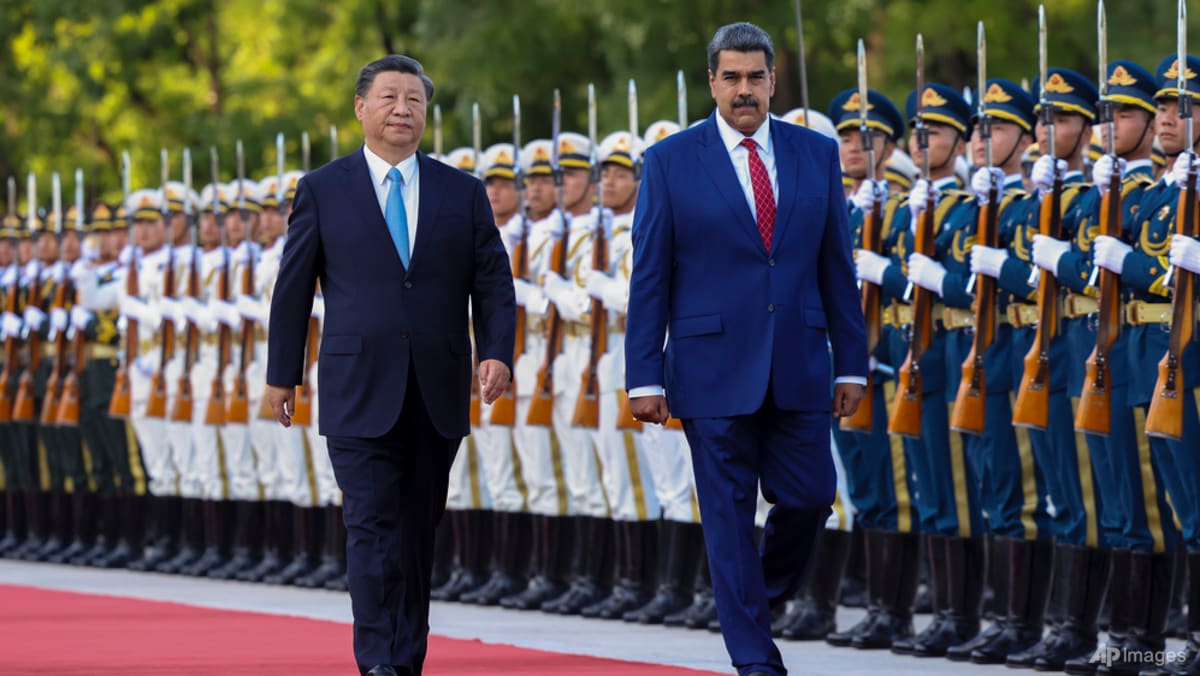
The episode-widely described at the United Nations as illegal and destabilizing-instantly became the most consequential U.S. use of force in Latin America since the 1989 removal of Panama’s Manuel Noriega. It has also pushed China, Venezuela’s biggest external creditor and a central buyer of its crude, to calibrate a response that protects its investments, upholds its sovereignty‑first diplomacy, and limits spillover across a region where Beijing has steadily expanded economic and financial ties.
China is deeply shocked by and strongly condemns the U.S.’s blatant use of force against a sovereign state and forcible seizure of its president… [a] clear violation of international law.
Beijing’s stake: energy, debt, and influence
China has poured more money into Venezuela than into any other Latin American economy during the past two decades, much of it via oil‑for‑loans arrangements that helped Caracas finance spending while committing future barrels to Chinese buyers. Research by the Center for Strategic and International Studies estimates Venezuela received more than US$62 billion in Chinese state‑to‑state finance since 2007-over half of all Chinese policy‑bank lending to Latin America in that span. New credit largely dried up after 2016 as debt restructuring took precedence and Beijing reined in sovereign lending to high‑risk borrowers.
China remains a critical offtaker of Venezuelan crude. Chinese imports of Venezuelan oil averaged roughly 470,000 barrels per day in 2025, including rebranded shipments, with some flows dedicated to debt repayment. The turbulence following Maduro’s removal has already rattled oil operators and creditors across the sector, raising questions over how existing supply contracts and repayment‑in‑kind arrangements will be honored by any successor authority in Caracas.
For Chinese regulators, counterparty risk has quickly moved from theoretical to immediate. Guidance from the National Financial Regulatory Administration has asked major lenders to disclose their Venezuela exposure and tighten monitoring amid uncertainty over contracts and repayment streams-an early test of Beijing’s broader effort to impose more disciplined risk management on its overseas financial system.
From Chávez‑era oil‑for‑loans to today’s constrained finance
The architecture of China-Venezuela ties was built under Hugo Chávez, who inked large credit lines and joint ventures tied to Orinoco Belt development and pledged dramatic increases in shipments to China. By 2010, Caracas announced a US$20 billion loan from Beijing and deeper upstream cooperation; in 2007, Chávez had said Venezuela aimed to supply up to one million barrels per day to China in the coming years. Those ambitions collided with a historic production collapse, U.S. sanctions, and chronic under‑investment, curbing the feasibility of volumes pledged under earlier frameworks and leaving Beijing holding sizable but politically sensitive claims.
Across Latin America more broadly, Chinese policy‑bank lending has fallen sharply since the mid‑2010s as Beijing shifted from sovereign loans toward selective corporate investment and project finance. In 2023, for example, the Inter‑American Dialogue/Boston University database tracked just two policy‑bank loans in the region, both to Brazil. That retrenchment leaves China with significant legacy exposure in Venezuela but greater latitude to manage incremental risk elsewhere, even as it tries to maintain a narrative of long‑term partnership with governments across the hemisphere.
Renminbi reach and financial linkages in the Americas
Beijing’s economic playbook in the hemisphere increasingly runs through financial plumbing as much as headline lending. Argentina has repeatedly activated and renewed a multi‑billion‑dollar currency swap line with the People’s Bank of China, using yuan to settle imports and bolster scarce reserves; Brazil, meanwhile, has established an RMB clearing bank and taken steps to expand local‑currency trade settlement with China. These arrangements illustrate how Beijing’s financial statecraft has deepened across the Southern Cone-relationships potentially stress‑tested when geopolitical crises roil the region and when governments weigh exposure to U.S. financial sanctions against tighter integration with Chinese payment and settlement systems.
A legal fight in New York, and a political fight in New York
In Manhattan, Maduro and Flores entered not‑guilty pleas to U.S. charges that include narco‑terrorism conspiracy and conspiracy to import cocaine. Maduro told the court he was “kidnapped” and described himself as a “prisoner of war,” with the defense signaling plans to assert immunity. U.S. prosecutors contend longstanding non‑recognition of Maduro as Venezuela’s legitimate head of state undercuts any status‑based immunity claim, and legal analysts note the Noriega case provides a contested but relevant precedent for trying a deposed leader captured in a U.S. operation. A subsequent status conference is set for March 17, ensuring the courtroom proceedings will continue to run in parallel with diplomatic maneuvering at the United Nations and in regional capitals.
Under U.S. law, head‑of‑state immunity is a common‑law doctrine that typically turns on the executive branch’s recognition decisions; courts generally defer to the State Department on status‑based immunity, while conduct‑based immunity is narrower and contested. Those doctrines-and their application to an unrecognized leader-are now poised for fresh scrutiny in a case that will be closely watched by foreign ministries far beyond Latin America.
At the U.N., a sovereignty clash with global echoes
An emergency meeting of the Security Council convened after the raid featured broad criticism of the U.S. action, including from close American partners, with multiple delegations citing U.N. Charter Article 2(4)‘s prohibition on the use of force against the territorial integrity or political independence of any state. The U.S. mission argued the operation was a surgical law‑enforcement action grounded in criminal indictments, not an act of war. With Washington holding a veto, any Council resolution or formal statement remains uncertain; China has urged the Council to “play its due role,” called for Maduro’s release, and warned of a dangerous precedent for Latin America and the Caribbean if armed cross‑border seizures of leaders are effectively tolerated.
Regional blowback and immediate security concerns
Across Latin America, the reaction has skewed toward condemnation. Brazil, Spain, Chile, Colombia, Mexico, and Uruguay issued a joint communiqué rejecting “unilateral military actions” in Venezuela as contrary to international law and a threat to regional stability. Mexico’s government accused Washington of undermining democracy in the hemisphere, even as it tightens bilateral security cooperation. Regional militaries from Colombia to the Caribbean have moved to manage potential spillover, from border deployments to crowd‑control measures, while interior and migration ministries prepare for possible refugee flows and disruptions to cross‑border commerce.
What Beijing is watching next
For Chinese policymakers, three immediate variables stand out:
- Energy continuity: whether Venezuela’s export logistics, joint ventures, and debt‑for‑oil shipments to Chinese buyers can proceed without major disruption as the political situation evolves and as any interim authorities seek to renegotiate commercial terms.
- Creditor exposure: how Chinese policy banks and state‑owned firms secure outstanding claims and project stakes amid legal and contractual uncertainty, including the prospect of competing claims from different Venezuelan political factions.
- Norms and precedent: whether the U.N. response-and reactions in Latin America-harden opposition to extra‑territorial captures, a core Chinese diplomatic concern with implications well beyond Venezuela, from sanctions enforcement to future debates over cross‑border arrests.
As of Jan 6, 2026, Maduro and Flores remain in U.S. federal custody following their Jan 5 arraignments in Manhattan; the next court date is scheduled for March 17, and the U.N. Security Council remains seized of the matter as Beijing and Washington test how far they are prepared to push their competing visions of sovereignty, security, and international law.
Related reading
- Global Food Security Alliances: How Climate-Resilient Agricultural Corridors Are Stabilizing Wheat and Rice Supplies
- Cross-Border Renewable Energy Grids: North Sea and Mediterranean Subsea Cable Networks Enter Phase Two
- Services Supplied About Two-Thirds of China's 4.6% Nine-Month Growth (daybreakwire.com)
