
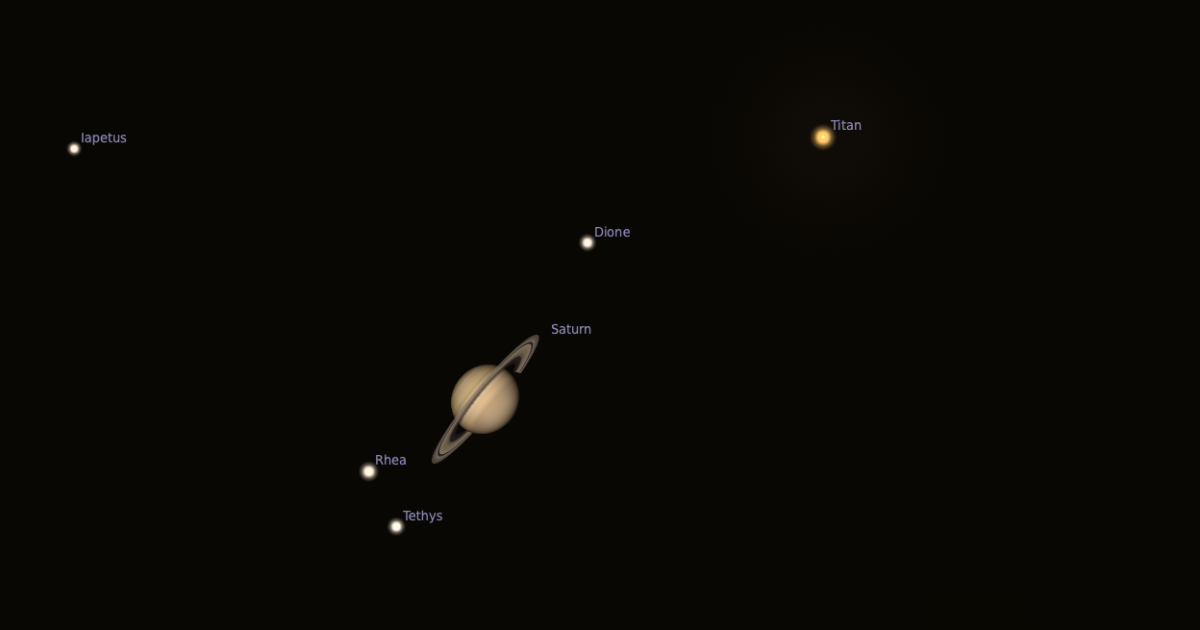
This chart shows the orientation of Saturn’s brighter moons early on Thursday, June 25. Only moons brighter than magnitude 11.5 are shown. North is to the upper left, east is to the lower right. Credit: Stellarium/Oleg Pluton
The precision required to isolate celestial bodies at the edge of amateur visibility highlights the ongoing evolution of optical engineering and planetary tracking. On June 25, 2026, the moon Iapetus-characterized by its stark, two-toned surface and long known to planetary scientists as one of Saturn’s most puzzling satellites-reaches a position 1.9’ due north of Saturn, providing a critical window for observers to test the resolution and light-gathering capabilities of their equipment.
Detecting Iapetus requires overcoming the extreme contrast between the planet’s brilliant ring system and the moon’s relatively dim 11th-magnitude glow. This observation window coincides with Iapetus moving toward its western elongation, a phase where its brightness increases, making it more accessible to high-aperture telescopes and to advanced backyard observatories that now operate under the same basic technical principles used by professional facilities.
Optical Precision and Target Coordinates
Successful observation depends on the telescope’s ability to resolve fine angular distances and to hold those targets steadily in frame. Saturn itself presents an angular size of 17”, while its ring system extends nearly 40”. Distinguishing Iapetus from the planetary glare requires stable atmospheric conditions and precise equatorial tracking to maintain a lock on the target, particularly for stacked or long-exposure imaging runs.
For observers planning sessions, the following spatial data defines the current celestial arrangement relative to Saturn’s disk:
| Celestial Body | Apparent Magnitude | Position Relative to Saturn |
|---|---|---|
| Iapetus | 11th | 1.9′ North |
| Titan | ~8.4 | 1.7′ West |
| Dione | 10th | West |
| Rhea | 10th | East |
| Tethys | 10th | East |
This compact configuration allows observers to verify their pointing and focus against the brighter moons-particularly Titan-before pushing their systems to capture the fainter Iapetus just north of the planet.
Sensor Sensitivity and Albedo Variations
The “two-toned” nature of Iapetus is a result of extreme albedo variance-the measure of how much light a surface reflects. One hemisphere is covered in dark, organic-rich material, while the other is bright ice. Capturing this distinction via digital imaging requires sensors with a high dynamic range to avoid saturating the pixels on the bright side while still registering the dim, dark side, a balancing act familiar to any observatory that must protect detectors from overexposure when operating near bright planetary targets.
Modern imaging standards for astronomical sensors focus on reducing read noise and increasing quantum efficiency. In parallel, national and international technical frameworks such as the measurement science standards maintained by NIST help ensure that detectors used in both public research facilities and commercial instruments perform in predictable and verifiable ways. For observers, the challenge is translating those standards into practice by utilizing a setup that can handle the 11th-magnitude signal of Iapetus against the backdrop of Saturn’s high-luminosity rings.
Observation Infrastructure Requirements
To capture this event, observers must align their hardware with specific temporal and spatial constraints. The most effective window opens approximately two hours before sunrise, once Saturn achieves an altitude of 20° in the eastern sky. This minimizes the amount of atmosphere the light must penetrate, reducing “seeing” distortions caused by atmospheric turbulence and bringing amateur practice closer to the site-selection criteria used for professional observatories.
Hardware specifications for this level of observation generally include:
- Aperture: Medium to large aperture telescopes to gather sufficient photons from 11th-magnitude sources, with careful collimation to preserve contrast.
- Mounting: Computerized GoTo mounts to accurately locate coordinates within arcminutes of accuracy, reducing setup time and increasing the number of viable imaging attempts during the pre-dawn window.
- Optical Coatings: Anti-reflective coatings to minimize internal glare from Saturn’s rings and enhance contrast around the planet’s limb.
- Tracking: Sidereal tracking to compensate for Earth’s rotation during long-exposure sensor integration or high-frame-rate video capture for later stacking.
The alignment of Iapetus will persist for two to three days, allowing for repeated attempts to calibrate equipment and verify the moon’s position. For educators, outreach programs and citizen-science projects, that extended window offers a rare, time-bound opportunity to demonstrate how precision standards, regulatory measurement frameworks and front-line observational practice intersect-showing how the same underlying rules that govern professional planetary missions quietly shape what determined amateurs can see from their own backyards.
Worth a look
