
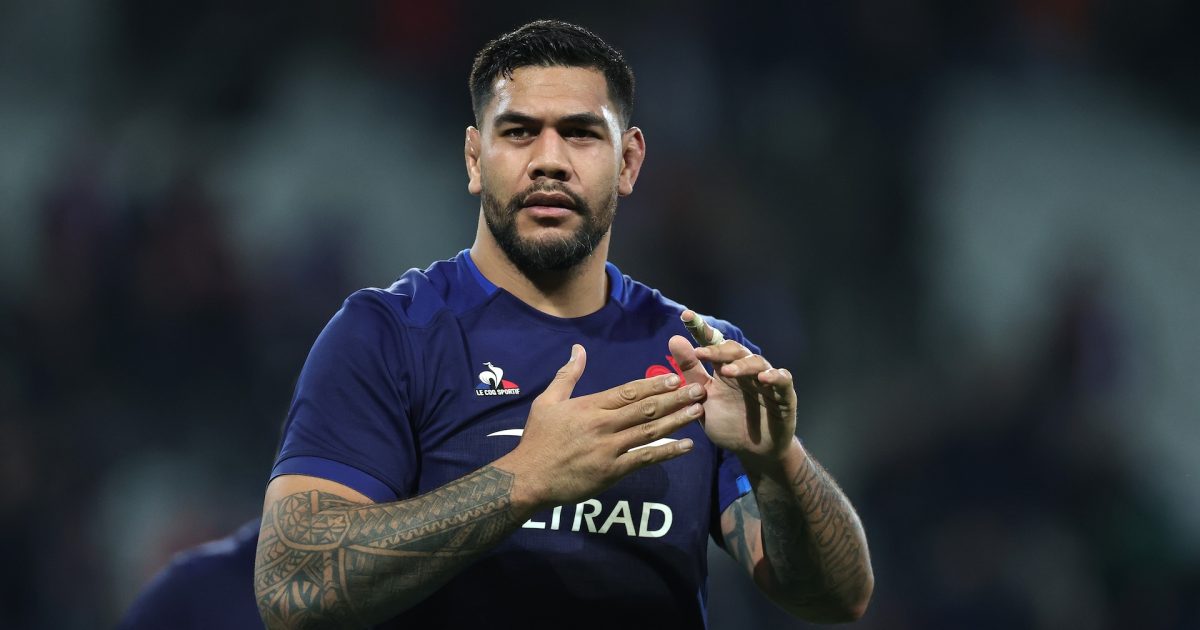
Romain Taofifenua is set to extend his stay at Racing 92 with the experienced second row expected to sign a new two-year deal through to 2028 – RugbyPass understands. The 35-year-old has won 59 caps for France and was coming to the end of his current contract this summer. The extension will see the 6’8, 138kg lock remain in the Hauts-de-Seine until the ripe old age of 37 years and nine months old. Taofifenua joined Racing in 2024 from Lyon and has been a regular presence in the engine room since his arrival. He scored four tries in his first season with the Parisian club and has added three more by the midway point of the current campaign, underlining his ongoing value despite his age profile. He retired from international rugby after the 2023 World Cup in France. The move represents a boost for Racing’s forward planning, with fellow international lock Will Rowlands currently out of contract.
Racing’s bet on veteran power is a data decision
At a time when French professional rugby operates under strict squad-size and salary-cap rules agreed with the Ligue Nationale de Rugby, a multi-year commitment to a veteran lock is rarely sentimental. Elite clubs increasingly use integrated performance stacks-tracking, video analytics, and medical decision support-to evaluate forwards whose value is expressed in repeatable, high-impact actions: scrum stability, maul momentum, ruck efficiency, defensive repeat efforts, and close-range carries. Extending a late-prime lock fits a model in which durable set-piece specialists are retained when objective workload and force metrics remain within safe, high-output ranges, allowing sporting directors to treat contract decisions as risk-managed capital allocation rather than gut feel. In that context, Taofifenua’s extension reads as a calculated move to lock in a proven set-piece asset while preserving flexibility elsewhere in the roster.
| Marker | Detail |
|---|---|
| Height / Mass | 6’8 (203cm) / 138kg |
| Club entry | 2024 |
| Contract horizon | Through 2028 |
| Age at contract end | 37 years, 9 months |
| Tries (first season) | 4 |
| Tries (mid-current campaign) | 3 |
Wearables, force diagnostics, and automated workload planning
Keeping a 138kg lock match-fit across domestic and European calendars is a sensor and scheduling challenge. Clubs blend GNSS/LPS trackers, force diagnostics, and machine-assisted planning to manage cumulative load and collision exposure while demonstrating compliance with competition medical and player-welfare standards that are increasingly codified in league regulations and collective bargaining frameworks. For Racing, these systems are not add-ons but the operational layer that makes a long-term commitment to an older forward defensible to medical staff, sporting leadership, and club governance.
- On-body trackers quantify high-intensity efforts, accelerations, decelerations, and contact load to flag overreach risk in real time and to evidence duty of care to league and union authorities when training volumes are questioned.
- Force-plate and isokinetic testing benchmark neuromuscular readiness, guiding micro-cycle adjustments after heavy set-piece sessions and informing selection calls when staff must balance short-term results against long-term availability.
- Video analysis with pose estimation grades scrum binds, entry angles, and lift timing, converting technique into measurable KPIs that can be tied directly to individual performance bonuses and contract options.
- Automated practice planning tools generate position-specific minutes, contact caps, and recovery blocks to align with medical constraints and with internal governance policies on rest, mandated days off, and youth-player integration. That alignment increasingly features in board-level discussions around risk, insurance, and reputational exposure.
Head-impact monitoring and duty-of-care obligations
For tight-five forwards repeatedly exposed to sub-concussive contacts, contract extensions now sit inside a wider framework of medical governance. Head Injury Assessment workflows, independent match-day medical oversight, and progressively adopted instrumented mouthguards are reshaping return-to-play decisions, with clubs expected to show that technology is reinforcing-not replacing-clinical judgement. Any club-scale data program handling head-impact metrics or wellness records must meet stringent privacy requirements because health and biometric data are treated as sensitive under national and European data-protection law, and compliance is scrutinised not only by medical regulators but also by club boards and insurers.
- Clinical pathway alignment with the Head Injury Assessment protocol, including conservative stand-down triggers and documented medical clearance, is now a baseline expectation for licensing and competition eligibility and feeds directly into how long clubs are prepared to commit to collision-heavy positions.
- Data governance: explicit consent, purpose limitation, minimal retention, and strict access controls for medical performance datasets are required to stay within frameworks such as the EU General Data Protection Regulation when handling cross-border squads and competitions.
- Auditability: immutable logs for who accessed which records and why, plus encryption in transit and at rest for athlete data lakes, protect clubs against litigation risk and regulatory scrutiny if welfare decisions are later challenged.
Arena and broadcast tech shape the forward’s role
Racing’s indoor home environment stabilizes variables that shape set-piece tactics-surface consistency, wind, and moisture-while dense connectivity enables multi-angle review for coaches and officials. Because decisions affecting scrums, mauls, and dangerous clear-outs are increasingly made via remote review, reliability engineering around these systems affects competitive outcomes and broadcast integrity as much as it does fan experience. In a league where disciplinary and citing processes often rely on broadcast feeds, the technical quality of these systems forms part of the informal regulatory ecosystem shaping how forwards contest the contact area.
- High-density Wi‑Fi/5G and optical backhaul support live telemetry, edge processing for vision models, and rapid content syndication, linking what happens in the tight exchanges to real-time analysis on touchlines and in television trucks.
- Referee and TMO review pipelines depend on synchronized, high-frame-rate camera arrays; latency budgets are engineered to sub-second thresholds so that foul play around rucks and mauls can be sanctioned without unduly disrupting the spectacle.
- In-venue LED and IPTV layers draw from the same data backbone, allowing dynamic visualizations of scrums, mauls, and lineout maps that help explain selection and substitution decisions to increasingly data-literate supporters and, indirectly, to club stakeholders tracking whether on-field tactics match stated strategic plans.
Roster calculus: cap discipline, succession, and the Rowlands variable
Extending a proven starter creates optionality: build continuity around a known set-piece anchor or allocate budget to complementary profiles. With Will Rowlands out of contract, Racing’s engine room planning becomes a live exercise in systems design and risk balancing, conducted under the financial and regulatory guardrails that govern French professional rugby. Decisions on whether to pair two senior internationals or pivot to a succession model with a younger lock feed into compliance with squad-cost regulations and internal mandates on homegrown development.
- Continuity path: retain senior locks to stabilize lineout calls and scrum pairings; invest marginal spend in hooker depth and jumpers to spread aerial risk across the pack.
- Transition path: recruit a younger aerial specialist, leveraging veteran mentorship while tapering minutes via workload models that preserve Taofifenua for knockout fixtures and manage cumulative contact for both players.
- Budget symmetry: balance heavy forward cap share with academy promotion in the back five of the scrum to maintain multi-season flexibility, satisfy homegrown-player quotas, and demonstrate sustainable squad building to club governance boards.
Strategic takeaway for Racing 92’s pack
For Racing, this extension is more than a reward for service; it signals confidence in measurable durability and impact for a late-prime second row at a time when welfare rules and economic constraints are tightening. With analytics hardwired into training, medical, and match-review systems, the club can scale Taofifenua’s strengths while actively managing contact load and regulatory risk-turning veteran experience into a repeatable advantage at set piece, in the red zone, and across the multi-competition seasons that define modern elite rugby. In an era when club executives are judged as much on governance and risk management as on trophies, locking in a data-validated senior lock is as much a boardroom decision as it is a selection call.
Related reading
