
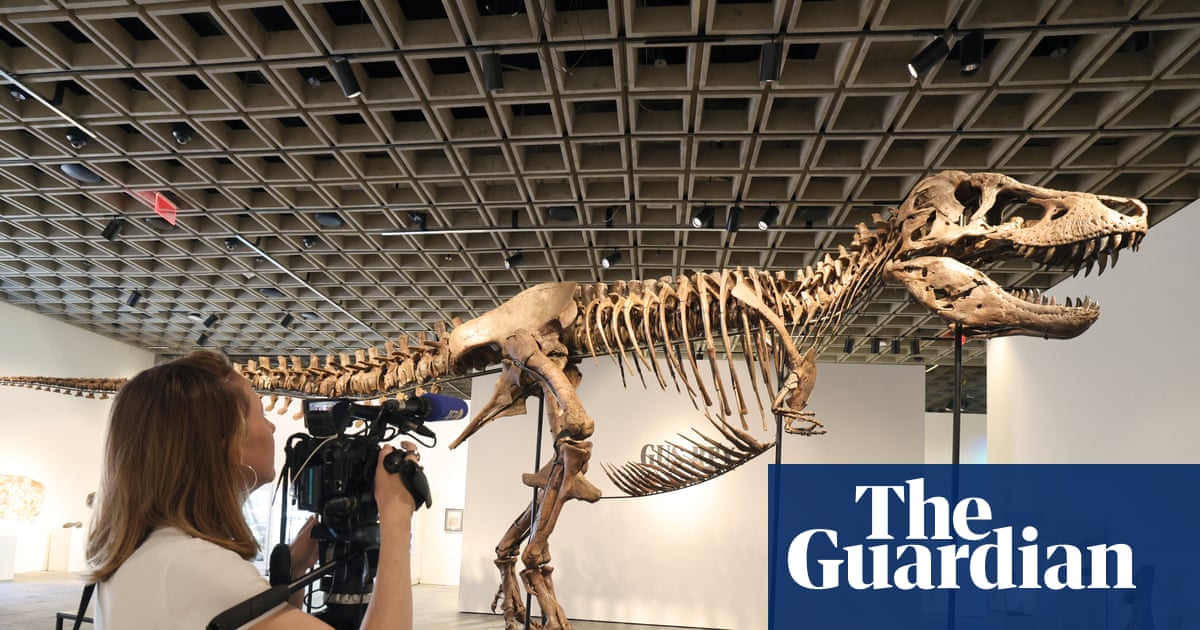
The commercialization of prehistoric biological data has reached a new zenith with the upcoming auction of “Gus,” a massive Tyrannosaurus rex skeleton. Listed by Sotheby’s in New York with an estimated valuation between $20 million and $30 million, the specimen highlights an escalating tension between the high-net-worth “passion asset” market and the fundamental requirements of scientific infrastructure.
The Commodification of Prehistoric Data
In the current luxury market, rare fossils are increasingly treated as alternative assets, similar to blue-chip art or rare gemstones. This shift transforms biological remains into commodities, often decoupling the specimen from its scientific utility and public value. The financial trajectory of these assets is steep; a stegosaurus known as Apex recently set a benchmark by selling for $44.6 million in 2024, significantly exceeding its initial listing and signaling to collectors that dinosaurs now sit firmly in the same asset class as marquee artworks.
Gus, a robust adult T rex estimated to be 67 million years old, was excavated over three years starting in 2021 from a ranch in Harding County, South Dakota. The discovery was managed by Theropoda Expeditions with the cooperation of landowner Gary “Gus” Licking, for whom the dinosaur is named. The specimen is being marketed as a once-in-a-generation opportunity for private buyers at the very moment public museums are grappling with stagnant acquisition budgets and rising conservation costs.
The physical specifications of the specimen underscore its market appeal and the scientific stakes attached to its future home:
- Height: Approximately 3.8 metres (12.5ft)
- Condition: One of the largest and most complete T rex skeletons discovered to date
- Pose: Mounted in a predatory stance with gaping jaws for display
- Origin: Harding County, South Dakota, USA
Infrastructure Risks and Scientific Reproducibility
From a technical and academic standpoint, the movement of fossils into private living rooms creates a “data blackout.” In the scientific community, a fossil is not merely an object but a primary data source embedded in a wider research infrastructure of collections, catalogues and comparative datasets. When these sources are privatized, the ability to verify findings-a cornerstone of the scientific method-is compromised.
“The current trend towards dinosaur fossils being marketed and sold like rare artworks at vast prices by auction houses is very concerning, as is the idea of buying dinosaur fossils as a status symbol or a commodity,” says Prof Richard Butler, a vertebrate palaeontologist at the University of Birmingham. “A fossil not in a recognised museum collection cannot be studied and is therefore lost to research. Fossils have been bought and sold for hundreds of years, but prices are increasingly out of the reach of museums, much to the detriment of science.”
The primary risk involves the integrity of peer-reviewed research. Many academic journals now require that any specimen described in a paper be housed in a permanent, public repository to ensure that other researchers can access the data to replicate results. The policy language is increasingly explicit: if a fossil cannot be revisited, the conclusions drawn from it may not meet modern standards of transparency and reproducibility.
“When we publish research, we need to make sure that research is repeatable, meaning that other scientists can check our data and results and verify our conclusions, or not. The only way for our research to be repeatable is if the dinosaur fossils we study are in a museum, where other scientists are guaranteed access to them,” explains Prof Stephen Brusatte of the University of Edinburgh.
Regulatory Disparities in Paleontological Governance
The legality of the Gus auction stems from the specific land-use and mineral rights laws in the United States, which often treat fossils as the property of the landowner. On private land, vertebrate fossils are generally governed by state property rules rather than federal conservation mandates, a framework that contrasts sharply with regimes in many fossil-rich countries.
In nations such as Mongolia or Brazil, fossils are classified as state property and their commercial sale is prohibited, reflecting a view of paleontological material as part of the national scientific and cultural estate rather than an extractable asset. In the United States, by comparison, statutes such as the Paleontological Resources Preservation Act focus primarily on protecting vertebrate fossils found on federal land, leaving a patchwork of rules and wide latitude for private transactions when specimens are discovered on ranches or other privately held terrain.
“As this dinosaur was found in the USA, and in America you can do what you want with what you find on your land, the auction looks to be legal. But as a scientist it still concerns me,” says Prof Brusatte. “If a dinosaur like this fetches tens of millions of dollars at auction, then there’s little that scientists or museums or universities can do. Those prices can only be paid by the super-rich.”
The divide between private ownership and public trust is detailed in the following comparison of curation models:
| Feature | Private Collection | Public Trust / Museum |
|---|---|---|
| Accessibility | Discretionary; subject to owner’s whim | Open to qualified researchers and, typically, the public |
| Longevity | Risk of dispersal via estate sales/auctions | Permanent curation and conservation under institutional mandates |
| Verification | Difficult to replicate scientific studies | Standard for peer-reviewed reproducibility |
| Governance | Private property laws and individual preference | Institutional policies, ethical codes and, in some cases, state oversight |
The Conflict of Stewardship
While some argue that private funding accelerates the discovery of fossils that might otherwise remain buried, critics suggest this is a flawed pipeline that externalizes public costs and internalizes private rewards. Fossils are often located and excavated by commercial teams, then introduced into an auction ecosystem where museums must compete with billionaires and corporate buyers.
Dr Thomas Carr, a vertebrate palaeontologist at Carthage College, argues that the temporary nature of private loans is insufficient for rigorous science. “A private collection has no guarantee that a fossil will stay in a collection for all time, whereas a public trust’s mission is to maintain, conserve and curate its collection indefinitely,” says Dr Carr. “Fossils need to be available to test previous observations and to make new insights; the fossils are the data so they must always be available for study.”
Regarding the practice of loaning private fossils to museums, Dr Carr adds: “The problem is that a privately owned fossil can be recalled from a museum at any moment back into an owner’s home, so the principles of availability and replicability are not guaranteed.” In effect, the scientific record becomes dependent on the continued goodwill of individual owners whose priorities may shift with market cycles, inheritance disputes or changes in taste.
There are rare instances where private ownership facilitates public access. Michael Benton, a professor of vertebrate palaeontology at the University of Bristol, notes: “Occasionally things can work well when the purchaser realises they can get even more pleasure from their purchase by sharing it with a wide community, for example through loaning or donating it to a museum or helping to finance a touring exhibition.” Such arrangements, however, remain voluntary and fragile, rather than embedded in a stable governance model.
Ultimately, the fate of Gus reflects a broader debate over the ownership of natural history and the responsibilities that come with it. For scientists, the goal is the total forfeiture of private ownership in favor of public access, or at minimum a legal framework that treats scientifically important fossils as part of a shared knowledge commons. “A fossil in a public trust is a win for science and society all around,” says Dr Carr, “rather than being hoarded in some McBillionaire’s living room.”
Sotheby’s maintains that the commercial drive of private firms is essential for recovery efforts, asserting that the high market price reflects both the rarity of the specimen and the technical labor required for its excavation. As Gus heads to the block, the sale will test not only how much a single dinosaur is worth to the world’s wealthiest buyers, but also whether public institutions and policymakers are prepared to treat the deep past as a regulated resource rather than a luxury collectible.
Worth a look
