
Radiation Hardening and the Space-Proven DSLR
Capturing high-resolution imagery in the vacuum of space requires more than just professional-grade optics; it requires hardware capable of surviving the bombardment of ionizing radiation. For the Artemis II lunar flyby, NASA relied on a mix of legacy reliability and modern mirrorless capabilities to document the journey, balancing crew safety requirements, mission risk constraints, and the agency’s obligation to create a durable public record of taxpayer-funded exploration.
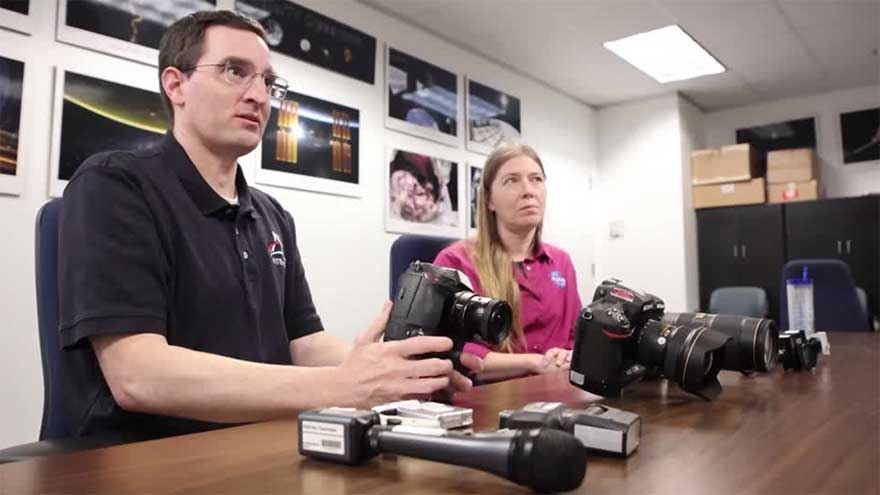
The Nikon D5 served as the primary workhorse for the mission. While a DSLR from 2016, its selection was based on its established track record aboard the International Space Station (ISS), where it demonstrated an ability to maintain operational integrity despite prolonged exposure to cosmic rays and solar particles.
“We had a lot of flight experience with it,” said Paul Reichert. “We knew it could handle radiation, at least several years of radiation dosage on the ISS, and it didn’t have any problems with it.” That flight heritage, combined with NASA’s internal safety and certification process for crewed missions, made the D5 a low-risk choice when program managers weighed reliability against the allure of newer, less proven systems.
Beyond radiation shielding, the D5’s sensor architecture is optimized for the extreme contrast of the lunar environment, where the “inky blackness” of space meets the blinding reflectivity of the lunar surface. This necessitates exceptional low-light performance and dynamic range to prevent image clipping. For mission planners, that image quality is not just aesthetic; it underpins engineering analysis, supports scientific interpretation, and feeds directly into how elected officials and the wider public will eventually see and judge the success of Artemis II.
The Hardware Suite and Optical Configurations
The crew’s imaging kit was designed to cover a spectrum of perspectives, from wide-angle vistas of the Earth and Moon to tight, detailed shots of spacecraft components. This required a strategic combination of focal lengths and sensor types, with each camera and lens pair mapped to specific mission phases and contingency scenarios.
| Equipment | Type | Primary Utility |
|---|---|---|
| Nikon D5 | DSLR | Radiation-resistant workhorse / Low-light performance / Certified, space-proven platform |
| Nikon Z9 | Mirrorless | High-speed capture and modern sensor resolution for fast-evolving spacecraft maneuvers |
| 14-24mm Lens | Wide-Angle | Panoramic space vistas, Earthrise sequences, and interior cabin shots for public outreach |
| 35mm Lens | Standard/Prime | General purpose documentation, crew activities, and experiment monitoring |
| 80-400mm Lens | Telephoto | Long-distance lunar surface and Earth detail, plus inspection of exterior hardware |
| iPhone 17 Pro Max | Smartphone | Rapid, handheld point-and-shoot capture for informal, documentary-style storytelling |
| GoPro | Action Cam | Real-time livestreaming to Earth and fixed-perspective views during critical burns |
Behind that simple equipment list sits a complex approval chain: every camera, lens, and mount must clear NASA’s human-rating and payload safety reviews, processes rooted in the agency’s charter under the U.S. National Aeronautics and Space Act that governs how federal spaceflight programs manage risk and accountability. The result is a hybrid kit that feels familiar to professional photographers but is configured to meet the redundancy and failure-tolerance standards of a crewed lunar mission.
Bandwidth Constraints and Data Telemetry
The integration of consumer electronics, specifically the iPhone 17 Pro Max, introduced a significant engineering paradox: the ability to capture massive amounts of data versus the ability to transmit it. Unlike terrestrial 5G networks, deep space communication relies on NASA’s Deep Space Network, which manages limited bandwidth over millions of miles for all U.S. robotic and human exploration assets.
Katrina Willoughby noted that the smartphones were late additions to the mission’s equipment manifest. While their ease of use is an asset, the resulting file sizes create a bottleneck in the telemetry pipeline.
“One thing we do have to think about onboard is what does it take to get files down?” Willoughby said. “And unfortunately, we don’t have bandwidth. And that’s something a lot of people down here are really used to instantly having.”
This data friction requires astronauts to be selective about which images are prioritized for transmission, highlighting the gap between modern CMOS sensor capabilities and the physics of long-range radio frequency (RF) transmission. On the ground, that same constraint forces NASA communications teams and mission managers to make editorial-style choices in real time: which images best capture the mission for the public record, and which must wait on onboard storage until the spacecraft is safely home.
The Shift to Digital Immediacy
The Artemis II mission represents a fundamental leap in documentation compared to the Apollo era. Where previous crews relied on chemical film that had to be physically returned to Earth for processing, today’s astronauts operate in a digital-first environment with instantaneous feedback loops between the capsule and mission control.
The use of GoPros for livestreaming provided a real-time window into the mission, transforming the nature of space exploration from a delayed archival record into a live global event. This immediacy created a high-pressure, high-reward atmosphere for the ground teams in Houston, who were not only monitoring spacecraft health but also curating a stream of imagery that would shape congressional oversight hearings, international partnerships, and public support for later Artemis flights.
“And the excitement in the back rooms and the front rooms as the images were being seen and being put out was pretty good. We were all very excited,” Willoughby said.
To ensure this success, the crew underwent rigorous training to master these tools in a zero-gravity context, completing roughly 20 hours of specialized photography instruction over several years to ensure that the technical execution matched the mission’s scientific objectives. That training now functions as a template for future Artemis crews and a quiet but important part of how a major federal space program documents itself-for engineers, for historians, and for the policymakers deciding what comes after Artemis II.
Keep reading
