
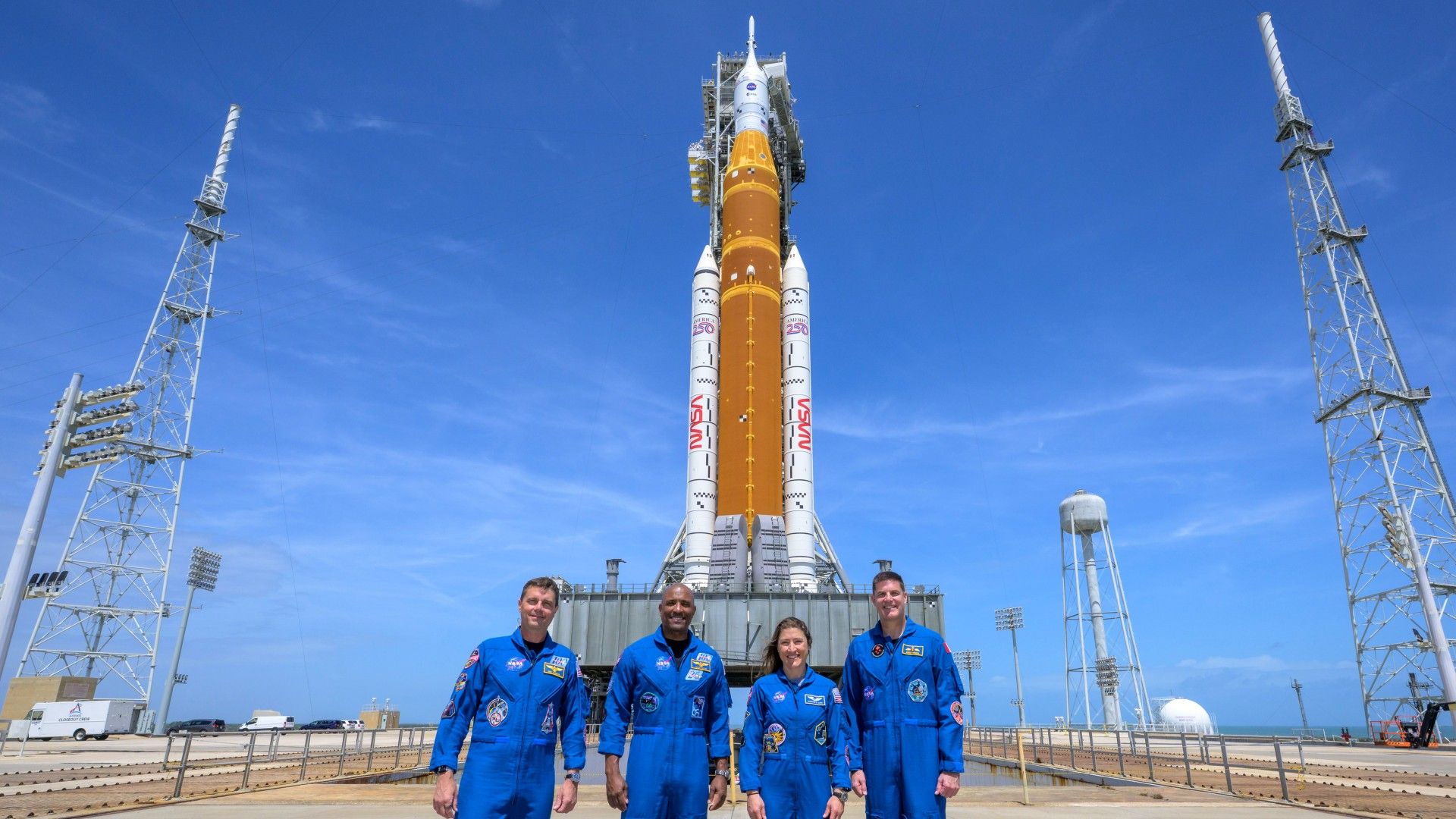
CAPE CANAVERAL, Fla. – NASA is pressing ahead with the first crewed Artemis flight to the moon on Tuesday, April 1, after a powerful solar flare and coronal mass ejection over the weekend rattled radio links across parts of Asia and Australia. Mission managers gave a formal “go” for liftoff at 6:24 p.m. EDT (2224 GMT), saying the space weather spike will subside ahead of launch and does not alter risk posture for the crewed flight test.
“We’re not expecting the CME to cause any effects,” said Amit Kshatriya, NASA’s associate administrator for the Moon to Mars Program, during a briefing at Kennedy Space Center. “We’re not tracking concerns for the mission in general.” He added: “The team concluded that everything continues to look good and there are no issues preventing us from pressing ahead at this point.”
Solar storm drama meets range rules and mission planning
The late-Sunday X1.4-class flare at 11:19 p.m. EDT on March 29 (0319 March 30 GMT) arrived with a directed CME, but current modeling points to a short-lived disturbance. NASA’s flight team cross-checks flare forecasts and radiation indices with real-time measurements before committing to crewed ascent and trans-lunar injection. The process taps federal space-weather operations and the U.S. Space Force range for constraints such as lightning, upper-level winds, and charged-particle events, under the same launch safety authority that governs other U.S. civil and commercial rockets.
Why this flare is not a launch blocker
- Event profile: X1.4-class flares are strong but typically produce transient radio blackouts and short-duration ionospheric disturbances. The CME travel time aligns with dissipation before Tuesday evening’s window, based on current space-weather models.
- Operational buffers: Crewed ascent occurs well within Earth’s magnetosphere, which shields against most solar energetic particles; high-exposure phases are monitored with onboard dosimetry and ground-based space-weather feeds.
- Decision gates: Mission Control retains authority to delay milestones such as upper-stage burns or crew activities if radiation levels breach predefined thresholds agreed with medical and flight safety boards.
- Range oversight: The 45th Weather Squadron’s lightning and electric field rules remain the primary atmospheric constraints; solar activity is tracked through U.S. government space-weather channels and can trigger a scrub if hazard criteria are met.
For situational awareness, teams watch proton flux and geomagnetic indices provided by the NOAA Space Weather Prediction Center, layering those data with spacecraft and ground-sensor measurements and the program’s internal risk models.
How Orion hardens the crew against radiation
Artemis 2 will fly deeper and faster than any crewed U.S. mission in decades, so NASA is rehearsing how the crew reconfigures the capsule for rare but potentially hazardous events. The flight is treated as a system-level test of radiation protection measures that future long-duration missions will rely on.
“One of our test objectives is to set up a radiation shelter, so we’ll be doing that anyway, even without a radiation event,” Artemis 2 flight director Emily Nelson said. “Basically, we’ve got a section of the spacecraft that we would set up in and the crew would stay in that area until we gave them the all clear that the radiation event had passed.”
- Shelter concept: The crew concentrates in a protected zone, augmenting Orion’s inherent shielding with soft-stowage items to increase mass between astronauts and the radiation source, mirroring approaches used on the International Space Station.
- Instrumentation: Personal and cabin dosimeters provide live readouts to flight controllers to validate exposure models and shelter effectiveness, feeding into future flight rules for deep-space radiation limits.
- Procedural drills: Timed configuration checklists ensure the shelter can be established rapidly, then reversed without compromising power, thermal, or comm margins, an operational discipline that will be critical for later lunar surface and Mars-bound missions.
Communications and navigation resilience under space weather
- Network diversity: Orion relies on NASA’s Near Space Network for Earth-orbit comms and the Deep Space Network for cislunar links, with S-band and Ka-band options to ride through scintillation and plasma noise while maintaining continuous coverage for crew safety.
- Autonomy safeguards: Fault detection, isolation, and recovery logic mitigates single-event upsets in avionics; critical burns are protected by redundant guidance, navigation, and control sensors and onboard procedures the crew can execute if ground support is degraded.
- Operations timing: Non-urgent activities can be sequenced to avoid peak solar radio bursts; trajectory tracking leverages multiple ground stations to preserve geometry in degraded conditions and meet human-rating requirements.
Hardware stack at a glance
- Launch vehicle: Space Launch System Block 1 with two five-segment solid boosters and a liquid core stage powered by four RS-25 engines, producing roughly 8.8 million pounds of liftoff thrust.
- Upper stage: Interim Cryogenic Propulsion Stage with an RL10 engine for orbital insertion and the trans-lunar injection burn.
- Spacecraft: Orion crew module mated to the European Service Module for propulsion, power, and thermal control; heat shield uses an ablative Avcoat system for high-speed lunar return developed to meet NASA’s human-rating standards.
Crew, range, and weather picture
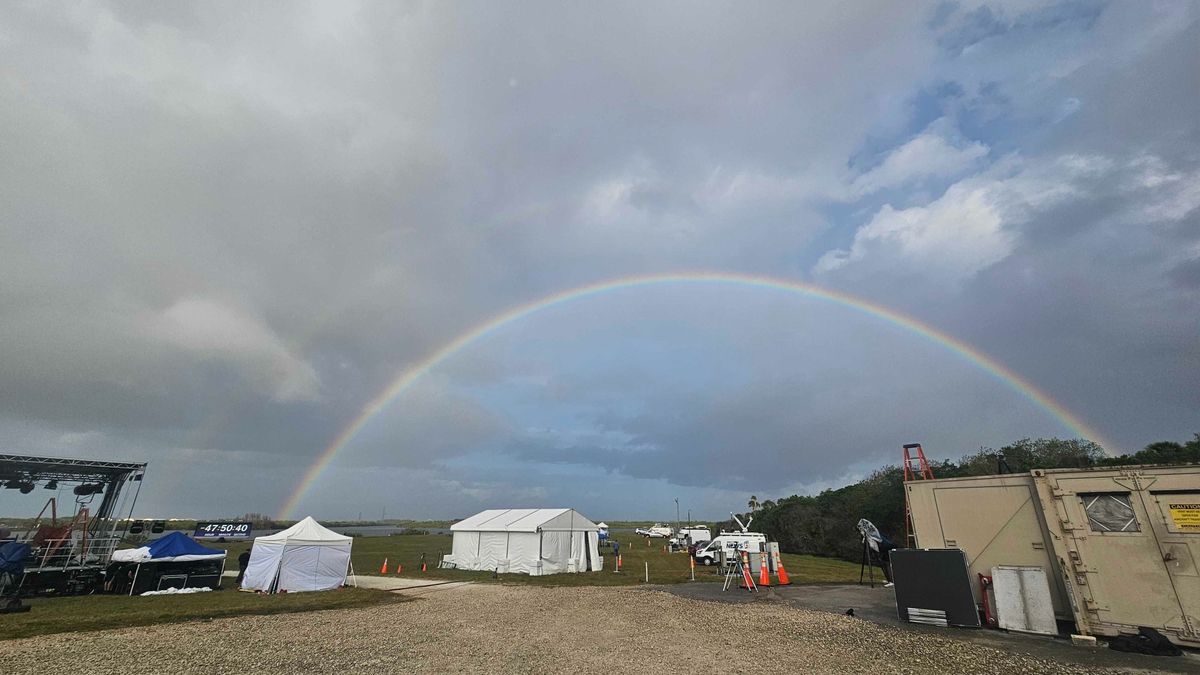
The four-person crew-commander Reid Wiseman, pilot Victor Glover, and mission specialists Christina Koch and Jeremy Hansen-arrived at Kennedy Space Center on Friday, March 27, and entered prelaunch health quarantine. A ground review on Monday, March 31, affirmed an 80% probability of favorable local weather at liftoff, with standard coastal convection the primary watch item for the evening window. The U.S. Space Force range, which ultimately controls whether the vehicle can launch on safety grounds, reported no additional constraints stemming from the solar activity.
Mission profile and timing
- March 27, 2026: Crew arrival and quarantine begins at Kennedy Space Center.
- March 31, 2026: Launch readiness review confirms “go” for attempt under NASA’s formal human-spaceflight safety regime.
- April 1, 2026, 6:24 p.m. EDT (2224 GMT): SLS liftoff from Launch Complex 39B.
- ~10 days total duration: High Earth orbit checkout, trans-lunar injection, lunar flyby trajectory, Earth return, splashdown.
Risk layers and safeguards
| Hazard | Primary Safeguard | Operational Backstop |
|---|---|---|
| Solar radiation storm | Orion structural shielding and crew shelter procedure | Delay or re-sequence activities until flux subsides |
| Ionospheric/space radio noise | Dual-band comms across Near Space Network and DSN | Alternate ground stations and dynamic data rates |
| Avionics single-event effects | Radiation-tolerant hardware with FDIR | Redundant sensors and manual crew procedures |
| Atmospheric launch constraints | Range lightning and wind rules | Recycle to backup window if thresholds exceeded |
Why Artemis 2 still matters-even on a quiet Sun day
As the first human flight of the modern lunar architecture, Artemis 2 will validate life support in operational conditions, prove the navigation and comms stack in cislunar space, and harden crew procedures for radiation contingencies. The mission is also a systemic test of how federal range authorities, space-weather operators, and a human spaceflight program coordinate in an era of heightened solar activity and crowded launch schedules. Real-time decisions made this week will shape how subsequent crews sequence burns, configure shelters, and time critical communications as exploration pushes farther from Earth.
Programmatically, Artemis 2 is the bridge from uncrewed system verification to sustained human operations in deep space. The flight data, crew workload assessments, and communications performance gathered during this 10-day campaign will feed design and operations updates across the stack-launch vehicle, spacecraft, networks, and ground segment-within NASA’s Artemis program. The mission also unfolds within the United States’ broader civil space mandate set in the National Aeronautics and Space Act, which charges NASA to advance human exploration while protecting crew safety and the public.
“We’re not expecting the CME to cause any effects,” Kshatriya said. “We’re not tracking concerns for the mission in general.” With the “go” in hand and an 80% good-weather outlook, all eyes now turn to Tuesday evening’s countdown on Florida’s Space Coast.
Worth a look
