
Engineered Microbial Ecosystems for Pharmaceutical Remediation
The persistence of pharmaceutical contaminants in global water systems represents a critical failure of traditional wastewater infrastructure. Sulfamethoxazole (SMX), a common sulfonamide antibiotic prescribed worldwide, frequently bypasses conventional sewage treatment plants, leading to systemic ecological contamination in soil and aquatic environments. While constructed wetlands have long been utilized as nature-based filtration systems, their organic efficiency has historically been limited by the unpredictability of microbial interactions and the absence of deliberate biological “tuning.”
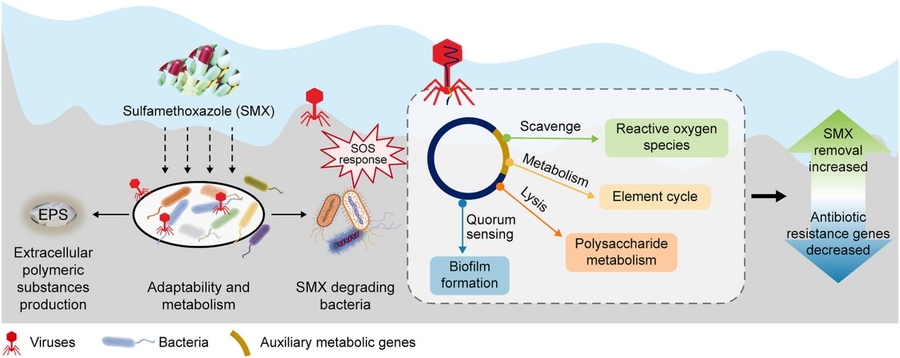
New research indicates that the strategic introduction of phage-concentrated solutions (PCS) can fundamentally alter these dynamics, transforming passive wetlands into high-efficiency bioremediation hubs. By modulating bacteria-phage interactions rather than relying on chance colonization, these systems can achieve a significant increase in the degradation of persistent antibiotics and other trace pharmaceuticals.
| Metric/Component | Impact of Phage-Concentrated Solutions (PCS) |
|---|---|
| SMX Removal Efficiency | Increase of up to 35% compared to control systems |
| Primary Bacterial Drivers | Enrichment of Proteobacteria and Firmicutes phyla |
| Metabolic Mechanism | Activation of auxiliary metabolic genes (AMGs) |
| Structural Influence | Enhanced extracellular polymeric substance (EPS) for improved biofilm formation |
Taken together, these shifts point to an engineered microbial ecosystem that is not only more effective at stripping pharmaceuticals from water, but also more structurally resilient and predictable over time.
Biological Mechanisms and the War on Antibiotic Resistance
The efficacy of this approach relies on the dual role of bacteriophages. These viruses do not merely facilitate the degradation of pollutants; they act as a regulatory mechanism for the microbial community, continuously reshaping which bacteria survive and how they behave. Through the use of auxiliary metabolic genes (AMGs), phages enhance the metabolic capacity of SMX-degrading bacteria, accelerating the breakdown of the antibiotic and routing it through more efficient biochemical pathways.
Beyond pollutant removal, this technology directly intersects with the escalating crisis of antibiotic resistance. In contaminated environments, the spread of antibiotic resistance genes (ARGs) creates “superbugs” that threaten public health and strain hospital systems. The introduction of lytic viruses specifically targets and destroys antibiotic-resistant bacterial cells, effectively pruning the microbial population of its most dangerous elements while favoring communities that can degrade SMX without amplifying resistance.
The study indicates that lytic viruses-which destroy the host cell upon exit-are more prevalent in PCS-treated systems than lysogenic viruses, which integrate into the host genome and can carry resistance genes forward. This ensures that the primary driver of ARG reduction is direct predation rather than genetic transfer, a critical distinction for regulators concerned about unintended horizontal gene flow.
“Our findings highlight the crucial role of viruses in enhancing antibiotic removal in wetland systems,” says Dr. Xiaohui Liu, the corresponding author. “By enriching SMX-degrading bacteria and limiting the spread of ARGs through lysis, viruses provide an innovative approach to bioremediation. The ability to regulate viral populations in constructed wetlands could offer a sustainable solution for managing environmental antibiotic contamination and reducing the global health threat of antibiotic resistance.”
Integration into Urban Infrastructure and Policy
The transition from passive constructed wetlands to engineered biological systems marks a shift in how municipalities approach water security and compliance. Integrating phage-based modulation into urban drainage and wastewater infrastructure allows for a more surgical approach to pollutant management without the need for energy-intensive chemical or advanced membrane treatments-an attractive proposition for cities facing rising operational costs and climate-related stress on utilities.
The implementation of such biological controls faces several infrastructure and regulatory considerations:
- Biosecurity and Monitoring: The deployment of concentrated viral solutions requires rigorous, continuous monitoring to ensure that target-specific phages do not disrupt non-target beneficial microbial populations or migrate beyond designated treatment zones. Utilities will need clear operational thresholds and incident-response protocols before PCS can move from pilot to routine use.
- Regulatory Compliance: As governments tighten standards on pharmaceutical runoff in order to meet surface- and drinking-water targets set under frameworks such as the U.S. Clean Water Act, engineered wetlands provide a scalable path toward meeting stringent effluent limits without wholly rebuilding treatment plants from the ground up.
- System Scalability: The transition from controlled research sediments to large-scale municipal wetlands requires precise dosing of PCS to maintain the balance between lytic predation and bacterial enrichment. That, in turn, demands new sensor networks, dosing algorithms and workforce training so operators can adjust in real time to seasonal flows and pollution spikes.
- Infrastructure Resilience: Biofilm enhancement via EPS production increases the physical robustness of the filtration layer, reducing the frequency of system dredging and maintenance. For city budget offices, that resilience translates into lower lifecycle costs and a stronger case for including constructed wetlands in long-term capital planning.
Policy makers are also watching how phage-based interventions intersect with guidelines from national regulators and professional bodies, as they weigh the benefits of viral biocontrol against the need for conservative safeguards in public infrastructure.
By leveraging the natural predatory behavior of viruses, this approach transforms a biological threat into a tool for environmental recovery. It complements emerging phage-based strategies in clinical settings-such as targeted treatments for multidrug-resistant infections at major medical centers-to illustrate how the same class of viruses can be turned toward both human health and ecosystem repair. This framework provides a roadmap for the sustained optimization of pollutant degradation in systems designed to safeguard public health, regulatory compliance and ecological stability.
Worth a look
