
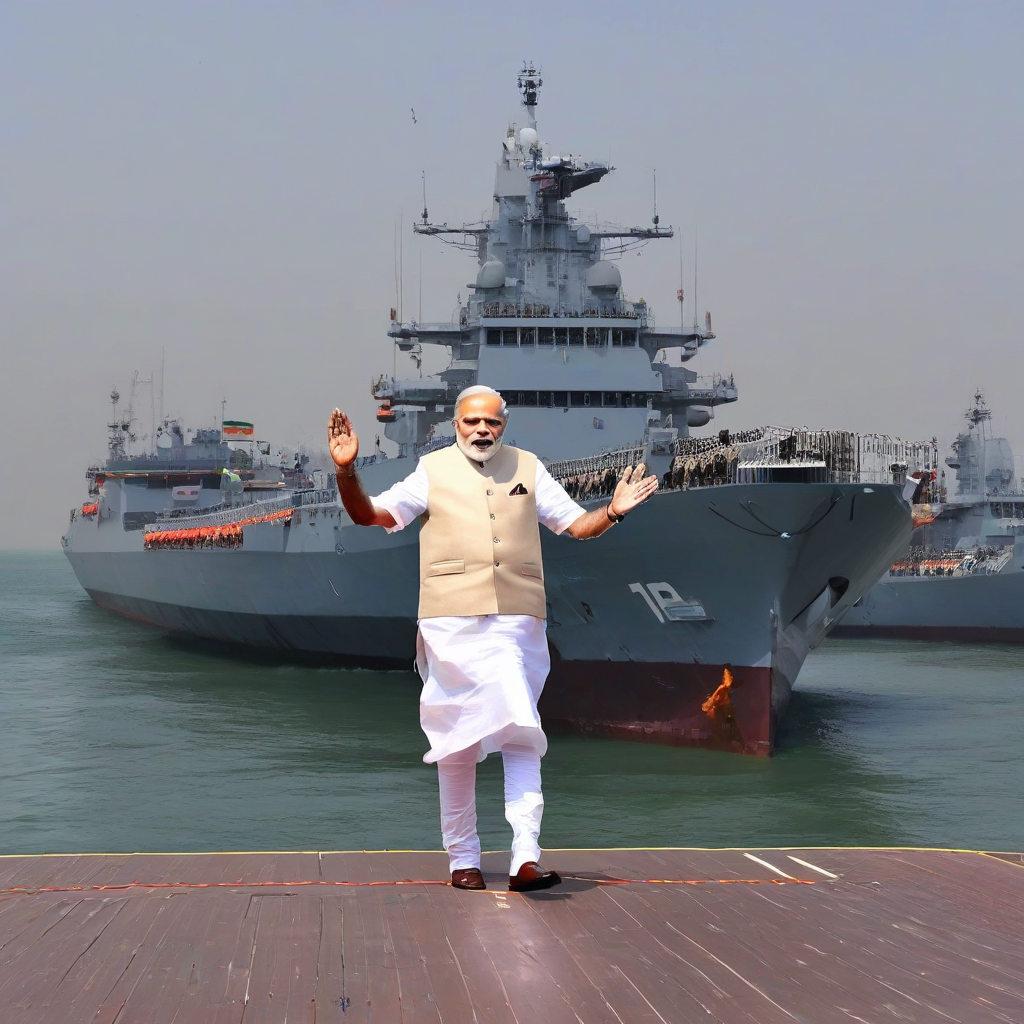
KOLKATA – Prime Minister Narendra Modi commissioned three indigenous naval vessels-the stealth frigate INS Dunagiri, the anti-submarine shallow water craft INS Agray, and the large survey vessel INS Sanshodhak-into the Indian Navy on Sunday.
The induction of these platforms marks a strategic transition in India’s maritime policy, shifting the nation from a primary importer of naval hardware to a domestic manufacturer. The move is designed to align India’s strategic influence in the Indian Ocean Region with its capacity to design and build its own frontline assets.
During the ceremony, PM Modi stated that the country “does not want to remain a mere purchaser” and is focused on expanding its maritime and manufacturing capabilities.
“A nation’s economic and strategic influence are directly linked to its maritime prowess…The day India becomes a Nirmata (creator), it will also become a Nirnayak (decider),” the Prime Minister said.
Strategic Shift Toward Naval Self-Reliance
The commission of these vessels is part of a broader acceleration of the Aatmanirbhar Bharat (self-reliant India) initiative within the defense sector. The government has integrated shipbuilding into a wider vision of national security, linking oceanic control to economic stability and to export-oriented industrial policy.
PM Modi noted that development, security, and prosperity are closely tied to the oceans, citing the reliance of global trade on sea routes and the operation of critical data networks via undersea cables. He further highlighted that the future of energy and the acquisition of critical minerals will be increasingly dependent on the maritime domain.
The naval push is also being positioned by New Delhi as a demonstration of India’s ability to meet capability requirements laid out in its own planning frameworks, rather than through foreign procurement alone. The Ministry of Defence’s procurement processes are governed by the Defence Acquisition Procedure and by the overarching “Make in India” and Aatmanirbhar Bharat policies, which prioritize domestic content and technology transfer in large military contracts.
To support this transition, the government has implemented several policy reforms and financial incentives:
- Financial Investment: A Rs 70,000-crore incentive package has been allocated to the shipping sector to drive industrial expansion and attract private and public shipyards into long-term naval and commercial orders.
- Current Momentum: More than 40 indigenously built warships and submarines have been inducted into the Navy in recent years, reflecting a gradual shift from licensed production to higher-value local design, integration, and systems engineering.
- Future Pipeline: 45 major naval platforms are currently under construction across various Indian shipyards, forming part of a multi-year force modernisation plan overseen by the Ministry of Defence and the Defence Acquisition Council.
Officials frame the commissioning as consistent with India’s stated aim of becoming a “net security provider” in the wider Indian Ocean, while keeping decision-making authority, intellectual property, and sustainment capacity largely within domestic institutions.
Technical Capabilities of New Additions
The three vessels commissioned on Sunday serve distinct roles in naval warfare, coastal surveillance, and oceanographic research, and are intended to plug specific capability gaps identified in recent naval planning documents.
INS Dunagiri
As the fifth Nilgiri-class frigate under Project 17A, INS Dunagiri is the second vessel of its class produced by Garden Reach Shipbuilders & Engineers (GRSE). Named after a Himalayan peak, the stealth frigate is designed for multi-dimensional warfare, including anti-air, anti-surface, and anti-submarine roles in blue-water and littoral environments. Its armament includes:
- Eight BrahMos cruise missiles for offensive strikes.
- Barak-8 surface-to-air missiles for defensive cover.
The ship also integrates advanced radar, electronic warfare suites, and aviation facilities to embark helicopters and unmanned aerial systems, improving the Navy’s ability to conduct extended patrols and joint operations.
INS Agray
Specializing in submarine hunting, INS Agray is an anti-submarine shallow water craft. It is equipped with advanced sonar systems, torpedoes, and anti-submarine rockets to secure littoral waters and approaches to major ports and naval bases. Operating close to the coastline, it is designed to work in concert with aircraft, helicopters, and larger surface combatants to deter and track hostile submarines.
INS Sanshodhak
A large survey vessel, INS Sanshodhak is tasked with hydrographic and oceanographic missions. The ship carries four survey motorboats and advanced sensing systems intended to support the sustainable use of ocean resources and facilitate offshore development. Its surveys feed into nautical charting and maritime safety regimes administered by Indian authorities and underpin planning for undersea infrastructure such as pipelines, cables, and offshore energy projects.
Defense Manufacturing Ecosystem
Defense Minister Rajnath Singh addressed the expansion of the domestic defense industry in a post on X, stating, “These state-of-the-art platforms are a testament to our robust defence manufacturing ecosystem and our unwavering resolve towards Aatmanirbhar Bharat.”
The integration of these ships represents a collaboration between the Indian Navy and domestic engineering firms, intended to reduce the lead time for acquiring new capabilities and to deepen local supply chains for complex components. Shipyards, public-sector undertakings, and private contractors are increasingly expected to meet localisation thresholds and technology benchmarks set by the Ministry of Defence under the country’s formal defence procurement rules, which are publicly outlined in the government’s Defence Acquisition Procedure.
The Indian Navy continues to expand its fleet with 45 major naval platforms currently in various stages of construction. Senior officials say the commissioning of INS Dunagiri, INS Agray, and INS Sanshodhak is intended not only to add hulls to the order of battle, but also to signal that India’s long-term maritime posture will rest on domestic design, manufacturing, and life-cycle support anchored in its own regulatory and industrial framework.