

NHL Braces for a $150M Cap Era – and a Reckoning on How the Money Is Shared
Boardroom warning atop Hudson Yards
At the very end of his Board of Governors’ media conference last month on the 101st floor of 30 Hudson Yards in Manhattan, NHL commissioner Gary Bettman offered an unprompted forewarning on the future of hockey’s salary cap.
“Somebody had asked about the cap going up,” Bettman jumped in.
“Please keep in mind that the cap going up at the rate it’s going up, it’s still a function of recapturing where we’re supposed to be after years of a flat cap,” Bettman said. “That number continues to be [managed] as we try to create a smooth increase in cap and not drive everyone crazy by who happened to be a free agent in a year with a huge jump.”
Bettman reminded that once the system recaptures it, which he estimated “it will take two more years give or take,” then the cap “will go up at the same rate as revenues grow.”
For a league that already operates on a hard cap system through its Collective Bargaining Agreement (CBA) with the NHL Players’ Association, that was more than a passing comment. It was effectively guidance to 32 front offices that roster construction, free agency strategies and long-term extensions are about to move into a different financial world.
Record revenues, artificially low cap
Fortunately for Bettman and the NHL, revenue continues to climb at record rates. Bettman said last month that this season’s projected revenue was “just north” of $8 billion, or $8 billion “and change” in “mixed currency” since the league’s teams earn revenue in American and Canadian dollars.
Sources said the league internally has that projection at $7.1 billion USD plus $1 billion CAD. Based on today’s exchange rates, that conservatively puts total projected revenue for this season at roughly $7.7 billion USD.
Under the current CBA, the NHL and NHLPA split so‑called hockey‑related revenue on a 50/50 basis. With this season’s revenue profile, the unadjusted salary cap ceiling flowing from that formula would be approximately $128 million.
Yet this season’s official cap sits at $104 million. In other words, teams are building rosters under a ceiling that is roughly $24 million lower than where the pure revenue math would place it.
That gap is deliberate. It is the by‑product of the mechanism both sides used to steer the league out of the pandemic years without forcing players to surrender even larger portions of their salaries into escrow.
The pandemic ‘lag’ that still shapes today’s rosters
To understand why the current cap is being held so far beneath the unadjusted figure, you have to go back to the pandemic and the Collective Bargaining negotiations that followed. With games cancelled or played in empty arenas, revenues plunged and the league’s long‑standing linkage between revenue and the cap became a problem rather than a guide.
In response, the NHL and NHL Players’ Association agreed to a two-year ‘lag’ formula, a departure from standard cap calculation. For a defined period, the cap would be calculated on a look back of revenue from two seasons prior, not the current year’s projection.
The goal was straightforward: a flat or gently rising cap would allow players to repay owners for wages taken in shortened seasons without forcing massive escrow withholdings on every paycheque. The lag formula effectively slowed the cap’s rebound relative to the underlying business recovery.
Nearly two calendar years ago, shortly after the Colorado Avalanche traded Mikko Rantanen in January 2025 fearing they would be unable to fit his next contract under the cap, the NHL and NHLPA released an unprecedented three-year look ahead of salary cap projections.
That guidance called for the cap to rise from $88 million to $95.5 million in 2025-26, then to $104 million this season, followed by $113.5 million next year. After six seasons of a largely flat ceiling, those figures were greeted as a relief. Players finally saw meaningful year‑over‑year increases; owners and general managers viewed the path as measured enough to avoid one‑off windfalls that could distort competitive balance.
There is just one structural problem: those specific annual figures are, by design, somewhat arbitrary. They are policy choices layered on top of a system that is supposed to be tightly tethered to revenue.
Cap mechanics: the CBA, escrow and a reversed imbalance
The CBA’s starting point is clear. The NHL and the NHLPA divide the total pot of hockey-related revenue equally at 50/50. Regardless of how team‑by‑team payrolls are allocated, the final accounting is meant to balance that split. Escrow payments – where a portion of players’ salaries is held back and later reconciled – were the enforcement tool that made the math work.
Escrow has been a flashpoint in labour relations for years, and those withholdings have now been absent for three seasons. In fact, the pendulum has swung in the other direction: with the cap artificially low versus the business it is supposed to reflect, players are now drastically underpaying themselves in real time.
Multiple sources told Sportsnet that NHL players are currently tracking to receive a top-up payment of seven per cent above their contract’s face value for this season. On current projections, players will be paid approximately 43 per cent of the 50 per cent they are owed from the total revenue pie during the season, with the balance arriving as a lump‑sum reconciliation.
For players, that may feel like a welcome bonus, but the economic reality is closer to a large tax refund cheque. It is money that could have been in their pockets all season rather than arriving later, interest‑free, because the cap ceiling has been held below where linked revenue would otherwise put it. In practice, the suppressed ceiling is depressing nominal salaries across the league.
Projection: a $150M cap within three seasons
The compression today sets up a sharp release later. Projections run by Sportsnet, verified by multiple team, league and Players’ Association sources, suggest the NHL’s salary cap ceiling could reach $150 million USD by 2029-30 – just three seasons from now. That would represent a 44 per cent jump from this season’s $104 million ceiling.
The calculation follows directly from the current revenue picture and Bettman’s own public framing. If, as he has indicated, the system will “recapture” the pandemic-era lag over roughly two more years and then allow the cap to “go up at the same rate as revenues grow,” any sustained revenue increase will be magnified on the cap line once the artificial brakes are removed.
The cap framework is anchored in league bylaws and the CBA, overseen by the NHL’s central office and the NHLPA. Once the lag period expires and the cap re‑links directly to top‑line growth under that jointly administered system, the numbers begin to move quickly.
The implications for hockey operations are significant. Front offices that have planned conservatively around the published path to $113.5 million next season risk being caught flat‑footed if the ceiling is revised upward and then accelerates toward $150 million soon after. Long‑term extensions signed today could sit very differently on the books by the time the cap fully reflects the underlying business.
Why stars are already pushing past $20M – and why more will follow
One visible symptom of this shifting landscape arrived last summer, when players’ salaries crossed the $20 million per year threshold. That level would have been unthinkable not long ago under a flatter cap. Now, it is a rational response to the coming environment.
Teams and agents have begun to project out the expected increases relative to revenue and have concluded that, in the near future, contracts that look oversized against a $104 million ceiling will become standard for franchise players in a $130‑150 million world.
In a league where elite talent can swing playoff races and Cup windows, that recalibration matters. Clubs that lock in their core stars on deals calibrated for a higher cap could secure cost certainty and competitive advantage later in the decade. Others, still working off the published step‑up to $113.5 million without fully internalising the potential acceleration, risk being forced into reactive trades or buyouts as the market for top‑end talent resets.
Based on conversations with league and team figures, there remains a cohort of clubs that have not yet fully grasped the looming scale of the cap’s potential jump, even as internal planning documents circulated to teams underscore how quickly the ceiling can move once it is re‑linked to revenue.
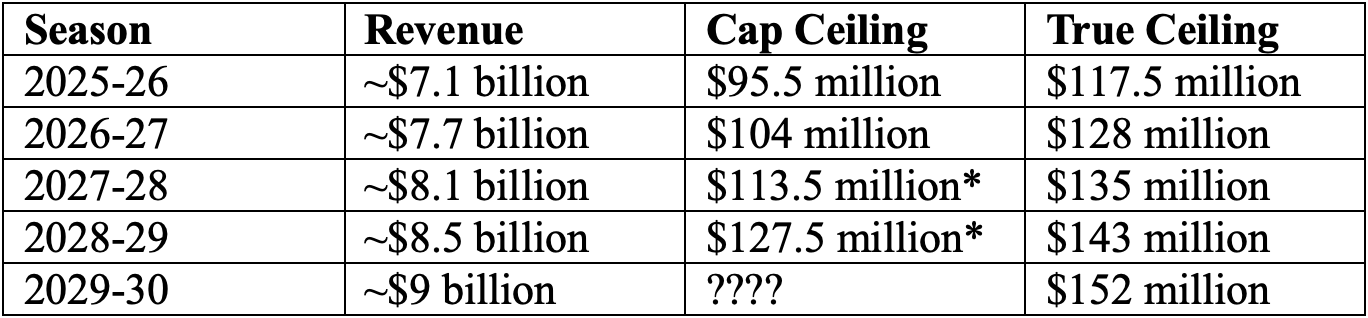
Assumption: 5 per cent growth in revenue year-over-year. Historical average is closer to 7 per cent. *denotes projection supplied from NHL to teams.
Pressure to revise the cap path – and who benefits
All of this creates a live question for the NHL and NHLPA: whether to revisit next season’s projected $113.5 million ceiling. In that September Board of Governors meeting, Bettman advised teams that the projection for the 2028-29 season is $127.5 million – a $14 million increase in a single summer from the prior year’s path.
There is a scenario in which the two sides agree to move part of that jump forward by adjusting next season’s cap figure upward. Doing so would have three interlocking effects:
- Reduce the size of players’ end-of-year top-up payments by paying more of their 50 per cent revenue share during the season itself.
- Smooth the year-to-year change in the cap, making roster planning less volatile for general managers.
- Bring the system closer, earlier, to the underlying CBA principle of direct linkage between hockey-related revenue and player compensation.
Put simply, this is an area in which the NHLPA has clear incentive to push. Every player in the league benefits from a higher cap: stars at the top of the market, depth players fighting for roster spots and restricted free agents seeking their first major paydays.
The sweet spot for both sides is a system where the year‑end reconciliation is small – a minimal one or two per cent top‑up to players – but significant escrow withholdings never return. A steadily rising cap, tightly linked to transparent revenue growth, would achieve that and provide clearer cost certainty for teams.
Expansion, currency risk and the Canadian question
The revenue assumptions underpinning these projections are conservative. The working model here uses five per cent annual growth, while the league’s historical average is closer to seven per cent. If revenue tracks closer to that historical trend line, the eventual cap jumps will be even more pronounced.
Potential expansion is another upside catalyst. Should a new franchise join the league, the few hundred million dollars per year in additional hockey-related revenue it would generate would be thrown into the shared pot, pushing both total revenue and, ultimately, the cap ceiling higher.
That dynamic helps explain why expansion is not universally popular inside the ownership ranks. Smaller Canadian markets that earn significant portions of their revenue in Canadian dollars must contend not just with rising cap numbers, but with the exchange rate converting that cap into local currency.
With a potential cap three seasons from now at north of $210 million in Canadian dollar equivalent, those clubs face structural pressure. Ticket prices and local commercial revenue cannot always be raised at the same pace as US‑dollar denominated cap spending. For those organisations, a league‑wide cap that surges on the back of expansion and strong US‑based growth can make it harder to keep homegrown cores together or compete aggressively on open‑market free agents.
That cross‑border tension is baked into the NHL’s current governance framework. A hard cap applied uniformly across franchises, administered centrally by the league office, is being tested against diverging local economics and currency realities.
Competitive stakes: from playoff races to long-term windows
While these are boardroom and bargaining‑table issues on the surface, the competitive consequences are immediate. How quickly and smoothly the cap rises will influence everything from deadline trades to the shape of Stanley Cup contenders over the rest of the decade.
Teams with aging cores may be more willing to absorb short‑term overpayments now if they believe those cap hits will feel lighter under a $140‑150 million ceiling. Rebuilding clubs, meanwhile, will have to decide whether to front‑load extensions for emerging stars or stagger their commitments to retain flexibility when the new cap reality arrives.
The trade that saw Colorado move on from Mikko Rantanen in January 2025 out of concern over his next contract’s fit under the cap is an example of how front‑office risk assessments have already been shaped by the lag era. Similar decisions in the next few seasons will be made in the shadow of projections that point toward far more room, but not yet at the point where that room exists on the books.
For players, the stakes are equally clear. Younger stars approaching their second contracts must weigh the security of signing now against the prospect of negotiating in an environment where the ceiling – and market comparables – may be dramatically higher.
“Only goodness comes from growth” – and the challenge of managing it
Despite the internal debates, these are fundamentally positive problems for the NHL to navigate. Finding ways to manage growth is a more favourable position than scrambling for new revenue streams simply to keep the system stable.
“Only goodness comes from growth,” said Washington Capitals owner Ted Leonsis, newly elected chair of the Board of Governors. “There is no stasis, you’re either growing or you’re shrinking, and every day you’re in a battle for mind share and market share and bringing in new dollars. The cap growing is a positive sign for everybody. We’re going to continue to be a growth stock.”
His optimism captures the direction of travel. The league’s business is expanding, and under the jointly negotiated framework between the NHL and its players, that ultimately means more money directed onto the ice in the form of salaries.
The critical question for the years ahead is how quickly that growth is allowed to flow through the cap, how evenly it is distributed across markets and rosters, and whether the system can deliver a closer match between what players earn during the season and the share of revenue they are owed at year’s end.
For now, the message from the 101st floor of Hudson Yards is clear. The flat-cap era is ending, a higher‑ceiling era is coming, and teams that fail to plan for a $150 million world may find their competitive windows closing faster than they expect.
Keep reading
