
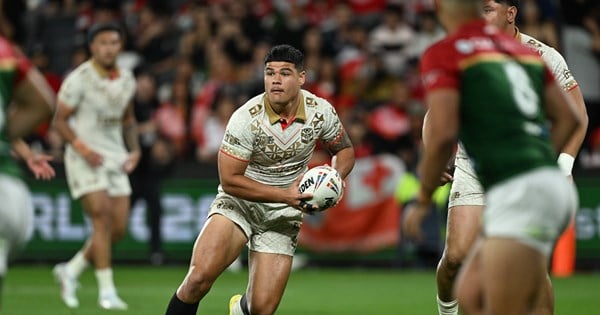
From Back-Row Prospect to World Cup No.9: Foketi’s Rapid Rise Anchors Tonga’s Campaign
A new hooker emerges on the World Cup stage
In a Rugby League World Cup stacked with elite dummy-halves such as Harry Grant, Jeremy Marshall-King and Api Koroisau, it is Tonga’s unexpected No.9 who has altered the narrative.
Salesi Foketi, 20, has worn the Sydney Roosters jersey 45 times in the NRL and featured in 18 NSW Cup matches, all in the second row or at lock since joining the club. Yet on the international stage he has been redeployed in the middle of the field, guiding Tonga around as starting hooker and injecting fresh shape into their World Cup push.
The switch is not a gamble in the eyes of Tonga coach Kristian Woolf. He entered camp aware that Foketi had played all his junior football in Auckland at five-eighth, operating in the spine and steering teams with the ball in his hands. For Woolf, the World Cup became the moment to tap back into that playmaking background.
Trust from the coach, surprise from the premiership winner
Armed with that knowledge, Woolf had no hesitation shifting Foketi into the hooking role for this campaign. It is a positional call that has not only reshaped Tonga’s attack but also caught out one of the most experienced club coaches in the NRL.
Roosters premiership coach Trent Robinson, calling the action in commentary for Channel Seven, admitted he had not realised how accomplished the Manurewa Marlins junior was at dummy-half. Foketi later recounted that the pair spoke in Perth after Tonga’s win over England, where Robinson told him that if he ever needed a No.9 at club level from now on, he would not hesitate to use him there.
That endorsement underlines how quickly this World Cup has broadened Foketi’s professional profile. What began as a national team adjustment has the potential to influence his role in the NRL, with his versatility across the spine and back row now firmly on record.
Filling a veteran’s jersey and keeping Tonga on track
The Tongan No.9 jersey Foketi has inherited carries its own weight. It was vacated by Siliva Havili, a 24-Test veteran whose experience and control around the ruck have been central to Tonga’s growth as a force in the international game.
Stepping into that space, the young Roosters forward has delivered in Tonga’s wins over England and Lebanon, passing the first examination of whether the side could transition from an established senior hooker to a younger, more playmaking-oriented option.
Tournament structure heightens the significance of that smooth adjustment. Under the World Cup’s pool system, Tonga’s clash with Samoa at CommBank Stadium on Sunday night is a direct hinge-point for their campaign:
- A win against Samoa guarantees Tonga a place in the semi-finals.
- A loss does not automatically eliminate them; Tonga can still progress if the winner of Friday’s England-Papua New Guinea match finishes with an inferior for-and-against differential.
In that context, stability at dummy-half is not a luxury; it is central to how Tonga manage field position, limit errors and control tempo in a high-stakes rivalry match.
Junior spine education meets World Cup pressure
For Foketi, the move back into the spine is not a reinvention so much as a return to earlier habits, now layered onto a forward’s physical profile.
He describes growing up in Auckland playing five-eighth, with his father Solomone Foketi as coach, as a foundation for his on-ball understanding. That background is what Woolf sought to reactivate in camp, with the player himself likening the transition back to No.9 to “getting back on the bike” after some initial rust in the first couple of days.
The World Cup allows national coaches to make such calls precisely because they operate within an established international framework overseen by the International Rugby League, which sets competition rules and eligibility structures for tournaments of this scale. That stability gives teams scope to innovate tactically while working inside a clearly defined schedule and format.
For Tonga, the tactical innovation has centred on putting the ball in Foketi’s hands more often in the middle of the field, trusting his decision-making under pressure despite his relative inexperience in the position at professional level.
Club form, confidence and the Roosters connection
Foketi’s surge at international level has been underpinned by his work across the 2026 club season. The Roosters back-rower has built his reputation through consistent minutes in the Telstra Premiership and NSW Cup, and his attacking instincts were on display in the Round 26 clash with the Dolphins, where he scored for Sydney in a match-up that is now part of his growing highlights reel.
That involvement in both first grade and state competition matches meant he arrived in Tongan camp with match hardness in the forwards, which has translated into defensive resilience and ruck toughness as a hooker. The World Cup has simply shifted where he stands in the line and how often he touches the ball.
The international schedule has also produced a compelling individual subplot in the next round. Samoa’s starting hooker is Foketi’s Roosters teammate Benaiah Ioelu, setting up a direct duel between club colleagues in the middle third of the field.
Foketi has described the match-up as akin to “the master going up against his student”, acknowledging that Ioelu has passed on guidance across the season at club level. For Tonga, that familiarity becomes a tactical asset and a challenge: one Rooster controlling the ruck for them, another trying to disrupt it for Samoa.
Internal reviews and leadership backing
Inside the Tongan camp, senior players have welcomed how naturally Foketi has handled the transition into the role. Lock forward Tyson Frizell has highlighted his Roosters teammate’s composure and the quality of his service from dummy-half, remarking that if a neutral observer did not know rugby league, they would not guess he had so little professional experience playing hooker.
That view is echoed in how Tongan staff have structured their spine. Foketi is learning in real time from Dolphins halfback Isaiya Katoa, who returns this week after missing the win over Lebanon with an ankle sprain. In camp, Katoa has been giving him pointers on what to look for as a No.9, simplifying the brief so that the young hooker can focus on crisp delivery and ruck tempo while the playmaker shapes the wider attack.
The arrangement reflects a broader international trend in which teams use a playmaking No.9 and a dominant halfback as joint organisers, rather than placing all creative burden on one position. For Tonga, that partnership is still in its early stages, but it is already central to how they hope to navigate the remaining pool fixtures.
Strategic implications for Tonga and beyond
For a global rugby league audience, Tonga’s decision to entrust a major positional change to a 20-year-old in a World Cup serves several broader storylines.
At competition level, the choice feeds directly into qualification pathways. With a semi-final berth on the line and for-and-against potentially decisive, every set from dummy-half in the Samoa match carries direct consequences for knockout seedings and the composition of the final four.
At player level, the tournament doubles as a live audition for Foketi’s long-term role. Demonstrating he can run a game from No.9 against top-tier international opposition strengthens his value both to Tonga and to his NRL club, where positional flexibility across the spine and forward pack is increasingly prized within roster management strategies.
At structural level, Tonga’s approach underscores how international selection can be used to accelerate player development. National coaches, operating under the global laws and tournament conditions set out for major events, have scope to experiment with positional shifts that may not always be feasible during compressed club seasons.
If Tonga secure progression from their pool, this World Cup will be remembered not only for results but also for how a side with established stars at prop, edge and centre managed to uncover a new on-field organiser from within its own back row. If they fall short, the campaign will still have expanded their depth chart at a specialist position and given a young Rooster the experience of steering his country on one of the sport’s biggest stages.
In either scenario, the emergence of Salesi Foketi as a credible Test-level hooker is already one of the tournament’s most significant developments for Tonga and a notable example of how international rugby league continues to reshape player roles within the modern game.
Worth a look
