
MLB’s Salary-Cap Standoff Pushes League Toward December Lockout
Owners Dig In as Players Warn of ‘Non-Starter’ Proposal
NEW YORK – Major League Baseball is moving sharply toward its first lockout in more than three decades after Commissioner Rob Manfred said club owners will not move off their demand for a salary cap, leaving the sport on track for a shutdown starting Dec. 2 that could jeopardize the 2027 season.
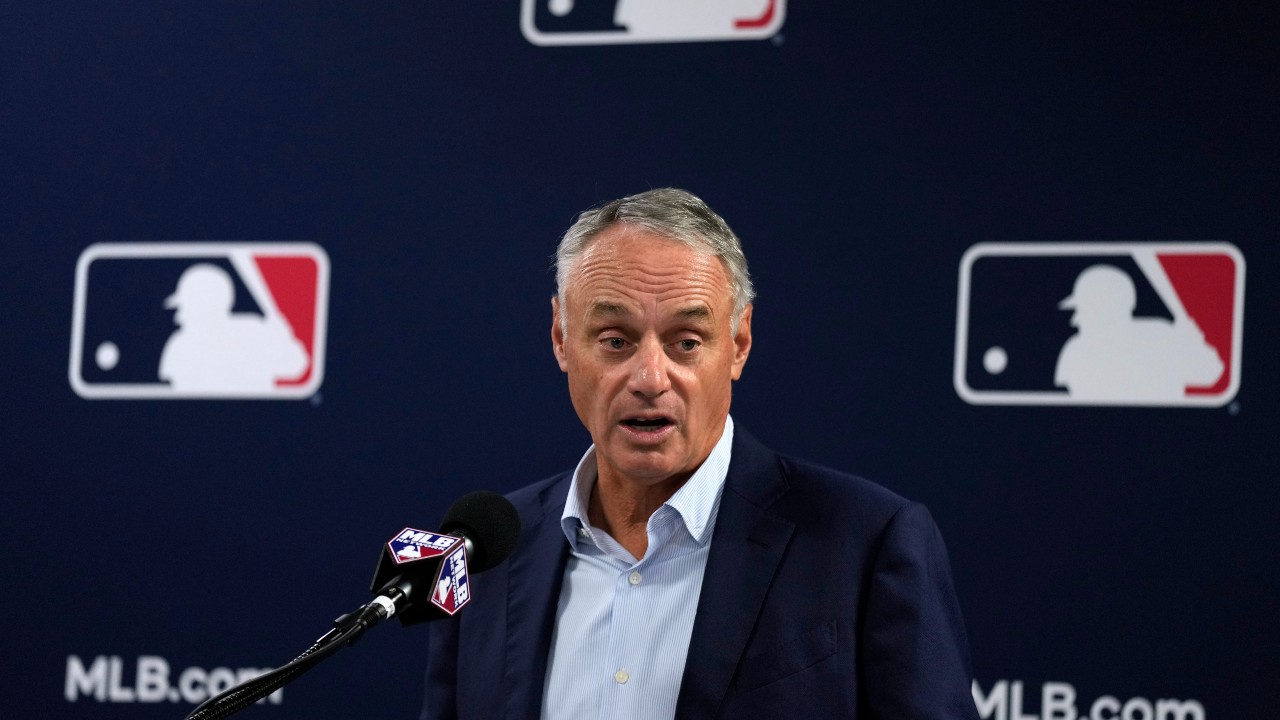
“I can’t imagine the owners ratifying a deal that does not include a cap and floor,” Manfred said Wednesday at a news conference during an owners meeting in New York.
The comments harden what has become the central fault line in negotiations with the MLB Players Association (MLBPA): owners insisting on a cap-and-floor system and players insisting they will never accept one.
The last time ownership formally proposed a cap, in 1994, it led to a 7 1/2-month players’ strike and the cancellation of the World Series for the first time in 90 years – a historical reference that still shapes union strategy and fan memories across the sport.
Deadline Looms as CBA Expires
Baseball’s current five-year collective bargaining agreement is set to expire at 11:59 p.m. EST on Dec. 1. A lockout beginning Dec. 2 would be the sport’s 10th work stoppage since 1972 and would immediately halt all trades and free-agent signings.
The timing is notable. The agreement runs out just over a month after Milwaukee became the first small-market team to win the World Series since 2015, an outcome both sides now cite very differently in arguing about competitive balance and spending.
Manfred said ownership has not yet taken a formal decision on a lockout but signaled it is the likely path if no breakthrough emerges.
“A decision on a lockout is one that we’re going to make at the last possible moment,” Manfred said. “We’re going to devote ourselves to the bargaining process. I’m not that big on Thanksgiving as a holiday. We’ll make ourselves available whenever and wherever to bargain in an effort to make an agreement.”
A prolonged shutdown that bleeds into future seasons would disrupt the standard 162-game regular-season format and could compress schedules, reshape competitive windows and alter career trajectories – particularly for players approaching free agency or arbitration windows.
Inside MLB’s Cap-and-Floor Plan
Under MLB’s proposal, the league would, for the first time, move from its current luxury-tax system to a hard salary cap and payroll floor built off so-called luxury-tax payrolls, which use average annual values of contracts.
- Hard cap in 2028: $258.2 million per team
- Payroll floor: $180.2 million
- Permitted dip: clubs could go as low as 90 per cent of the floor in 2028 – $162.18 million – but would be required to spend the full floor amount over a three-year period
Individual contracts also would be capped at 15 per cent of a team’s payroll under the plan, or 16 per cent for re-signing existing free agents. MLB says it has proposed a 50-50 split of league revenue between clubs and players, while the union says it currently calculates the players’ share at over 55 per cent.
From the league’s perspective, the structure is meant to pull down top-line payrolls for the highest-spending teams while pushing up spending for clubs at the bottom, with the stated aim of improving “competitive balance” across the 30 franchises. That balance is central to the commercial value of the league’s national and international media rights, particularly as Major League Baseball seeks to deepen its global footprint.
Union Rejects Cap as Rights Fight
The MLBPA has made clear it views a hard cap as both an economic and a rights issue and remains firmly opposed.
“There can be no clearer example of the league’s lack of seriousness than their insistence that they will not negotiate over the economics outside of a radical change to the system that would dramatically reduce overall player compensation for all categories of players and strip fundamental rights from players like the ability to have truly guaranteed contracts,” union head Bruce Meyer said in a statement.
“There should be no illusions about the owners’ true motivation in pushing for this system. They want to make more money in profits and franchise values by artificially suppressing player salaries.”
Players have repeatedly described the salary-cap concept as a “non-starter,” a phrase that goes directly to the memory of the mid-1990s strike and the union’s long-standing refusal to accept NFL- or NBA-style hard caps.
Manfred pushed back on that characterization, arguing that the union’s stance amounts to a refusal to negotiate over the core economic framework.
“We made the proposal way back in May. Another word for ‘non-starter’ over months is a refusal to bargain,” he said. “I think it’s time that the MLBPA needs to realize that this proposal is serious. I’m not suggesting they need to accept it whole cloth. I think they need to look at the proposal and try to find some ways to move to the middle as opposed to making no proposal at all.”
In MLB’s view, players are seeking to expand their share of revenues without accepting constraints that would redistribute talent and payroll more evenly between markets.
“The MLBPA wants more and its proposals undermine, further undermine the competitive quality of our game,” Manfred said. “What has the MLBPA done? They’ve engaged in a lot of rhetoric. They’ve characterized our proposals as not real or not serious. They’ve criticized and mischaracterized aspects of the cap and floor system in an effort to promote player opposition.
“What the MLBPA has not done is made any meaningful effort to move towards us. In fact, they have not made a significant economic proposal since their opening proposal. Indeed, there’s a paucity of responses even on topics that do not directly impact our economics.”
Players’ Counter: Floor Penalties and Earlier Pay
The union has advanced its own economic framework aimed at lifting earnings for younger players and raising the effective spending baseline without accepting a hard cap.
Players have proposed a “competitive integrity tax” that would penalize teams whose payrolls fall below a specified floor. They have also asked for:
- A higher luxury-tax threshold at the top end of payrolls
- An almost doubled minimum salary for major leaguers
- Expanded salary arbitration rights to bring players into the mid-career pay system earlier
That package is designed to prevent prolonged rebuilds, accelerate compensation for players during their prime years and give the union a mechanism to challenge what it sees as under-investment by some franchises – all within the existing framework that does not cap overall spending.
For players, the stakes go beyond the next five years. A hard cap and individual contract cap would set ceiling levels that could constrain elite free agents for an entire generation, while a robust floor and stronger arbitration system would move a greater share of revenue toward younger and mid-tier players who currently earn less despite carrying heavy workloads.
Brewers’ Title, ‘Aberrational’ Success and the Small-Market Question
Just weeks after the Milwaukee Brewers, in baseball’s smallest market, won the World Series in a matchup between teams in the bottom half of payrolls – the first such matchup since 1991 – MLB officials used that very result to argue that small-market titles remain outliers in the broader economic landscape.
In a 40-minute presentation before Manfred’s news conference, MLB executive vice president Morgan Sword outlined the economics behind the league’s proposals, citing Financial Information Questionnaires (FIQs) submitted by clubs that showed revenue this year at $12.9 billion.
MLB said FIQ revenue has risen 246 per cent since 2003, while player payroll has increased 147 per cent in the same span. The union disputes the validity of management’s conclusions drawn from those calculations.
The league’s analysis highlighted that, since 1998, only one champion has emerged without a top-20 payroll, and eight of the top-10 teams by payroll reached this year’s postseason.
“While the World Series champion Brewers play in baseball’s smallest market and the World Series matchup was the first since 1991 between teams in the bottom half of payrolls, MLB contends high-spending teams have better chances of success in the long-term,” the league said in its presentation.
“It is truly aberrational in baseball for small markets to be successful,” Sword said. “It’s not impossible, but it is much, much more difficult in our sport than it is in any of the other sports.”
Those comments underscore why the debate is drawing interest beyond North America. For international audiences who have seen European football experiment with financial fair-play regulations and spending caps of various forms, the MLB fight is another test case in how leagues try to reconcile open markets with predictable competitive structures.
Big-Market Cuts Under Proposed 2028 Cap
MLB’s own numbers illustrate how disruptive the proposed cap would be at the top end of the payroll spectrum, particularly for clubs that have become global brands in their own right.
Since the start of the current labour contract in March 2022, MLB said the Los Angeles Dodgers, New York Mets, New York Yankees and Philadelphia combined to commit $5.95 billion to free agents. Over that same span, the bottom 22 teams in free-agent spending allocated $5.41 billion.
Based on 2026 payrolls and the proposed 2028 cap of $258.2 million, the projected cuts for those high-spending franchises would be significant:
- Los Angeles Dodgers: would need to reduce payroll by $174 million
- New York Mets: $108 million
- New York Yankees: $83 million
- Philadelphia: $64 million
Sword said it has not yet been determined how clubs with players holding no-trade provisions would be able to get under the cap, describing that as an issue still to be bargained.
For players on those rosters – and for agents planning long-term markets for stars in North America, Asia, Latin America and elsewhere – the combination of a teamwide cap, individual contract limits and no-trade complications would reshape contract structures and potentially narrow the universe of clubs able to sign the very top-tier free agents.
Media Revenue, Sharing and the Changing Economics of TV
Beyond payroll rules, MLB’s proposal would also restructure one of the core financial pillars of the sport by calling for local media revenue to be split equally among all 30 teams for the first time.
MLB said local media revenue is $1.8 billion this year, down $575 million from a high of about $2.4 billion annually from 2021-24, reflecting the decline of traditional cable networks. The proposed equal split is designed to blunt the impact of regional disparities between large and small media markets at a time when streaming models and international rights packages are becoming more central to the sport’s business.
Any changes to revenue sharing and caps would operate within the league’s existing governance framework under the Basic Agreement between MLB and the MLBPA, the core document that, alongside the Official Baseball Rules, structures how the sport is run on and off the field.
In the current season, MLB said, players with six or more years of service – essentially those eligible for free agency – earned 69 per cent of player compensation when counting regular payrolls and the pre-arbitration bonus pool. Yet those players produced just 29 per cent of an averaged Wins Above Replacement (WAR) drawn from Baseball Reference and FanGraphs, by the league’s calculations.
By contrast, younger players and pre-free-agency contributors accounted for the bulk of on-field value while earning a smaller share of the compensation pie.
“Major league players will earn more money in this system and it’s just a matter of just distributing the players differently across the teams,” Sword said. “The key to having valuable national media rights we believe is having lots of teams that have a national audience and appeal beyond just the contours of their city.”
That vision speaks directly to MLB’s international ambitions. A more balanced league, with competitive clubs in multiple time zones and markets, enhances the product for global broadcasters and partners – but only if a deal can be reached that keeps the sport on the field.
Fans, Competitive Balance and the Stakes for 2027
Manfred has framed the owners’ position as a response to fan sentiment.
“There’s plenty of room for compromise, but there’s one thing that I will not compromise and that’s the issue that we’re hearing from the vast majority of our fans: They want a salary cap and floor and on that we will not compromise,” he said. “We are not prepared to tell 70 per cent of our fans that they’re wrong on this issue. Competitive balance is a serious problem, and it needs to be addressed and it’s one that we can’t avoid just because the negotiation may be difficult.”
Whether fans truly support a hard cap is difficult to measure with precision, and the union has pushed back on that framing. What is clear is that both sides are now explicitly invoking fans as stakeholders in a negotiation whose consequences run through every layer of the sport:
- On-field competition: A cap-and-floor system could narrow the gap between big- and small-market clubs but might also reduce the number of superteams built through massive payrolls.
- Player careers: Younger players could see earlier and potentially higher earnings under either side’s various bonus and arbitration concepts, while established veterans could face new limits on contract size and destination.
- Global calendar: Any disruption to spring training, regular seasons or postseason schedules would affect international tours, World Baseball Classic planning cycles and national-team selection windows in multiple countries.
For now, both MLB and the MLBPA remain publicly entrenched, and the calendar is unforgiving. If the two sides cannot bridge their differences before Dec. 2, the labor battle will move from rhetoric to reality, with the 2027 season already identified as being at risk.
Related reading
