
Milano Cortina Day 5: Canada’s pivotal tests as curling opens, ice dance medals loom, and women’s doubles luge debuts
Wednesday, February 11 (ET) brings one of the most consequential slates so far for Canadian athletes at the Olympic Winter Games, spanning early-morning alpine and snowboard starts through to medal-deciding ice dance and a landmark first in luge under the Olympic programme administered by the International Olympic Committee, the body that sets the overall legal and governance framework for the Winter Games.
Key times (ET)
- Snowboard – Women’s Halfpipe Qualification: 4:30 a.m.
- Alpine Skiing – Men’s Super-G (Bormio/Stelvio): 5:30 a.m.
- Freestyle Skiing – Women’s Moguls Q2: 5:00 a.m.; Finals from 8:15 a.m.
- Biathlon – Women’s 15km Individual: 8:15 a.m.
- Luge – Women’s Doubles Runs: 11:00 a.m. and 12:53 p.m.; Men’s Doubles Runs: 11:51 a.m. and 1:44 p.m.
- Speed Skating (Long Track) – Men’s 1000m: 12:30 p.m.
- Curling – Men’s Round Robin: Canada vs Germany, 1:05 p.m.
- Figure Skating – Ice Dance Free Dance: from 1:30 p.m. (Canadian start times below)
Alpine skiing: One-run risk, four Canadians in the Super-G
The men’s super-G at the Stelvio Ski Centre in Bormio starts at 5:30 a.m. ET. Canada fields Jack Crawford, Cameron Alexander, Brodie Seger, and Riley Seger, who makes his Olympic debut. Start order can be decisive in super-G, where a single run decides everything and changing snow texture can reward early precision or punish late starters.
Canadian start bibs (as provided): Crawford 2, Alexander 20, Brodie Seger 27, Riley Seger 30. A low bib for Crawford positions him to exploit the best of the track, while the Seger brothers and Alexander will have to balance aggression with the reality of a deteriorating racing line.
Biathlon: Precision at a premium in the 15km individual
The women’s 15km individual begins at 8:15 a.m. ET with Canadians Nadia Moser, Shilo Rousseau, Pascale Paradis and Benita Peiffer. Unlike mass starts or sprints, the individual format adds a one‑minute time penalty for each miss, putting a premium on clean shooting across four bouts and amplifying the strategic choices made by coaching staffs on pacing and wind management at the range.
Because team selection and start rights are regulated through national high‑performance criteria and International Biathlon Union quotas, strong results here can shape relay lineups later in the week and influence funding and carding decisions for the next Olympic cycle.
Curling: Canada opens nine-game round robin against Germany
Canada’s four-player men’s team—skip Brad Jacobs with Marc Kennedy (third), Brett Gallant (second), Ben Hebert (lead), and Tyler Tardi (alternate)—faces Germany at 1:05 p.m. ET in the first of nine round robin games. Early momentum often proves decisive in a compressed Olympic schedule, influencing potential tiebreak scenarios and hammer control in subsequent draws as determined by cumulative Last Stone Draw statistics.
Form guide from last season: Team Jacobs earned bronze at the 2025 World Men’s Curling Championship; Germany, skipped by Marc Muskatewitz, placed eighth. With World Curling Federation rules standardizing thinking‑time allowances and five‑rock free‑guard conditions across all Olympic competition, both teams arrive knowing that end‑game clock management will be as critical as shot execution.
Figure skating: Ice dance free decides the medals
The ice dance event concludes with the free dance beginning at 1:30 p.m. ET. Medals are awarded on the combined total of the rhythm dance and free, under the International Skating Union’s scoring system that blends technical base value with Grade of Execution (GOE) and program components.
- Piper Gilles/Paul Poirier: third after the rhythm dance on 86.18 points, 0.71 ahead of Great Britain’s Lilah Fear/Lewis Gibson; scheduled to skate third in the final flight at 4:26 p.m. ET.
- Marjorie Lajoie/Zachary Lagha: ninth on 79.66; set for 3:32 p.m. ET.
- Marie‑Jade Lauriault/Romain Le Gac: 15th on 74.35; first Canadians on the ice at 2:23 p.m. ET.
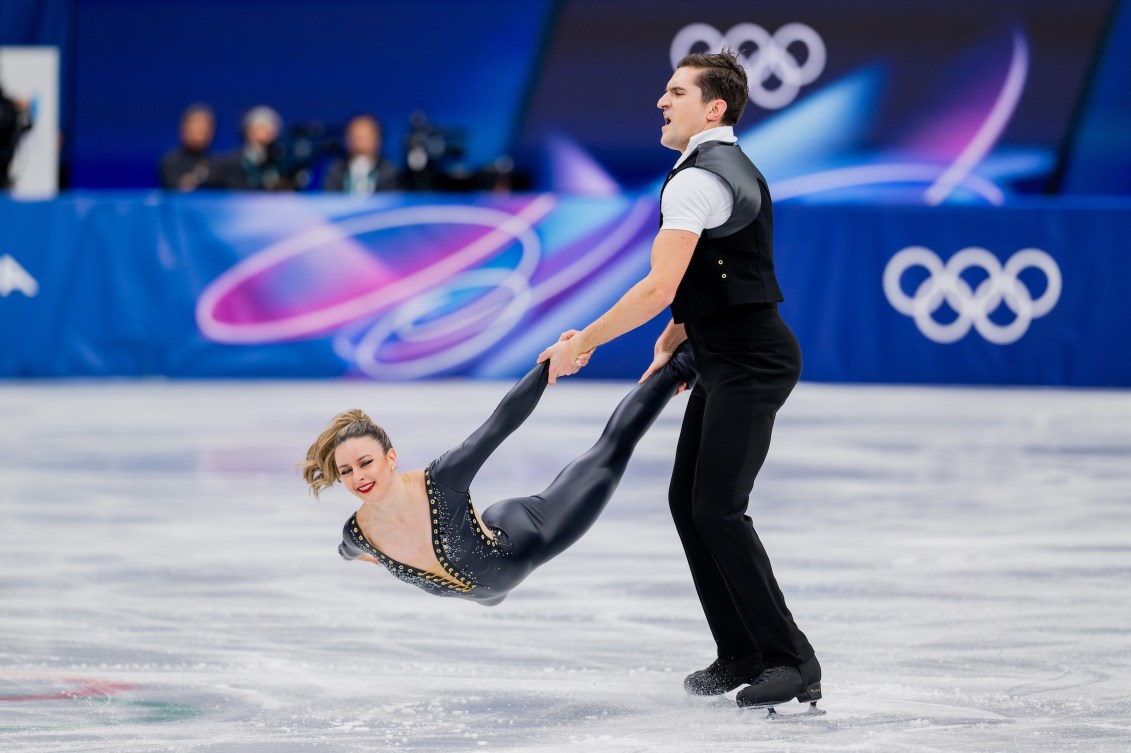
The razor-thin margins from the rhythm dance mean execution quality—GOE on lifts and step sequences, plus levels on twizzles—will likely separate the podium. Any minor error, from a stumble on a step sequence to a downgraded lift entry, risks a cascade of small deductions that can reorder the top five.
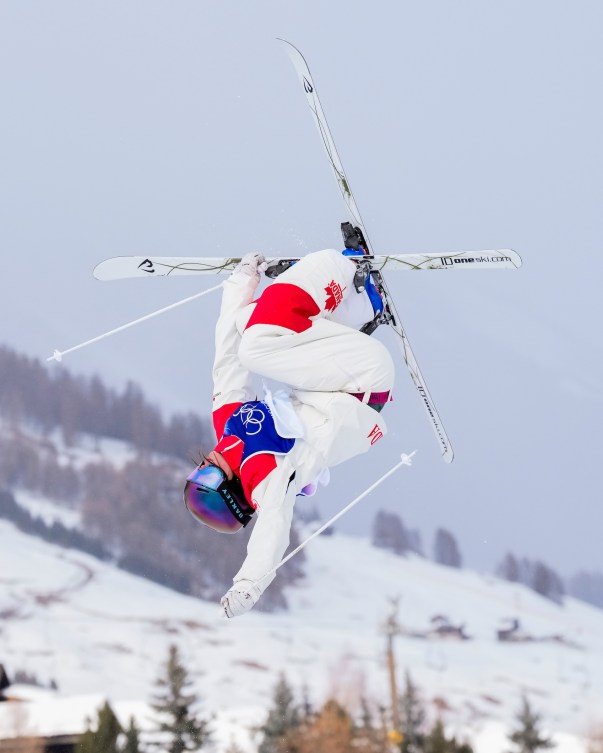
Freestyle skiing: Four Canadian mogul skiers chase finals
Second qualification in women’s moguls begins at 5:00 a.m. ET for Ashley Koehler and Jessica Linton, who need a top‑10 to reach the finals. Maïa Schwinghammer and Laurianne Desmarais‑Gilbert secured direct passage to the final with sixth and eighth in the first qualification round, giving Canada a full four‑woman presence in the medal phase.
Finals start at 8:15 a.m. ET; the top eight from Final 1 advance to the second final, which determines the medals. With turns, air and speed all scored under a fixed judging ratio, mistake management—avoiding hip checks and off‑axis landings while preserving speed—is as important as degree of difficulty, especially for athletes balancing World Cup‑level tricks with the higher risk tolerance of an Olympic final.
Luge: Women’s doubles makes its Olympic debut
Cortina’s doubles day includes the first Olympic women’s doubles event, an important step for programme parity within the discipline’s global rule set overseen by the International Luge Federation. Canada’s Kailey Allan and Beattie Podulsky take their first run at 11:00 a.m. ET and a second at 12:53 p.m. ET. In men’s doubles, Devin Wardrope and Cole Zajanski slide at 11:51 a.m. ET and 1:44 p.m. ET.
Unlike singles, final classification in doubles is based on the aggregate of today’s two runs—placing a premium on back-to-back consistency and on technical decisions made months earlier about sled set‑up and runner profiles. The inclusion of women’s doubles, after years of discussion at federation and IOC level, also has long‑term implications for how national sport systems allocate resources and identify talent in a discipline that now offers full gender parity on the Olympic slate.
Snowboard: Halfpipe qualifiers set the final field
Women’s halfpipe qualification starts at 4:30 a.m. ET with Elizabeth Hosking, Felicity Geremia and Brooke D’Hondt riding for Canada. Athletes get two runs with the best counting; the top 12 advance to Thursday’s final. Strategic choices—whether to lead with a high‑difficulty run or bank a safer score first—often decide who progresses, especially in variable morning conditions where changing light and wind can alter the risk calculus from heat to heat.
Speed skating (long track): Men’s 1000m balances power and pacing
Three Canadians line up at 12:30 p.m. ET: Laurent Dubreuil, the reigning Olympic silver medallist in this event, and Olympic debutants Anders Johnson and David La Rue. The 1000m rewards explosive acceleration off the start, clean lane exchanges on the backstraight and disciplined lap pacing; results are determined by time across pairs, not head-to-head wins, so every split matters from the first exchange.
With race conduct governed by standardised ISU rules on lane changes and obstruction, even a minor miscue in traffic or an illegal crossover can draw automatic disqualification, underscoring why national programme planners place such an emphasis on rehearsed race patterns and pairings long before the Games begin.
