
Campbell Stands By Lions’ Emotional Edge After Hutchinson ACL Blow
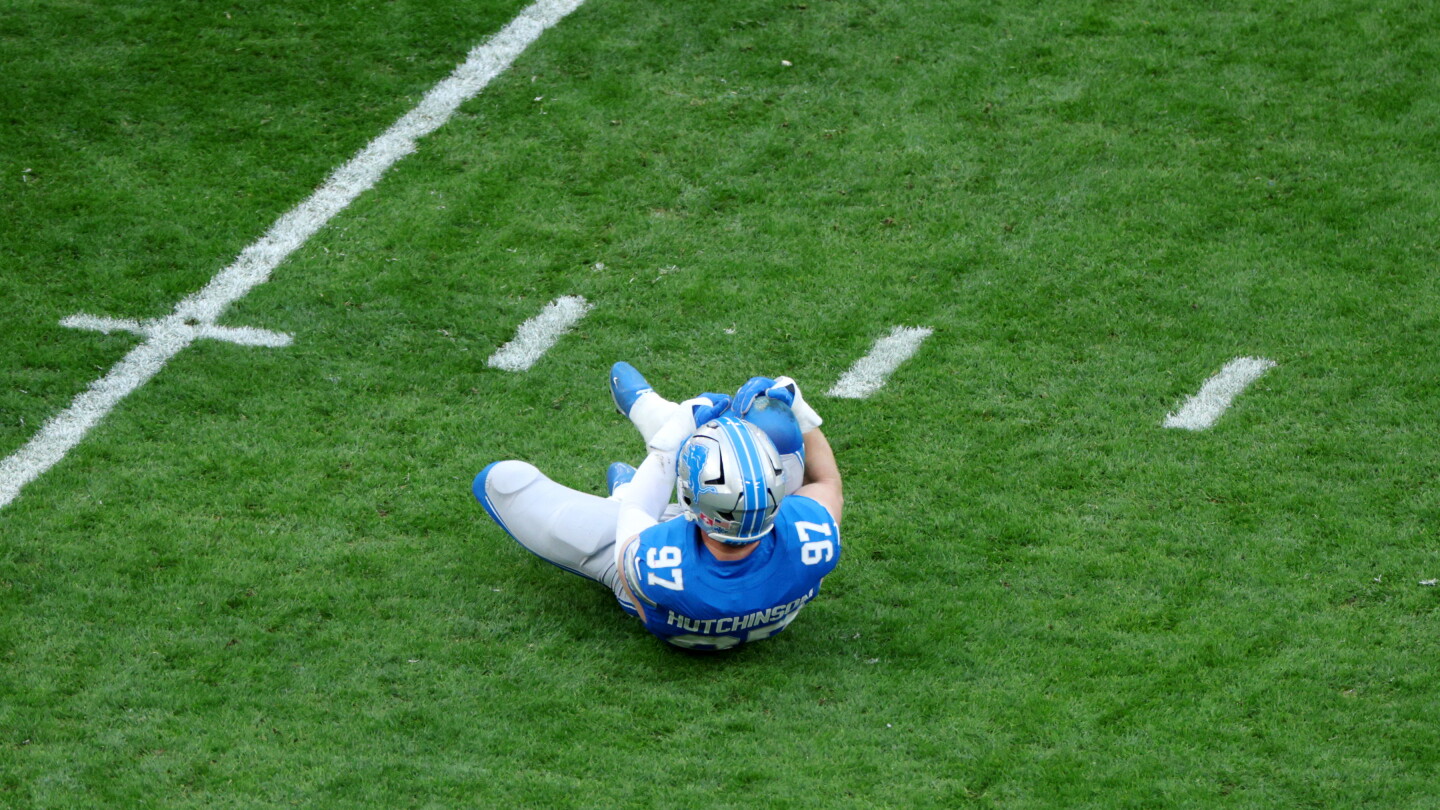
Lions head coach Dan Campbell says he will not ask his players to dial back their on-field celebrations, even after defensive end Aidan Hutchinson suffered a torn ACL in his right knee while celebrating a sack.
Hutchinson will miss the rest of the season after injuring the knee as he came down from his jump following a sack of quarterback Drake Maye in Sunday’s game in Munich. He immediately clutched his right knee after landing awkwardly on the turf.
“This Game Is Built Off of Emotion”
Speaking on Detroit radio station 97.1 The Ticket on Tuesday, Campbell described Hutchinson’s injury as “one of those things that happened” and made clear he does not intend to strip emotion out of how the Lions play.
Campbell said the sport is driven by intensity and reaction, and he does not want to remove that element from his team’s identity. While he expressed clear frustration and sympathy over the outcome, he framed the incident as an unfortunate outlier rather than the result of reckless behavior.
“I hate it, I know he hates it,” Campbell said, before referencing the volume of explosive, controlled movements Hutchinson routinely executes in games and training. He pointed to the pass rusher’s plyometric work, spins and single-leg balance drills as evidence that the play in Munich was not part of a pattern of unnecessary risk.
Campbell added that he wants his players to be “smart,” but drew a firm line against issuing a blanket ban on post-play reactions, stressing he is “not gonna say, ‘Nobody celebrates anymore.’”
Balancing Risk and Identity in the Modern NFL
The injury again highlights the fine line NFL teams walk between managing player risk and preserving the emotional edge that defines elite competition. Under the National Football League’s rules, coordinated and spontaneous celebrations are permitted provided they do not delay the game, taunt opponents or violate conduct standards, and teams across the league routinely incorporate choreographed reactions into their culture.
Celebrations have become part of how franchises market themselves globally, particularly during international games such as the Lions’ appearance in Munich. For players, those moments can serve as emotional release valves in a physically and mentally demanding environment. For coaches, the challenge lies in reinforcing basic safeguards – spatial awareness, avoiding contact with teammates, and controlling landings – without stripping players of an energy that can influence performance.
In that context, Campbell’s stance is consistent with a broader coaching trend: accept that rare freak injuries can occur in virtually any movement, while focusing risk mitigation on areas with clearer, repeatable patterns, such as practice workloads, tackling technique and contact in training.
Hutchinson Loss Compounds Competitive Pressure
From a competitive standpoint, losing a starting defensive end for the remainder of the campaign is a significant blow for Detroit. Edge rushers are among the most difficult positions to replace mid-season, not only because of their individual pass-rush impact but also because of how they fit into pressure packages and coverage structures.
In the NFL’s closed-league format – without promotion and relegation but with a playoff system that determines the champion – sustained disruption to a team’s pass rush can alter both weekly game plans and longer-term postseason ambitions. A season-ending injury to a central defensive piece often forces coaching staffs to:
- Adjust snap counts and responsibilities for remaining edge players and interior linemen
- Lean more heavily on scheme – such as blitz packages – to compensate for lost one-on-one pressure
- Reconsider rotation patterns to manage fatigue over the rest of the schedule
While Campbell did not publicly detail tactical changes, the acknowledgment that Hutchinson “will miss the rest of the season” underscores the scale of the adaptation required on a unit that relies on disruption up front to support coverage behind it.
Coach’s Own Experience Shapes His Response
Campbell also drew on his playing days to contextualize his decision. He recalled tearing his biceps while celebrating a play during his NFL career and noted that the experience did not lead him, once he became a head coach, to introduce rules against celebrating.
That personal history helps explain his response to questions about whether he will tighten team guidance after Hutchinson’s injury. Having lived through a similar moment, Campbell appears to view celebration-related injuries as part of the broader spectrum of risk inherent in professional football rather than a discrete behavioral problem to be policed.
For players and staff, that stance sends a clear internal message: the organization will review processes and emphasize smart decision-making, but it will not fundamentally alter the emotional style that has come to characterize Detroit under Campbell.
Emotional Expression in a Global Shop Window
The incident unfolded on one of the sport’s highest-profile stages outside the United States, with the Lions playing in Munich as part of the NFL’s international expansion. Games in Europe form a central part of the league’s strategy to reach new audiences and demonstrate the spectacle of American football in front of fans who may be seeing the sport live for the first time.
In that setting, celebrations are more than personal expressions – they are part of the visual language that helps explain the game’s stakes and intensity to an international crowd. Campbell’s refusal to outlaw them reflects a wider understanding that, while player health must be prioritized, the emotional dimension is inseparable from what makes elite sport compelling.
For Detroit, the task now is twofold: absorb the competitive impact of losing a key defensive end for the rest of the season, and ensure that when Lions players next celebrate a major play, they do so with the same freedom – and just a little more caution on the landing.
Related reading
