
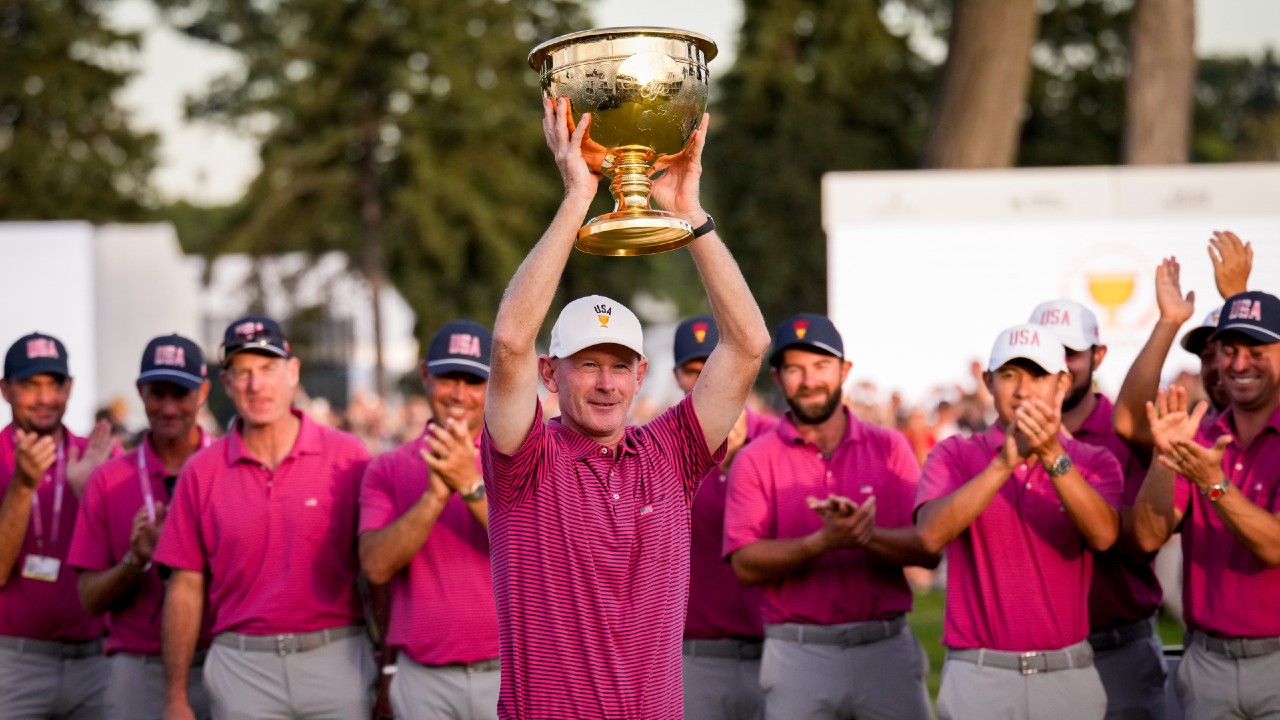
U.S. storms back at Medinah to extend Presidents Cup dominance
Record Sunday singles rout turns 10.5-7.5 deficit into 17-13 victory
Although the Internationals produced the more cohesive team golf for much of the week at the Presidents Cup, the United States retained the trophy with a record‑setting display in Sunday singles at Medinah Country Club.
The Americans captured the 2026 Presidents Cup 17-13, securing an 11th straight victory in the biennial match play competition. They overwhelmed the Internationals 9.5-2.5 in the closing session – the largest Sunday singles margin in Presidents Cup history – to flip a contest they had trailed 10.5-7.5 heading into the final day.
That turnaround underscored one of the defining tensions of modern team golf: U.S. strength in individual match play versus ongoing vulnerability in the multi‑ball formats that dominate the first three days of both the Presidents Cup and the Ryder Cup.
Singles surge exposes U.S. weakness in pairs formats
The U.S. started Sunday with work to do. With 12 points still on the board, there was no margin for error if the Americans were to overturn the Internationals’ three‑point cushion.
They did more than that, delivering a wave of early red on the leaderboards that transformed both the competitive balance and the atmosphere around Medinah.
“Sometimes you’ve got to hit the shots and make the putts. The U.S. just did that a little bit better today,” International captain Geoff Ogilvy said. “First four sessions, you couldn’t ask for more than to have a three‑and‑a‑half‑point lead going into singles in the U.S., that’s a hard thing to do. We did the hard work the first three days. The guys tried their hardest today. A good bit of red on that board, and Chicago got louder and louder and louder as that happens.
“You have a couple putts go in at the right time and the momentum goes our way, and it just didn’t do that today.”
The pattern mirrored last year’s Ryder Cup, when the U.S. also dominated the closing singles session 8.5-3.5 but still fell short of Europe overall. It reinforced how fragile their position remains in foursomes and fourball: across the past two years in those alternate‑shot sessions, the Americans are 8-26.
At the Presidents Cup level, that imbalance has strategic consequences. Captains and high‑performance staff must decide whether to double down on individual star power, confident that singles can repair early damage, or recalibrate selection and preparation around pair‑play chemistry and alternate‑shot proficiency.
Bridgeman delivers clinching point in largest final‑day comeback
Ultimately, the U.S. Sunday blitz produced the largest final‑day comeback to win in Presidents Cup history. The clinching point fell to Jacob Bridgeman, who edged Min Woo Lee 1 up.
For Bridgeman, closing out the deciding match against one of the International team’s most dynamic players immediately elevates his profile in the U.S. team‑golf conversation. Performances in events like this often shape captaincy thinking for future editions, influencing wildcard discussions and the depth chart behind the established stars.
American captain Brandt Snedeker framed the comeback as the product of belief as much as skill.
“I’m super proud of them. These guys never gave up. They believed in each other. They did a (heck of a) job. They were really special. I knew these guys were special,” Snedeker said.
“I keep saying they fought for each other today. It was impressive to watch. The fact that we went out… Is it a record in singles? That doesn’t happen unless you have a special group of guys, and we do.”
Captain’s picks go perfect as rookies seize the stage
Beyond the established names, the week doubled as a pressure test for the Americans’ next wave. Rookie Chris Gotterup finished tied as one of the top U.S. points earners alongside world No. 1 Scottie Scheffler and Cameron Young. Young, sent out first in singles, delivered the opening point of the day and set the tone for the comeback.
Crucially, all of Snedeker’s captain’s picks went 6‑0‑0 in singles. That flawless record validates the selection process in a competition where captain’s discretion is designed to balance statistical form, course fit, and locker‑room dynamics.
Among those picks, 21‑year‑old Jackson Koivun delivered one of Sunday’s defining performances. Tasked with facing Si Woo Kim, the International side’s highest‑ranked player, Koivun mounted a late charge with three birdies in his final seven holes.
The closing stretch at the 18th encapsulated the moment. After both his tee shot and approach, Koivun unleashed Tiger Woods‑style club twirls, drawing roars from American teammates who had assembled to watch the rookie try to close out his match.
“I put him in a big spot today, a really big spot. That was a massive match. If we were going to have any chance today, he had to win that match,” Snedeker said. “The guys were cheering in the room last night when we made that decision to put him in that spot.
“The whole team went crazy because they knew they wanted the kid to go up against Si Woo, and he delivered today in a big way.”
For Koivun and Gotterup in particular, such high‑leverage performances strengthen their case for future team events – not just at the Presidents Cup but also in Ryder Cup discussions, where captains increasingly value proven match‑play nerve.
International leaders falter as Kim, Im carry the load
While the International side showcased depth through the first three days, many of its most recognizable names were unable to close on Sunday when the cup was on the line.
Hideki Matsuyama, Adam Scott, Si Woo Kim, and Min Woo Lee all lost their singles matches – with Lee’s defeat to Bridgeman providing the deciding point. Ryan Fox, Christiaan Bezuidenhout, Ryo Hisatsune (in the opening match), and Nico Echavarria (against Scheffler) also fell.
Canadian Corey Conners endured a particularly difficult afternoon, falling 5 and 3 to Justin Thomas after being 5 down through just seven holes. Conners did, however, contribute two points to the International tally earlier in the week, both alongside compatriot Nick Taylor in foursomes.
Taylor ended the competition with 2.5 points after halving the final match of the 2026 event against Russell Henley. As a rookie, he emerged as one of the bright spots in the International locker room. The next Presidents Cup will see Taylor at 40 years of age; whether he returns will depend on future form and captaincy decisions, but his play and presence in this team environment drew significant internal praise.
On Sunday itself, the Internationals had just two winners: Tom Kim and Sungjae Im. Kim defeated Wyndham Clark 3 and 2 and finished the week with four points, the highest haul on the International side. Im beat Sam Burns 3 and 1.
“The effort makes me really happy as a captain,” Ogilvy said. “They did an amazing job this week. It was incredible. It doesn’t make it any less disappointing. Proud to be a captain, disappointed that it didn’t go their way.
“They wanted it, and they did everything they could to win this tournament this week.”
A rivalry shaped by structure – and by what happens next
The Presidents Cup sits under the governance of the PGA Tour, which stages the event as a flagship team competition pitting the United States against an International side drawn from the rest of the world excluding Europe. Its format – foursomes and fourball across the opening three days, followed by singles – is designed to balance team strategy with individual match‑play pressure.
This year’s result reinforces several structural realities.
- The U.S. continues to extend a long‑standing winning streak, underscoring the depth of elite American golf.
- The Internationals are closing the competitive gap in pairs formats but still searching for a way to translate early‑week leads into Sunday success.
- Captain’s picks and emerging talent on both sides are increasingly decisive in tight contests, shaping selection debates ahead of each new cycle.
Although the Internationals ultimately fell short, Ogilvy framed the week as another incremental step in building a group capable of ending a winless run that dates back to 1998. The squad is expected to retain much of its core when the event moves to Australia in two years, offering a rare combination of continuity and accumulated experience.
“This is an incredible group of people, and it’s not just the players here… the International Team is a very big group of people, and they’re very passionate about this team. They love the shield… They love everything about this tournament and this team,” Ogilvy said. “This team is no joke. We’re coming, and when we crack this thing, it’s going to get really good.”
With another dramatic Sunday at Medinah now part of Presidents Cup lore, both teams leave Illinois with clear agendas. For the U.S., the challenge is to address its persistent foursomes and fourball issues before they become more costly in future editions. For the Internationals, the task is to convert growing competitiveness into a complete, four‑day performance when the cup next goes on the road – and to prove that their momentum stretches beyond encouraging words into a long‑awaited breakthrough.
