
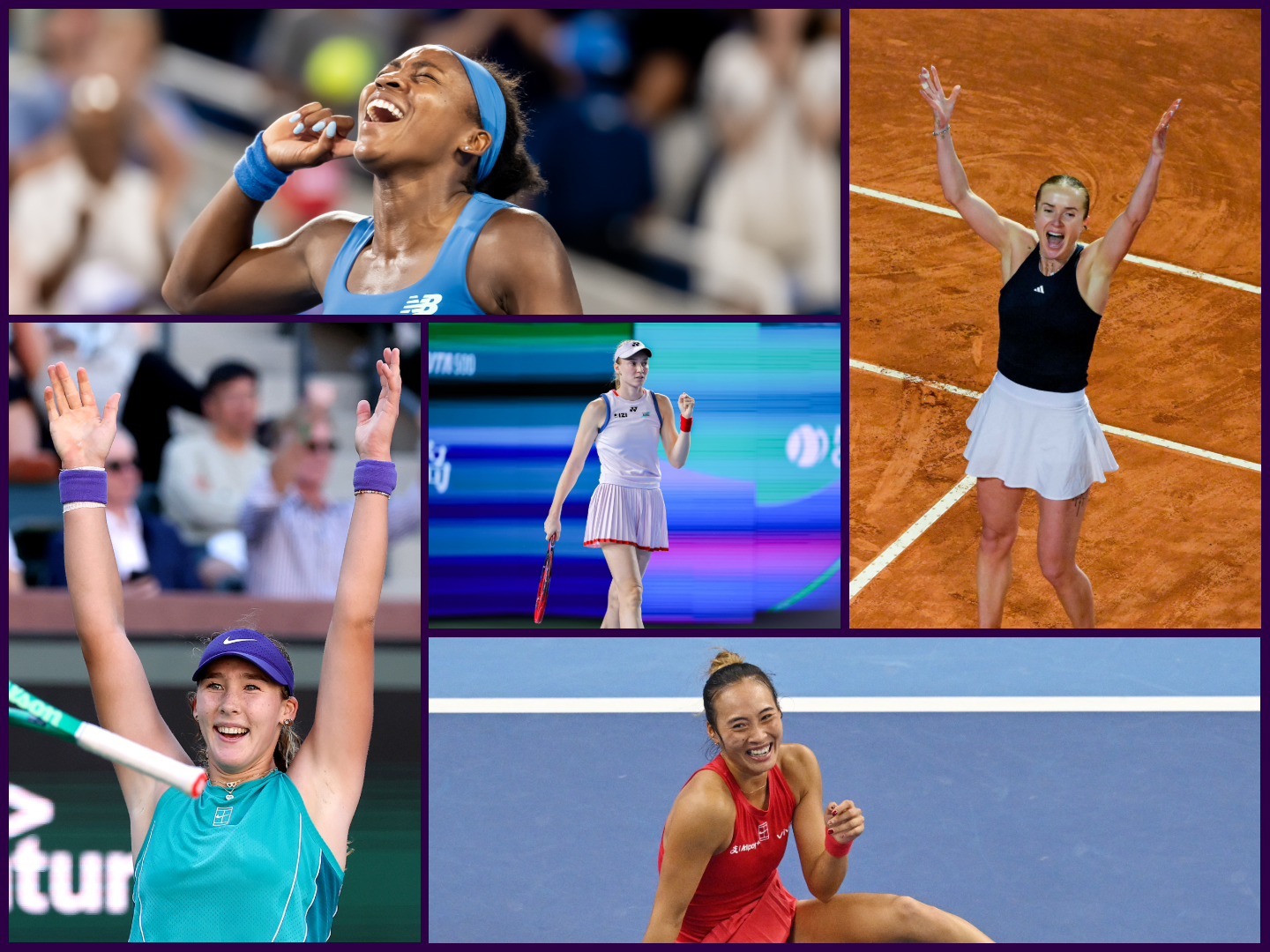
WTA 2026 in Numbers: Established Stars Hold Firm as a New Generation Breaks Through
This week, we break down some of the key numbers behind the 2025 WTA Tour season — from first-time milestones to noteworthy upsets and from the longest matches to the best three-set records.
Part one of the 2026 statistics wrap covers the season’s champions and finalists. Watch every championship point of the season above.
Champions, finals and the balance of power
The 2026 season saw 40 different champions across 54 tournaments in 26 countries or territories on every inhabited continent, underscoring the depth that now characterises the women’s game under the global calendar administered by the Women’s Tennis Association.
World No. 1 Elena Rybakina and World No. 2 Mirra Andreeva claimed tour‑leading title hauls of four trophies each, and were two of nine multiple titlists this season. In a year with four Grand Slams, WTA 1000, 500 and 250 events plus the season‑ending WTA Finals, that level of repeat success marks them out as the central figures around which the tour is currently organised.
The full breakdown of champions by tournament level is as follows:
4 titles: Elena Rybakina (2 x Grand Slam, 2 x WTA 500); Mirra Andreeva (1 x Grand Slam, 1 x WTA Finals, 2 x WTA 500)
3: Aryna Sabalenka (2 x WTA 1000, 1 x WTA 500)
2 (1 x Grand Slam, 1 x WTA 500): Linda Noskova
2 (1 x WTA 1000, 1 x WTA 500): Karolina Muchova, Jessica Pegula
2 (1 x WTA 1000, 1 x WTA 250): Marta Kostyuk, Elina Svitolina
2 x WTA 250: Marie Bouzkova
1 x WTA 1000: Maja Chwalinska, Coco Gauff, Iga Swiatek, Zheng Qinwen
1 x WTA 500: Sara Bejlek, Cristina Bucsa, Alexandra Eala, Leylah Fernandez, Iva Jovic, Emma Navarro, Diane Parry, Diana Shnaider, Donna Vekic
1 x WTA 250: Kimberly Birrell, Katie Boulter, Sorana Cirstea, Elisabetta Cocciaretto, Harriet Dart, Madison Keys, Tamara Korpatsch, Barbora Krejcikova, Magda Linette, Claire Liu, Kristina Liutova, Petra Marcinko, Robin Montgomery, Kaitlin Quevedo, Mayar Sherif, Katerina Siniakova, Peyton Stearns, Lilli Tagger
Rybakina and Andreeva also reached the joint‑most finals of any player in 2026, with six each, and were two of 21 players who contested multiple finals this year (ordered by record in finals):
4-2: Mirra Andreeva, Elena Rybakina
3-2: Aryna Sabalenka
2-3: Jessica Pegula
2-2: Karolina Muchova, Elina Svitolina
2-1: Marta Kostyuk
2-0: Marie Bouzkova, Linda Noskova
1-2: Leylah Fernandez, Coco Gauff
1-1: Maja Chwalinska, Alexandra Eala, Iva Jovic, Tamara Korpatsch, Barbora Krejcikova, Emma Navarro, Peyton Stearns, Lilli Tagger
0-3: Victoria Mboko
0-2: Emma Raducanu
Those records underline both consolidation at the very top and a broad chasing pack. Rybakina’s and Andreeva’s ability to turn deep runs into titles is the bedrock of their positions at the front of the Race and their seeding security at the biggest events, while Sabalenka’s WTA 1000 tally keeps her central to the hard‑court swing narrative.
First‑time champions and finals: turnover accelerates
Thirteen players captured their first tour‑level title in 2026 (compared to six in 2025), a sharp rise that points to increasing mobility through the rankings and greater opportunity for players emerging from ITF and qualifying circuits.
First‑time title winners in 2026
- Sara Bejlek – Abu Dhabi
- Cristina Bucsa – Merida
- Petra Marcinko – Rabat
- Robin Montgomery – ’s‑Hertogenbosch
- Lilli Tagger – Prague
- Alexandra Eala – Washington
- Kristina Liutova – Memphis
- Diane Parry – Monterrey
- Kaitlin Quevedo – Sao Paulo
- Kimberly Birrell – Seoul
- Maja Chwalinska – Wuhan
- Harriet Dart – Guangzhou
- Claire Liu – Hong Kong
Liutova was competing in her first tour‑level event and became the 10th player in history to win the tournament on her WTA main‑draw debut, a rarity that has immediate implications for her ranking protection and entry status. Quevedo was competing in her eighth tour‑level main draw, Tagger in her 10th and Marcinko in her 12th, illustrating how differing development pathways can still converge in the same breakthrough tier.
First‑time finalists in 2026 (title winners asterisked):
- Sara Bejlek, Abu Dhabi*
- Taylor Townsend, Austin
- Yuliia Starodubtseva, Charleston
- Panna Udvardy, Bogota
- Veronika Podrez, Rouen
- Petra Marcinko, Rabat*
- Maja Chwalinska, Roland Garros
- Robin Montgomery, ’s‑Hertogenbosch*
- Daria Snigur, Prague
- Kristina Liutova, Memphis*
- Darja Vidmanova, Memphis
- Diane Parry, Monterrey*
- Kaitlin Quevedo, Sao Paulo*
- Nadia Podoroska, Sao Paulo
- Talia Gibson, Singapore
- Harriet Dart, Guangzhou*
Liutova and Podrez were competing in their first WTA main draws, Vidmanova in her seventh, and Chwalinska and Quevedo in their eighth. In ranking and scheduling terms, those runs secure direct entry into higher‑grade events and can reshape draws for the following season, as these players move out of qualifying and into seeded contention at 250‑level tournaments.
Age spectrum: teenagers rise, veterans still deliver
The youngest champion of 2026 was 16‑year‑old Kristina Liutova in Memphis, and the oldest was 35‑year‑old Sorana Cirstea in Cluj‑Napoca. Harriet Dart, 30, became the oldest first‑time titlist in Guangzhou since a 32‑year‑old Arantxa Rus won Hamburg 2023.
Liutova’s Memphis result was one of seven title runs by teenagers in 2026, along with:
- Lilli Tagger – Prague (18 years old at the time)
- Mirra Andreeva – Adelaide and Linz (18 years old at the time); Roland Garros and the WTA Finals Indian Wells (19 years old at the time)
- Iva Jovic – Guadalajara (18 years old at the time)
From a tour‑wide perspective, that volume of teenage champions affects wild‑card strategies and development‑pathway discussions. Andreeva’s ability to translate junior promise into multiple titles across surfaces and tiers – including a Grand Slam and the WTA Finals – cements her as a long‑term pillar of the calendar, while Cirstea’s success at 35 reinforces the viability of extended careers under current training and scheduling norms.
Qualifiers, lucky losers and wild cards: disruption from below
One lucky loser won a title in 2026: Donna Vekic at Queen’s. Vekic lost to Anna Blinkova in the final qualifying round but went on to lift her fifth career trophy, and first at WTA 500 level. The Croatian became the seventh lucky loser in WTA history to win a tournament, the first since Sara Sorribes Tormo at Cleveland 2023 and the first to do so above WTA 250 level. Such an outcome reinforces the competitive density in qualifying draws and can influence future debate over entry‑list sizes and byes at 500‑level events.
Five qualifiers won titles in 2026: Elisabetta Cocciaretto (Hobart), Sara Bejlek (Abu Dhabi), Robin Montgomery (’s‑Hertogenbosch), Kristina Liutova (Memphis) and Harriet Dart (Guangzhou).
Two qualifiers were finalists in 2026: Veronika Podrez (Rouen) and Maja Chwalinska (Roland Garros). Chwalinska became the second qualifier to reach a Grand Slam final in the Open Era, following 2021 US Open champion Emma Raducanu, and the first to do so at Roland Garros. That kind of run has structural consequences for seeding in the next four Slams and demonstrates how the existing qualifying system keeps Grand Slam draws open to rapid movers.
Wild cards also impacted the title picture:
- One wild card won a title in 2026: Zheng Qinwen (Beijing).
- Two wild cards were finalists in 2026: Taylor Townsend (Austin) and Victoria Mboko (Strasbourg). Mboko was also the No. 1 seed in Strasbourg.
Seven players ranked beneath No. 100 won a title in 2025 — in ranking order at the time:
- No. 484 Robin Montgomery – ’s‑Hertogenbosch
- No. 229 Kristina Liutova – Memphis
- No. 120 Katie Boulter – Ostrava
- No. 115 Harriet Dart – Guangzhou
- No. 105 Kaitlin Quevedo – Sao Paulo
- No. 102 Claire Liu – Hong Kong
- No. 101 Sara Bejlek – Abu Dhabi
Excluding unranked players, Montgomery became the third‑lowest ranked WTA champion in rankings history, following No. 579 Angelique Widjaja at Bali 2001 and No. 508 Elina Svitolina at Strasbourg 2023. Two unranked players have won WTA titles: Mirjana Lucic‑Baroni at Bol 1997 and Kim Clijsters at the US Open 2009. These outlier title runs test the resilience of the seeding system and highlight how quickly a player can move from outside the top 400 into direct‑entry contention for higher‑level events.
Nine further players ranked beneath No. 100 were finalists in 2025 — in ranking order at the time:
- No. 317 Nadia Podoroska – Sao Paulo
- No. 209 Veronika Podrez – Rouen
- No. 170 Sonay Kartal – Wuhan
- No. 124 Tamara Korpatsch – Ostrava
- No. 119 Taylor Townsend – Austin
- No. 115 Paula Badosa – Iasi
- No. 114 Maja Chwalinska – Roland Garros
- No. 114 Darja Vidmanova – Memphis
- No. 112 Tatjana Maria – Eastbourne
For tournament organisers, that number of lower‑ranked finalists validates investment in qualifying and regional events, as local or emerging players are increasingly able to convert opportunities into late‑week appearances.
Defending champions and home‑soil stories
The season’s title defenses panned out as follows:
Brisbane: Aryna Sabalenka defended her title
Auckland: Clara Tauson competed in Brisbane instead
Adelaide: Madison Keys lost QF to Victoria Mboko
Hobart: McCartney Kessler lost R1 to Olga Danilovic
Australian Open: Madison Keys lost R4 to Jessica Pegula
Abu Dhabi: Belinda Bencic did not play
Cluj‑Napoca: Anastasia Potapova lost QF to Sorana Cirstea
Ostrava: held for the first time since 2022; the most recent champion, Barbora Krejcikova, did not play
Doha: Amanda Anisimova lost R2 to Karolina Pliskova (via retirement)
Dubai: Mirra Andreeva lost QF to Amanda Anisimova
Merida: Emma Navarro lost R2 to Zhang Shuai
Austin: Jessica Pegula did not play
Indian Wells: Mirra Andreeva lost R3 to Katerina Siniakova
Miami: Aryna Sabalenka defended her title
Charleston: Jessica Pegula defended her title
Bogota: Camila Osorio lost R2 to Jazmin Ortenzi
Linz: Ekaterina Alexandrova lost R2 to Karolina Pliskova
Stuttgart: Jelena Ostapenko lost R1 to Mirra Andreeva
Rouen: Elina Svitolina competed in Stuttgart instead
Madrid: Aryna Sabalenka lost QF to Hailey Baptiste
Rome: Jasmine Paolini lost R3 to Elise Mertens
Strasbourg: Elena Rybakina did not play
Rabat: Maya Joint competed in Strasbourg instead
Roland Garros: Coco Gauff lost R3 to Anastasia Potapova
Queen’s: Tatjana Maria lost R2 to Elena Rybakina (a reverse of the 2025 quarterfinal)
’s‑Hertogenbosch: Elise Mertens lost R2 to Elena‑Gabriela Ruse (a reverse of the 2025 final)
Berlin: Marketa Vondrousova did not play
Nottingham: McCartney Kessler lost R1 to Katie Volynets
Bad Homburg: Jessica Pegula did not play
Eastbourne: Maya Joint lost R1 to Emiliana Arango
Wimbledon: Iga Swiatek lost R3 to Alexandra Eala
Athens: inaugural tournament, the first held in the city since 1990
Iasi: Irina‑Camelia Begu did not play
Prague: Marie Bouzkova lost QF to Tereza Valentova (a reverse of the 2025 semifinal)
Hamburg: Lois Boisson did not play
Washington: Leylah Fernandez lost R2 to Alexandra Eala
Toronto: Victoria Mboko did not play
Cincinnati: Iga Swiatek lost SF to Jessica Pegula
Monterrey: Diana Shnaider did not play
US Open: Aryna Sabalenka lost F to Elena Rybakina
Guadalajara: Iva Jovic defended her title
Sao Paulo: Tiantsoa Rakotomanga Rajaonah did not play
Singapore: Elise Mertens lost QF to Maja Chwalinska
Seoul: Iga Swiatek did not play
Beijing: Amanda Anisimova did not play
Wuhan: Coco Gauff did not play
Ningbo: Elena Rybakina defended her title
Osaka: Leylah Fernandez competed in Ningbo instead
Tokyo: Belinda Bencic did not play
Guangzhou: Ann Li competed in Tokyo instead
Hong Kong: Victoria Mboko did not play
Chennai: Janice Tjen lost F to Magda Linette
There were five successful title defenses in 2026: Aryna Sabalenka (Brisbane, Miami), Jessica Pegula (Charleston), Iva Jovic (Guadalajara) and Elena Rybakina (Ningbo). Sabalenka has successfully defended six titles in her career, Pegula has defended two and both Jovic and Rybakina defended a title for the first time. In ranking and seeding terms, those defenses are significant: repeat champions preserve large point blocks, stabilising their positions across multiple seasons and influencing the distribution of seeds at the majors and WTA 1000 events.
Six players claimed a title on home soil in 2025:
- Sorana Cirstea (ROU) – Cluj‑Napoca
- Peyton Stearns (USA) – Austin
- Jessica Pegula (USA) – Charleston
- Tamara Korpatsch (GER) – Hamburg
- Coco Gauff (USA) – Cincinnati
- Zheng Qinwen (CHN) – Beijing
Hamburg native Korpatsch was the first German player to win a title in Germany since Angelique Kerber at Bad Homburg 2021, and Zheng was the first Chinese champion in Beijing in the tournament’s history. For national federations and host cities, those results strengthen the case for continued investment in home events as showcases for domestic talent.
Six finals between compatriots took place:
- Three all‑American finals: Peyton Stearns d. Taylor Townsend (Austin); Coco Gauff d. Jessica Pegula (Cincinnati); Iva Jovic d. Peyton Stearns (Guadalajara)
- One all‑Ukrainian final: Marta Kostyuk d. Veronika Podrez (Rouen)
- One all‑Czech final: Linda Noskova d. Karolina Muchova (Wimbledon)
- One all‑Australian final: Kimberly Birrell d. Maya Joint (Seoul)
Rouen marked the first all‑Ukrainian final in WTA history, and Wimbledon the first all‑Czech Grand Slam final in the Open Era. Seoul marked the first all‑Australian final since Samantha Stosur defeated Daria Saville to win Strasbourg 2017. These match‑ups carry added meaning for national programmes, with ranking points and prize‑money gains concentrated among compatriots within the same federation structures.
Dominant title runs and endurance tests
There were seven title runs in 2026 without the loss of a set:
- Aryna Sabalenka – Brisbane (dropped 27 games in 5 matches)
- Mirra Andreeva – Adelaide (15 games in 4 matches)
- Sorana Cirstea – Cluj‑Napoca (23 games in 5 matches)
- Madison Keys – Eastbourne (23 games in 5 matches)
- Iva Jovic – Guadalajara (24 games in 4 matches)
- Claire Liu – Hong Kong (32 games in 5 matches)
- Mirra Andreeva – WTA Finals Indian Wells (26 games in 5 matches)
Andreeva dropped both the fewest total games en route to a title (15) and the fewest games per match (3.75) in Adelaide, a level of dominance that reinforces her case for top seeding at similar‑surface events and underlines the gap she has opened on that particular swing.
A series of champions had to navigate heavier workloads:
- Peyton Stearns – Austin (dropped 3 sets in 5 matches)
- Jessica Pegula – Charleston (4 sets in 5 matches)
- Elina Svitolina – Rome (3 sets in 6 matches)
- Emma Navarro – Strasbourg (3 sets in 5 matches)
- Donna Vekic – Queen’s (3 sets in 7 matches, including qualifying)
- Linda Noskova – Wimbledon (3 sets in 7 matches)
- Tamara Korpatsch – Hamburg (3 sets in 5 matches)
- Kristina Liutova – Memphis (4 sets in 6 matches, including qualifying)
- Elena Rybakina – US Open (3 sets in 7 matches)
- Zheng Qinwen – Beijing (4 sets in 7 matches)
- Maja Chwalinska – Wuhan (3 sets in 6 matches)
- Diana Shnaider – Tokyo (3 sets in 4 matches)
- Harriet Dart – Guangzhou (6 sets in 7 matches, including qualifying; 5 sets in 5 main‑draw matches)
- Magda Linette – Chennai (4 sets in 5 matches)
Zheng conceded 78 games in Beijing — the second‑highest number of games dropped in main‑draw matches en route to a WTA title in the Open Era, behind only Madison Keys’ 87 dropped at the Australian Open 2025. Three weeks later, Dart conceded 80 games in Guangzhou, 63 of which were in the main draw. The Briton became the third player this century to win a WTA title after playing three‑setters in every main‑draw round, following Anastasia Pavlyuchenkova at Paris 2014 and Christina McHale at Tokyo (Japan Open) 2016.
Those heavy‑load title runs highlight another side of modern scheduling: players are increasingly capable of sustaining high‑intensity tennis across back‑to‑back weeks, but such campaigns can also shape decisions about entries and withdrawals on subsequent swings.
Champions who survived match points
Four players won a title after facing match point in 2025:
- Aryna Sabalenka – Indian Wells (saved one vs. Elena Rybakina in the final)
- Elena Rybakina – Stuttgart (saved two vs. Leylah Fernandez in the quarterfinals)
- Linda Noskova – Wimbledon (saved one vs. Sorana Cirstea in the third round)
- Harriet Dart – Guangzhou (saved two vs. Sun Xinran in the semifinals)
One final took place between players who had both faced match point to get there. Wimbledon runner‑up Karolina Muchova saved one against Coco Gauff in the semifinals. For all four champions, those saved match points not only preserved significant ranking points but also altered the competitive shape of the events involved, turning single‑point margins into landmark titles that will influence seedings and draws into 2027.
Related reading
