
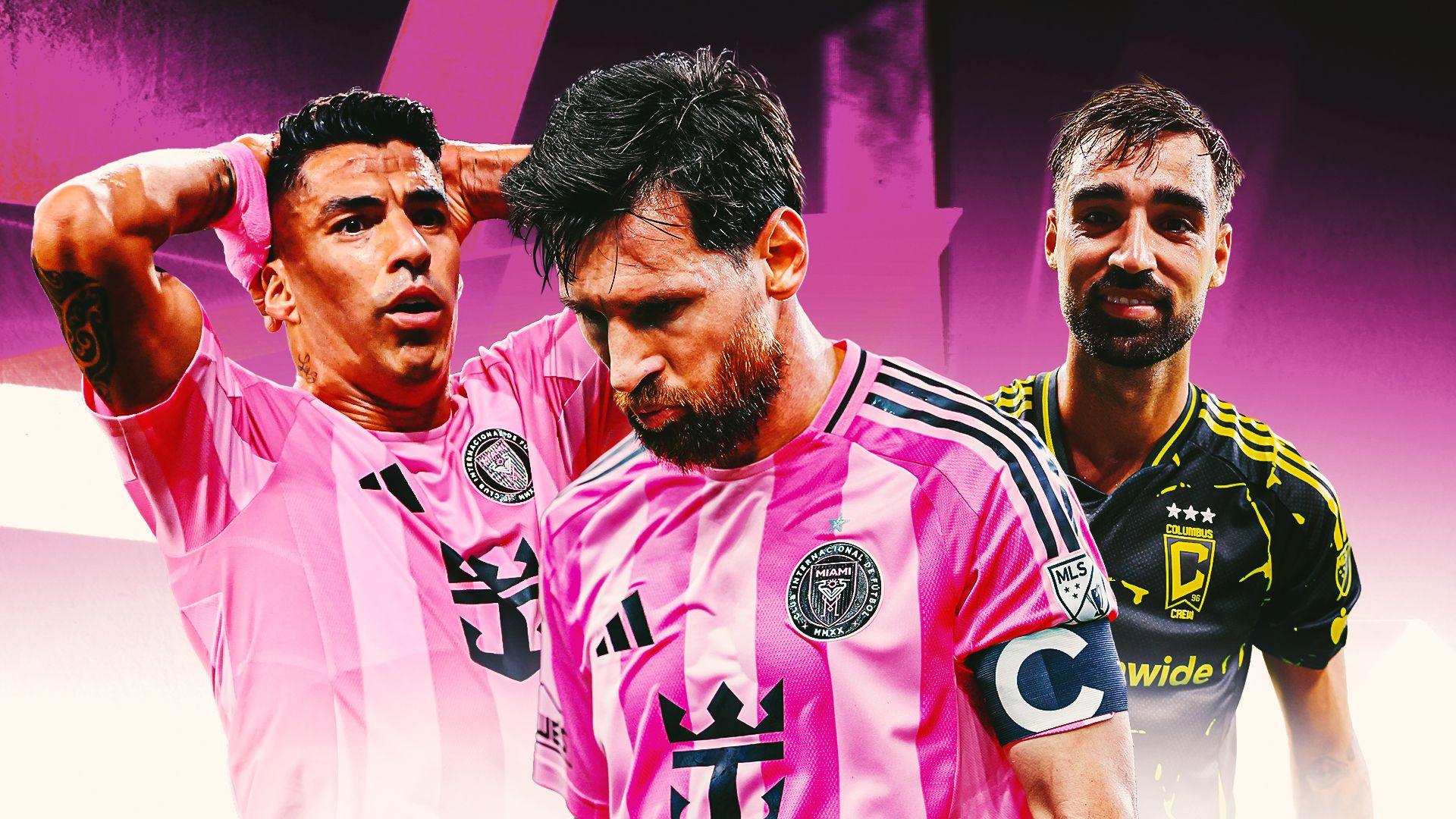
Inter Miami’s Galáctico Gamble: Glamour Up Front, No Engine in Midfield
A reshuffle that pushed Hoyos to the touchline
And then came Hoyos, who arrived as part of an organizational reshuffle. Formerly the Sporting Director – or, more accurately, Messi’s representative when needed – Hoyos was unsuited to life as manager. Mascherano was hardly praised for his tactical nous. Hoyos was worse. Mascherano had the nerve to bench Luis Suarez, so clearly a defensive liability for an already struggling Miami team. Hoyos, meanwhile, did not. Instead, he ensured that Suarez, Messi and the misfiring big-money signing German Berterame all start together.
That decision crystallised the broader strategic dilemma facing the club. The move from the boardroom to the bench placed a figure whose strengths lay in recruitment and player management into a role that, at MLS level, demands detailed game-planning and in‑game adjustment. Line‑up choices became the most visible symptom of that misalignment.
An attacking trio without balance
The imbalance was comical. Berterame, a No.9 lauded for his ability to stretch central defenders with his pace in behind, was tasked with playing on the left. Suarez slotted in at center forward and tried to run a lot. But he can’t. The Uruguayan, at 39, simply does not have the legs to make an impact without the ball. He has won the ball just 11 times in the final third all season. Messi, who has some of the worst defensive stats in the league, has won the ball more.
In a league that has grown steadily more athletic and transition‑driven under the competition framework overseen by Major League Soccer, a front line built around ageing stars places intense physical and positional demands on the rest of the side. When all three occupy central zones, opponents can play through pressure easily and attack directly into space behind Miami’s advanced full-backs.
Positioning Berterame wide left removed his primary threat – runs through the middle that fix centre-backs – and offered little support without the ball. With Suarez unable to lead an aggressive press and Messi naturally conserving energy for decisive actions in possession, Miami’s first line of defence became almost symbolic. The knock‑on effect was predictable: the midfield and back line were repeatedly asked to absorb waves of attacks with limited protection in front of them.
Midfield needs ignored in the transfer market
And then came the signature summer signing. What Miami needed, in any form, was midfield legs – a proper box-to-box guy who could do all of the dirty work – a soloist who could do the running for three. And there were plenty out there. Presumably, The Herons could have had options. But where, say, a player like Yunus Musah could have been an ambitious target, they went for Casemiro. This was a player so slow, so languid, that he became the subject of a meme when Jamie Carragher famously advised him on live television to ‘leave the football, before the football leaves you.’
Casemiro was implored to retire. Instead, he signed for Miami.
The recruitment choice underlined a clear philosophical tension. Miami’s on‑field profile cried out for an energetic midfielder capable of covering wide areas, supporting both full-backs and forwards, and bridging the large distances created by a front three that does not consistently track back. Instead, the club doubled down on celebrity and experience.
Casemiro’s pedigree as a multiple Champions League winner and long‑time international is unquestioned. However, recent debates around his mobility highlighted how far the modern holding role in top‑level football has evolved. In MLS, where travel demands and climate already test player conditioning across a 34‑match regular season and additional cup commitments, adding another veteran to the spine amplifies concerns about intensity over an entire campaign.
Tactical consequences across the pitch
Layered together, these choices create a structure that is difficult to sustain over 90 minutes, let alone across a season marked by midweek fixtures and cross‑conference travel:
- A manager promoted from a sporting role, lacking a clear, coherent pressing scheme.
- An attacking trio built around Messi, Suarez and Berterame, with all three naturally drawn to central attacking positions.
- A marquee midfield signing in Casemiro whose profile does not resolve – and may accentuate – the team’s physical deficit in the centre of the pitch.
For opponents with younger, more dynamic midfields, the blueprint against Miami becomes straightforward: withstand spells of individual brilliance from the stars, then exploit space in transition where Miami’s second line cannot arrive quickly enough to contest the ball.
Implications for results, squad building and governance
In a salary‑capped, roster‑regulated environment, every high‑profile move carries structural consequences. The decision to devote a key slot to Casemiro limits flexibility to add the box‑to‑box runner the system so obviously lacks. Committing to a manager whose primary background is in representation and recruitment rather than coaching narrows the scope for tactical course‑correction from the dugout.
The result is a squad whose commercial and branding appeal is extraordinary, but whose competitive profile is fragile. In a league where parity mechanisms are designed to prevent long‑term dominance, misallocating top‑end resources can quickly drag a club from title contention towards the margins of the postseason race.
For the players involved, these choices also shape career narratives. Suarez, at 39, is being asked to perform defensive tasks his body can no longer reliably execute. Messi’s creative contribution must constantly compensate for systemic weaknesses behind him. Berterame, signed for his ability to stretch defences centrally, is judged in a role that obscures his strengths. Casemiro, meanwhile, arrives under intense scrutiny, cast less as a solution and more as the symbol of a project tilting towards sentiment.
A project defined by its compromises
None of this diminishes the individual quality of the names involved. Collectively, they have shaped an era of the sport. But at club level, the Miami experiment has become a case study in the trade‑offs that come with chasing global star power without a fully aligned tactical and recruitment plan.
The balance between the boardroom and the bench, between commercial ambition and football logic, is now central to Miami’s prospects. If those institutional choices remain unchanged – with Hoyos on the touchline, Suarez fixed at centre forward, Berterame stranded on the left and Casemiro anchoring a midfield that still lacks legs – the club will continue to rely on moments of genius rather than a sustainable structure.
Worth a look
