
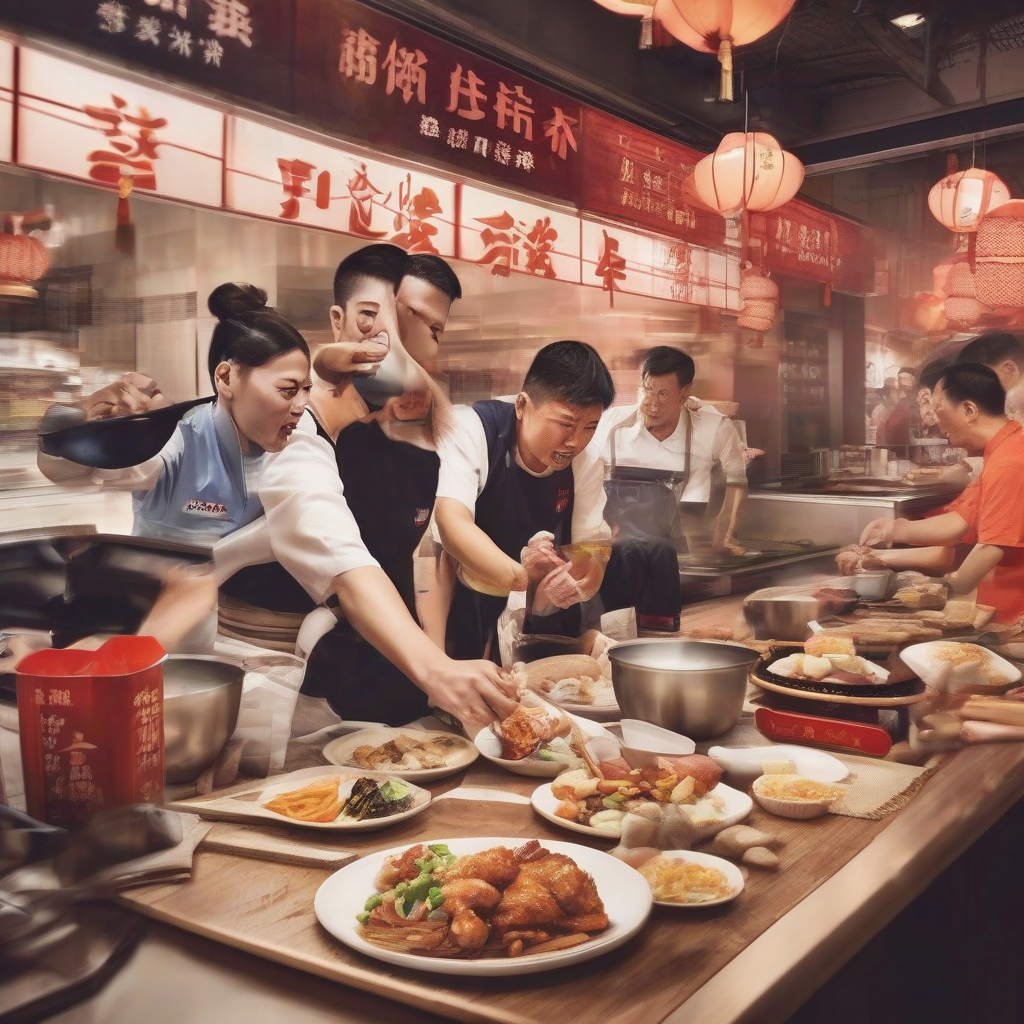
SINGAPORE – Chinese food and beverage (F&B) brands are rapidly expanding across the city-state’s retail hubs, utilizing Singapore as a strategic launchpad for broader Asian expansion amid a severe domestic crisis in mainland China.
This surge is driven by a structural phenomenon known as “involution” (neijuan), a state of excessive internal competition in China where companies prioritize global legitimacy and brand visibility over immediate profitability in the Singaporean market.
The domestic crisis of “involution”
The exodus of brands from mainland China follows a period of extreme market saturation. In 2024, approximately three million food businesses closed across China. In the first half of 2024 alone, over one million businesses shut down, marking a 70% increase compared to 2023.
Economists describe this as a cycle where companies compete for the same or shrinking demand by aggressively cutting prices, driving margins down to the point where survival replaces growth as the primary objective. In consumer sectors such as F&B and retail, this has translated into relentless discounting campaigns that condition customers to expect lower prices and shorter product cycles.
This dynamic is evident in several sectors:
- Coffee: Luckin Coffee pushed latte prices to RMB¥9.9 (S$2), only to be undercut by newer entrants like Lucky Cup, which sold coffee for RMB¥6.6 (S$0.90).
- Electric Vehicles: BYD has actively cut prices to defend market share, leading to its first annual profit decline in four years by March 2026.
- Scaling: Lucky Cup, backed by Mixue, expanded to over 10,000 stores across 300+ cities using a high-volume, low-margin model.
BYD Chairman Wang Chuanfu has described the industry as having reached a “boiling point,” where sales growth no longer guarantees sustainable profits.
Singapore as a “legitimacy stamp”
For these brands, Singapore is not the final destination but a tool for regional branding. The city-state’s high per-capita GDP in terms of purchasing power parity (PPP), its reputation for strict food safety and licensing oversight under the Singapore Food Agency, and its status as the first Southeast Asian city to receive a Michelin Guide make it a high-value testing ground.
Executives view a successful Singaporean presence as a prerequisite for succeeding elsewhere in Asia. A foothold in the Central Business District or iconic malls confers a form of “regulatory and consumer due diligence” that can be showcased to prospective landlords, franchisees and investors in neighbouring markets.
“If we can build up our brand in Singapore, the brand awareness can go to Malaysia and Vietnam, even Indonesia,” the Singapore manager for ChaPanda stated.
Luckin Coffee CEO Guo Jinyi described the city-state as a “critical testing ground” for refining operational systems and understanding overseas business models. Other brands, such as tea chain Tai Er, used Singapore as a regional stepping stone before entering the US market by 2023.
For Singapore policymakers, this wave of entrants dovetails with long-standing ambitions to position the country as a regional headquarters and innovation node, but also raises questions about how far the city-state should rely on foreign capital-heavy chains to animate its streetscapes and malls.
The “marketing expense” financial model
The ability of these brands to withstand Singapore’s high operational costs is rooted in vertically integrated supply chains and massive domestic scale. By controlling multiple stages of production in-house-from coffee roasting and ingredient processing to packaging-they avoid the costs associated with outsourced suppliers and can negotiate logistics at scale.
Luckin Coffee’s vertical integration allows for extreme cost efficiency in consumables. Across its 30,000-store network, packaging materials and straws cost approximately RMB¥210 million (S$39 million), averaging S$3.58 per store per day.
This scale allows the companies to treat Singaporean outlets as marketing expenses rather than profit centers:
- Rent Bidding: While local tenants may offer S$36 to S$38 per square foot, Chinese brands have been known to bid S$45, exceeding landlord expectations and effectively resetting rental benchmarks in prime locations.
- Loss Absorption: In financial year 2024, Luckin’s Singapore operations reported losses of RMB¥47 million (S$8.8 million). However, these were absorbed by a total revenue of over RMB¥34.5 billion (S$6.4 billion) and an operating profit of RMB¥3.5 to 3.9 billion from its China business.
In boardrooms, Singapore outlets are often framed less as standalone P&L units and more as “showcase stores” whose value lies in social media visibility, landlord relationships and investor signalling across the region.
Scale is a defining characteristic of the current wave of entrants:
- Pang Pang (Bugis): Over 600 outlets in China; sells 50 million pots annually.
- Xiao Yu Hao (Raffles Place): 800 outlets in China.
- Xita Lao Tai Tai (Bugis+): 600 outlets in China.
- Yeah Gelato (Tampines): 168 outlets in China.
Pressure on local incumbents
The influx has coincided with a period of high volatility for local operators. In 2024, 3,047 businesses shut in Singapore, the highest figure in nearly two decades. Notable casualties include the 85-year-old heritage restaurant Ka-Soh and the Privé Group.
Local restaurateurs say they are squeezed from both sides: by rising input and labour costs and by landlords benchmarking rents to aggressive bids from mainland-backed chains. While authorities have generally taken a market-based approach to commercial leasing, the concentration of foreign brands in marquee locations is starting to feature more prominently in industry feedback to business chambers and trade agencies.
Ethan Hsu, head of retail at Knight Frank, described the current retail environment as “very Darwinian,” noting that large-scale Chinese investment has contributed to rising rents in high-traffic locations.
TungLok Group CEO Andrew Tjioe noted that many of these incoming brands are driven by global brand visibility rather than immediate profitability. For domestic SMEs that rely on cashflow from a handful of outlets, competing with chains willing to operate at a loss for years is often not viable.
The risk of rationalization
The sustainability of this model depends entirely on the continued strength of the parent company in China. When overseas expansion is no longer justifiable to shareholders or investors, consolidation typically follows, with weaker outlets shuttered and only flagship or strategically important stores retained.
Haidilao provides a precedent for this shift. After expanding to over 20 outlets in Singapore, the chain began a period of rationalization. Its Clarke Quay flagship closed in August 2025, following closures at Bedok Mall and Downtown East. A spokesperson for Haidilao cited rental pressures, outlet locations, and labour costs as the drivers for these closures.
For policymakers and regulators, such cycles complicate long-term planning around manpower, urban planning and heritage conservation. Officials must balance the benefits of foreign investment and consumer choice with the risk that rapid entries and exits can leave gaps in neighbourhood ecosystems and erode the diversity of homegrown brands.
While many newer entrants are backed by private equity or venture capital-providing “patient capital”-they must still demonstrate a path to profitability within two to three years to maintain funding. Should the funding environment tighten, Singapore’s F&B landscape could see a sharp shake-out as investors force management teams to concentrate resources on core markets.
As of August 2025, approximately 85 Chinese F&B brands operated 405 outlets in Singapore, an increase from 32 brands and 184 outlets recorded one year prior. Against the backdrop of Singapore’s broader pro-enterprise framework and competition-law regime administered by the Competition and Consumer Commission of Singapore, policymakers are likely to face growing pressure from local operators to scrutinise how sustained above-market rent bidding and loss-leading strategies reshape the playing field.
- Urban Infrastructure Resilience: How European and Asian Megacities Are Adapting to Extreme Climate Oscillations in 2026
- UN General Assembly 2026 Framework on Autonomous Systems: International Diplomacy Faces Algorithmic Governance
- Japan vs China: 2026 Asian Games Men’s Basketball Semifinal Guide (archysport.com)
