
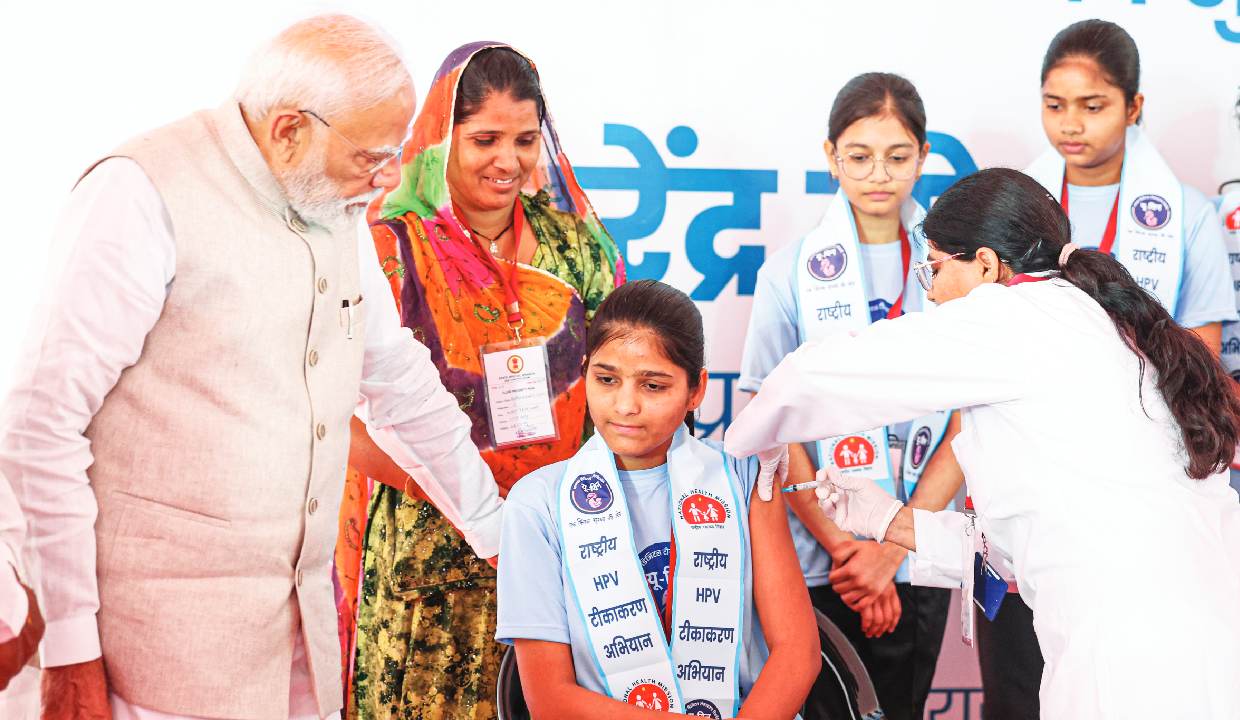
India launches nationwide HPV vaccination drive for 14-year-old girls
Prime Minister Narendra Modi launched a nationwide Human Papillomavirus (HPV) vaccination campaign for 14-year-old girls from Ajmer in Rajasthan, formally inaugurating the effort at a programme in Kayad where several girls received the first jabs. The prime minister also met beneficiaries at the event, underscoring a prevention-first approach to cervical cancer and signalling that adolescent girls’ health is now a priority within India’s broader universal immunisation agenda.
The drive forms part of a centrally supported initiative under the Union Health Ministry, with the vaccination to be integrated into routine services and financed as a public good rather than as an out-of-pocket expense for families. It is designed as a national rollout rather than a pilot, making state governments key implementing partners under India’s federal health governance framework.
What the campaign delivers
- Target group: 14-year-old girls across all states and union territories, including those not enrolled in school.
- Vaccine: “Gardasil 4,” a quadrivalent HPV vaccine covering types 16, 18, 6, and 11.
- Dose strategy: Single-dose schedule adopted for adolescent girls, in line with current global scientific consensus and national expert recommendations.
- Launch setting: Programme held in Kayad, Ajmer (Rajasthan), with on-site vaccinations and symbolic first beneficiaries.
- Operational direction: An official communication dated February 25 set out how states will implement the campaign, including session planning, reporting formats, and timelines for coverage.
As set out in that communication: “All 14-year-old girls across the country will be administered a single dose of the ‘Gardasil 4’ vaccine at Government health facilities, including Ayushman Arogya Mandirs (Primary Health Centres), Community Health Centres, sub-district and district hospitals, and Government medical colleges and hospitals.” The directive effectively adds HPV vaccination to the package of nationally supported vaccines delivered through India’s Universal Immunization Programme, creating a formal obligation on states to plan, stock, and report on delivery.
Campaign snapshot
| Element | Details |
|---|---|
| Eligibility | Girls aged 14 years at the time of vaccination, as per age records or school registers. |
| Dose schedule | Single dose, with no routine booster currently planned for this cohort. |
| Vaccine product | Quadrivalent HPV vaccine “Gardasil 4.” |
| HPV types covered | 16 and 18 (oncogenic types linked to cervical cancer); 6 and 11 (commonly associated with genital warts). |
| Delivery points | Government facilities: Ayushman Arogya Mandirs (PHCs), CHCs, sub-district/district hospitals, and Government medical colleges/hospitals, with scope for school-based and outreach sessions where states choose to organise them. |
| Launch site | Kayad, Ajmer, Rajasthan, as the national inaugural venue. |
State health departments are expected to align these parameters with their own microplans, often using school records, local registers, and community health workers to identify eligible girls and minimise drop-outs between enumeration and vaccination.
Why a single-dose approach fits public-health evidence
- HPV types 16 and 18 are responsible for most cervical cancers worldwide; immunizing before exposure substantially reduces lifetime risk, particularly in settings with limited screening access.
- Single-dose schedules for adolescent girls are supported by global immunization guidance, enabling faster scale-up while preserving strong protection and making better use of constrained budgets.
- Program simplicity-one visit rather than two or three-reduces missed opportunities, improves completion, and lightens workload across facilities that are already managing multiple vaccine and primary-care sessions.
- Lower logistical burden helps cold-chain capacity stretch further, particularly in high-volume districts and remote blocks where transport and reliable power supply are recurrent bottlenecks.
For policymakers, the single-dose choice is also a fiscal decision: it reduces per-girl delivery costs, allowing the same budget envelope to cover a larger cohort and making it easier for finance departments to sustain the programme over multiple years.
Health system delivery, oversight, and safeguards
| Program area | Operational focus |
|---|---|
| Cold chain and logistics | Ensure continuous 2-8°C storage, batch tracking, and temperature monitoring from state depots to peripheral facilities, with contingency planning for power disruptions. |
| Workforce readiness | Briefings and refresher trainings for vaccinators and supervisors on single-dose protocol, eligibility verification, counselling, and documentation in line with national guidelines. |
| AEFI surveillance | Routine reporting and rapid review of Adverse Events Following Immunization within existing national surveillance protocols, overseen by district and state AEFI committees. |
| Data systems | Named-line lists at facility level; district aggregation to monitor coverage, stock, wastage, and session performance, feeding into national dashboards for oversight. |
| Session planning | Facility-based sessions at primary and secondary care points; outreach and school-based sessions where feasible to extend reach in low-access and high-mobility areas. |
| Communication | Clear, age-appropriate messaging for adolescents and guardians to build confidence in vaccine safety and purpose, pre-empt misinformation, and clarify that the vaccine prevents certain cancers but does not treat existing disease. |
These elements operate within India’s broader regulatory and safety framework for vaccines, including licensure and pharmacovigilance overseen by bodies such as the Central Drugs Standard Control Organization and the national AEFI surveillance system, which are mandated under the country’s drugs and public-health legislation.
Cervical cancer prevention pathway
- Vaccination in early adolescence interrupts high-risk HPV infections that drive cervical cancer over time, moving the system from late-stage treatment to primary prevention.
- Screening and timely treatment remain essential for adult women, complementing vaccination to reduce incidence and mortality and supporting India’s stated alignment with the World Health Organization’s cervical cancer elimination ambitions.
- Public programs typically see the impact of HPV vaccination accrue over years as vaccinated cohorts age into adulthood, requiring long-term monitoring of cancer registries and survey data.
For health planners, this means HPV vaccination must be treated as a multi-decade investment whose full benefits will materialise gradually, reinforcing the need for stable funding and institutional continuity beyond electoral cycles.
Equity and access considerations
- Reaching adolescents beyond routine facility attendance, including those out of school or in migratory and hard-to-reach communities, through mobile teams and community-based enumeration.
- Ensuring privacy and adolescent-friendly environments at vaccination sites to reduce stigma and hesitation, especially in conservative settings where discussion of reproductive health is sensitive.
- Language- and culture-sensitive engagement through community health workers to bolster informed uptake, with clear explanations that the vaccine is about cancer prevention and not linked to sexual activity permissions.
- Consistent supply across rural, tribal, and urban informal settlements to avoid geographic disparities, backed by timely fund flows and stock redistribution mechanisms between districts.
States will also need to monitor whether marginalised groups-such as girls from lower-income households or remote habitations-are being left behind, and adjust microplans and incentives accordingly.
Policy and system impact to monitor
- Coverage by district and equity gaps between urban and rural blocks, tracked through routine reporting and periodic independent assessments.
- Session completion rates and instances of missed opportunities at facilities, including cases where eligible girls visit for other services but are not offered the vaccine.
- Vaccine stock continuity and cold-chain performance during peak demand, with early warning mechanisms for impending shortages.
- AEFI reporting completeness and timely case assessment, to maintain public trust and meet the standards set out in India’s national immunization and vaccine-safety framework.
Over time, these monitoring indicators will inform any policy recalibration-such as expanding eligibility to additional age cohorts or adjusting delivery strategies-and will feed into India’s reporting under national health plans and global commitments, including the World Health Organization’s cervical cancer elimination initiative, which has set targets for HPV vaccination, screening, and treatment by 2030.
