
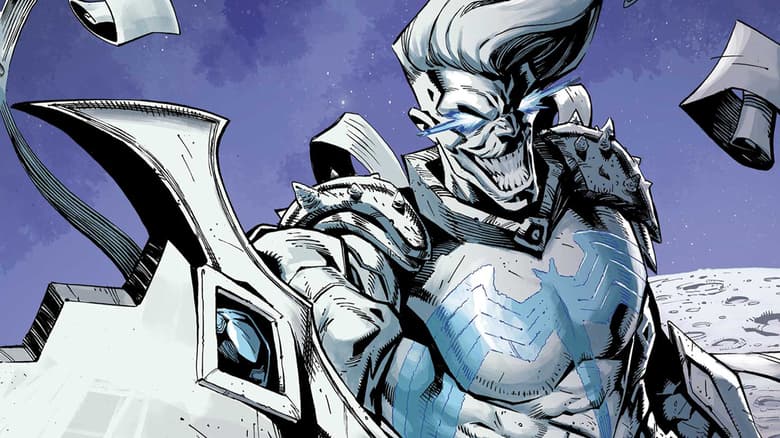
NEW YORK — QUEEN IN BLACK is being positioned as the next Marvel Comics crossover event built out of two currently running symbiote-focused titles, with the publisher outlining new status quo shifts for both Venom and Knull ahead of the event’s official announcement.
Marvel said the crossover spins out of the current run of VENOM (2025) by writer Al Ewing and artist Carlos Gómez and the newly launched KNULL (2026) limited series by Ewing, Tom Waltz, and artist Juanan Ramírez. The publisher’s framing puts Hela at the center of the event, stating that she “conquers the Marvel Universe” in the storyline.
Marvel ties the crossover to two ongoing series and a limited run
In outlining the crossover’s setup, Marvel emphasized that both Venom and Knull will receive “major upgrades” before the “Queen in Black makes her move,” and highlighted upcoming covers from VENOM and KNULL as early signals of the planned shifts. The company is again leaning on the event model that helped drive prior symbiote tentpoles like King in Black, using a core spine of titles to anchor tie-ins across its line.
Those covers, Marvel said, reveal “key developments” for the event, including new costumes for Mary Jane Watson—described as cementing her bond with the Venom symbiote—and for Knull, “befitting the God of the Abyss’ all-new power source—LIGHT.” Hela’s elevation to “Queen in Black,” seizing Knull’s throne in the wake of his earlier role as “God of the Symbiotes,” positions the character as both a narrative focal point and a recognizable figurehead for Marvel’s marketing push, following her broader profile boost from the studio’s film slate.
For the comics business, this kind of crossover architecture is a familiar mechanism: it links an event banner to multiple monthly and limited titles, concentrates marketing around cover-reveal moments, and encourages readership flow between series through coordinated story beats rather than standalone arcs. That structure also underpins how periodical comics are treated under U.S. publishing and copyright law, which grants creators and publishers exclusive rights over characters and storylines while allowing corporate owners like Marvel’s parent, Disney, to coordinate branding and licensing across media under frameworks such as the U.S. Copyright Act.
Mary Jane Watson’s new Venom status follows a confrontation in Venom #258
Marvel tied Mary Jane Watson’s new costume directly to continuity in VENOM, saying it spins out of a confrontation between Peter, MJ, and Venom in May’s VENOM #258. The publisher said the new costume debuts in VENOM #259 in June, positioning the redesign as a clear on-ramp for readers arriving via event coverage or retailer promotion.
Marvel also situated the issue’s character dynamics in the aftermath of DEATH SPIRAL, stating that Mary Jane Watson and Peter Parker “have a long overdue heart-to-heart,” before shifting back into superhero conflict: “when the masks go on, Venom and Spider-Man have some unfinished business.” The publisher added that “now that her secret is out,” MJ “fully embraces her symbiote strength,” leading to “a BIG change for Venom and MJ’s bond.” That emphasis on an emotional reset before a visual and power-level reset reflects Marvel’s recent efforts to present linewide events as character-driven rather than purely cosmetic.
Ewing described the new design as a story-driven escalation rather than a cosmetic refresh.
“MJ’s new look represents a ‘levelling up’ of sorts,” Ewing explained. “After her most serious challenge as Venom so far, it represents a reassessment of her relationship with the symbiote—just in time for an even bigger threat looming on the horizon.”
Retailers will be watching how heavily Marvel leans on variant covers and incentive ratios around these issues, amid ongoing debates in the direct market about sustainability, ordering risk, and the role of event-led sales spikes in a sector still informally guided by market standards rather than direct, medium-specific regulation by bodies like the U.S. Securities and Exchange Commission for listed parent companies.
Knull’s “LIGHT” power source signals a coordinated escalation across titles
Alongside MJ’s costume shift, Marvel’s most pointed single detail about Knull’s direction is the introduction of “LIGHT” as an “all-new power source” for the character, paired with a new costume. Framed as a “major upgrade,” it functions as an event-oriented signal: Marvel is setting up visible, high-concept changes to carry through promotional art, covers, and crossover branding, while in-story it inverts Knull’s traditional association with darkness and the Void.
In publishing terms, these “upgrade” beats are also practical. A new costume or power premise provides clean, legible entry points for casual readers, supports cover-led retail ordering, and creates distinct visual identifiers for later collected editions and digital storefront placements, even when story continuity is dense. They also help Marvel carve out clear phases in long-running intellectual properties, a consideration that matters for rights management, licensing, and international distribution as the company aligns comics storylines with broader franchise plans.
Mary Jane Watson’s new costume is set to debut in VENOM #259 in June, following the confrontation Marvel cited in May’s VENOM #258, as the publisher continues to position VENOM (2025) and KNULL (2026) as the immediate narrative launchpads for QUEEN IN BLACK. With Hela now installed as Queen in Black and Knull undergoing a recalibration around “LIGHT,” the stage is being set for an event designed to read as both a creative pivot and a commercial signal to retailers and readers that Marvel’s symbiote line is entering its next deliberate phase.
- Interactive Storytelling and Immersive Audio: How Next-Gen Gaming Engines Are Transforming Contemporary Television Production
- Independent Cinema’s New Distribution Paradigms: How Direct-to-Consumer Micro-Premiers Are Shifting Box Office Dynamics
- Venom frontman Conrad Cronos Lant dead at 63 (globallypulse.com)
- Mauritius secured the bronze medal in the mixed team event at the U19 All Africa Badminton (archysport.com)
