
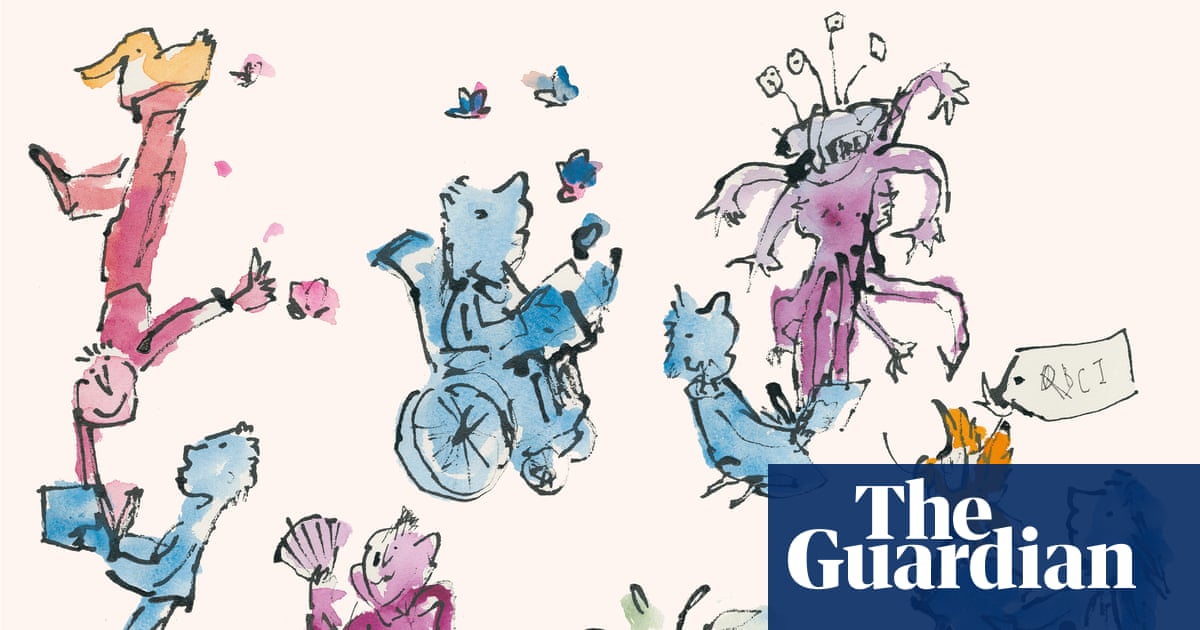
LONDON – The Quentin Blake Centre for Illustration is scheduled to open on June 5 within a 17th-century industrial complex in Clerkenwell.
The facility is positioned as the largest institution of its kind globally, serving as a permanent national home for an art form that informs children’s publishing, political cartoons, animation, fashion, and digital culture.
The establishment of the centre represents a structural attempt to move illustration from a peripheral role to a central position within British cultural and institutional life, aligning with broader debates over cultural value and the creative industries’ contribution to the UK economy.
Institutional Infrastructure and Archival Scale
The centre will eventually house the archive of Quentin Blake, consisting of 40,000 drawings.
Blake, 93, has spent 75 years illustrating works for authors including Roald Dahl, Michael Rosen, John Yeoman, Sylvia Plath, and Voltaire, in addition to his own authored books.
The institution is designed as a tripartite facility, functioning as a museum, a gallery, and a creative laboratory, with space for public exhibitions, conservation, and education programmes for schools and early-career illustrators.
“More needs to be done to recognise the importance of all illustration as an art form,” Blake stated. “What is particularly wonderful about it is that it’s a language everybody understands.”
Its creation also responds to longstanding concerns that illustration sits at the margins of cultural policy. Under the UK’s Creative Industries Sector Vision, illustration is formally grouped within the design and publishing economy, yet often lacks the institutional visibility enjoyed by major galleries and national museums.
Labour Standards, Credit and Professional Attribution
Industry professionals have highlighted a persistent trend of illustrators being viewed as secondary contributors rather than core creators, despite their central role in the commercial and educational success of children’s books.
Sarah McIntyre, an author-illustrator, launched the Pictures Mean Business campaign a decade ago to secure proper credit for illustrators, arguing that accurate attribution on covers, in metadata and in retailer listings directly influences contracts, advances and speaking invitations.
McIntyre noted that while writing a picture book can occasionally be completed in an hour, the illustration phase typically requires three to four months of intensive labour, often consisting of nine or more hours a day, six days a week.
Axel Scheffler, illustrator of The Gruffalo, described the profession as being “a bit in the shadow,” emphasizing that the collaborative process between author and illustrator is frequently underestimated.
The new centre is expected to provide a platform for these labour issues to be discussed more openly through residencies, commissioning policies and public events, in parallel with ongoing work by bodies such as the Authors’ Licensing and Collecting Society on fair remuneration for visual artists.
Data Gaps in Commercial Publishing
A significant discrepancy exists in the availability of commercial performance data between authors and illustrators.
McIntyre observed that while authors like Julia Donaldson have quantifiable bestselling status, illustrators such as Axel Scheffler often lack accessible sales data for the books they co-create.
According to McIntyre, this lack of data has a “trickle-down effect on how illustrators are perceived” within the industry, influencing everything from royalty negotiations to eligibility for public grants and prizes that rely on demonstrable market impact.
Industry groups have periodically called for more transparent reporting standards in publishing contracts and sales tracking systems, but implementation has been uneven across markets and formats, particularly in relation to tie-in merchandise and digital adaptations where artwork is reused.
Structural Integration of Visual and Textual Narrative
The technical execution of picture books typically involves a 32-page format where text and imagery are interdependent and page turns are used as narrative beats.
Jon Klassen, illustrator of I Want My Hat Back, utilizes a technique where images provide a context that may run counter to the written text.
“I usually end up putting a half truth in the words, or leaving a lot of things out,” Klassen said. “I think that helps with kids because, when the text is outright incorrect, they can see that the pictures are telling the truth.”
Other industry practitioners emphasize visual literacy as a cognitive tool. Ed Vere, creator of Waffles & Julius, cited an example where Blake used a drawing to explain the word “indignant” to children who did not know the definition, demonstrating the ability of illustration to communicate subtle emotional states.
Educators say this visual literacy dimension is increasingly relevant to policy discussions on reading standards, as children encounter stories through screens, games and graphic novels as much as through prose.
Intellectual Property, Franchise Scaling and Public Value
Early illustration often serves as the primary catalyst for large-scale intellectual property expansion.
Cressida Cowell, author and illustrator of the How to Train Your Dragon series, noted that a single pencil drawing of the character Hiccup created 30 years ago eventually expanded into 12 books, a movie series, and a theme park.
Similarly, Sue Hendra and Paul Linnet developed the Supertato series from an initial sketch into a franchise comprising 15 books.
Jamie Smart, creator of Bunny vs Monkey, leverages replicable character designs to lower the barrier for entry for child artists, contributing to a current boom in the publishing of comic books.
For policymakers, these examples underscore how a single illustrated character can underpin long-lived commercial ecosystems – from licensing and streaming agreements to visitor economies – reinforcing why illustration now features in debates over intellectual property duration, creator royalties and the stewardship of children’s cultural worlds under the UK’s Copyright, Designs and Patents Act 1988.
The Quentin Blake Centre for Illustration opens to the public on June 5.
Related reading
