
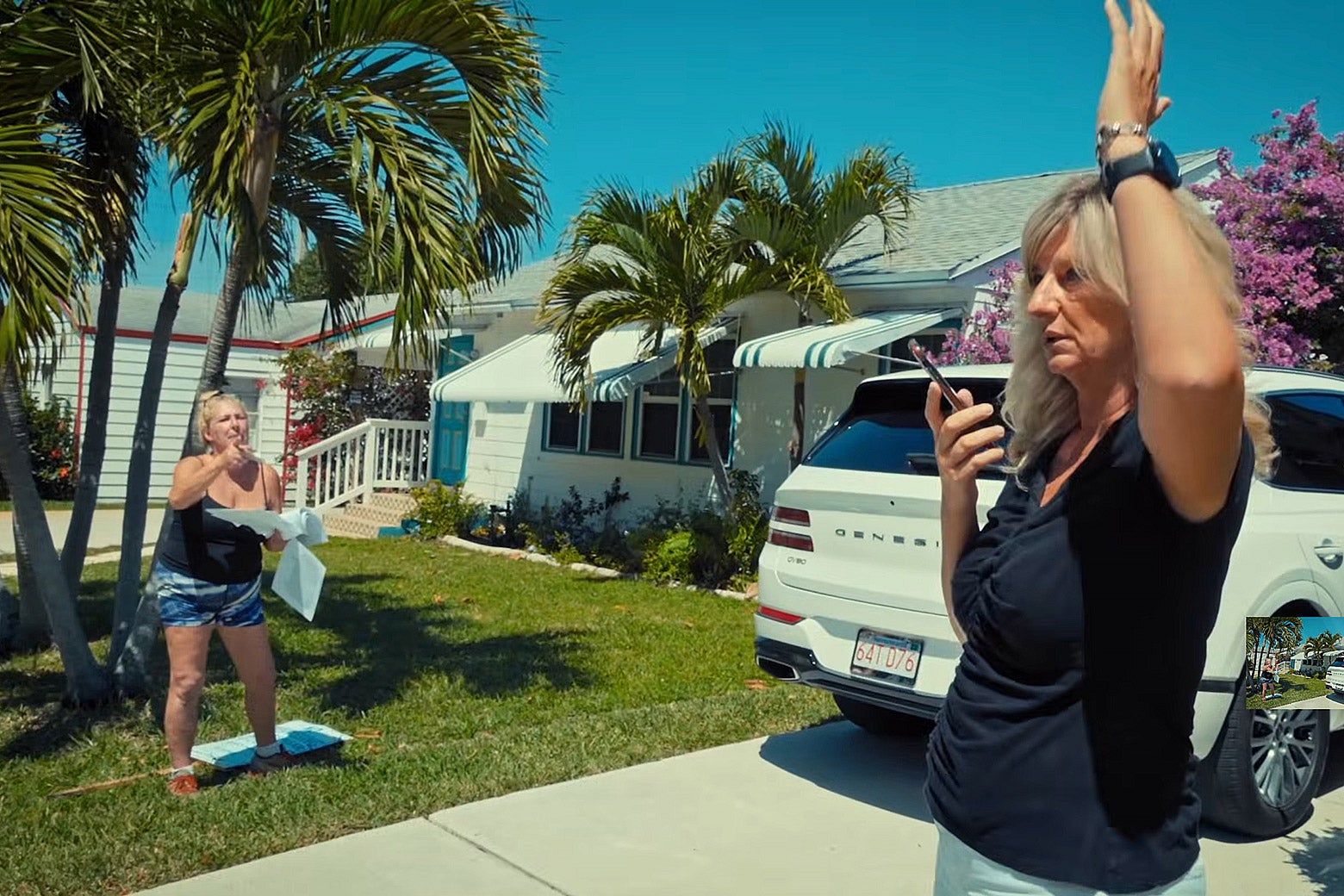
— HBO has added a new entry to its nonfiction slate with Neighbors, a six-episode docuseries created by Harrison Fishman and Dylan Redford and produced under the A24 banner, with Josh Safdie and Ronald Bronstein among its executive producers.
The series, which releases new episodes on Friday nights, structures each installment around two separate neighbor disputes that are loosely connected by theme. In practice, that format places the show in the contested space where “social” conflict becomes “watchable” content—an approach that can play as dark comedy in marketing terms, but that depends on real-world volatility for narrative propulsion.
A two-case-per-episode format built for escalation
Each episode of Neighbors is organized as a paired case study: two separate disputes, cross-cut to create rhythm and contrast. The first episode links battles over access to land—one in rural Montana and one in Florida’s panhandle. The second episode centers on “animal odors.” Across the series, the participants are depicted as already pushed past the point of reason by the time cameras arrive, frequently in front of an online audience that the show suggests has been “rubbernecking” and intensifying the conflicts.
That structure matters from an industry standpoint because it’s a packaging strategy as much as an editorial one. A paired format can increase episode density—more characters, more friction points, and more cliffhangers per hour—while limiting the need to resolve any single storyline. It also spreads legal and reputational risk across multiple segments rather than tying a full episode to one potentially sensitive dispute. In an era when unscripted series are routinely mined for litigation and reputational fallout, that choice functions as a kind of informal risk diversification strategy for both HBO and A24.[1]
Episode 1: public access, private control, and a camera that won’t arbitrate
In Shawmut, Montana, Neighbors follows a confrontation between two landowners, Seth and Josh, rooted in a disputed roadway and the practical consequences of fencing in rural communities.
Seth, described as a landowner in Shawmut, recalls moving there with his wife in 2016 to flee the “plague” that he said he saw coming, claiming it arrives “in the 20th year of every century.” He also cites “the ‘crazy that was going on in Portland’” as a factor.
Josh, introduced as a more recent arrival and a self-proclaimed homesteader, says he believed relocation to “the middle of nowhere” would insulate him from interpersonal conflict. Instead, he “immediately drew the ire of his new neighbors” by putting up a fence and a locked gate that blocks what had been a formerly public road—also preventing neighbors’ horses from grazing where they had for years.
The series does not establish definitively “just how public that public road was.” Viewers hear Seth and Josh “shouting their sides of the argument at one another,” including “the occasional threat to life and limb,” but the segment offers no authoritative on-camera resolution. A court-appointed mediator appears, but the show reports that he effectively throws up his hands. Police are said to have been involved in the past, but do not appear on camera. The segment emphasizes how thin civic infrastructure can feel in a small town: the combined families are portrayed as a “double-digit percentage of Shawmut’s population,” leaving few uninvolved parties to act as referee.
In regulatory terms, the fight sits in the murky overlap between property rights and public access: the kind of dispute that, off-camera, often turns on easements, county plat maps, and how strictly local officials interpret access rights that resemble—but may not actually be—those guaranteed under formal “right of way” or public-road statutes. The show sidesteps those details, reinforcing its choice to prioritize lived anger over the paperwork that’s supposed to channel it.
In Santa Rosa Beach, Florida, the dynamic flips: the series depicts a conflict with abundant witnesses, tourists, and opportunists. The dispute pits oceanfront property owners against other residents over who has the right to occupy the “fine white sand.” The show includes a self-described “First Amendment auditor” who films confrontations on an iPhone, claims he is exercising his rights, and pepper-sprays people who push back.
Two of the on-camera figures in the Florida dispute are Sara and Eric. Sara claims that “the law gives anyone access to any portion of the beach below the high-water line,” and taunts a security guard hired to chase off unwanted beachgoers as a “sunburnt scarecrow.” Eric, whose “sprawling porch” looks out over the stretch of sand he claims, says he is exhausted with “screaming tirades by hysterical liberals.” He also claims to mourn the lack of “productive debate” and a facts-based conversation in contemporary society—while the segment characterizes his idea of a productive debate as one that ends only when the other side concedes.
The Florida material brushes up against a much larger governance story: long-running fights over customary beach use and public-versus-private rights along the coastline, the sort of questions that have prompted counties and state lawmakers to hash out detailed rules for what counts as public beach and what remains enforceably private.[2] Neighbors acknowledges that legal scaffolding mostly through its characters’ shouted interpretations of “the high-water line,” leaving viewers to infer how far the formal law can be stretched—or weaponized—in a single afternoon argument.
Episode 2: a local headline meets national framing
The second episode shifts to Kokomo, Indiana, where Darrell is shown holding a copy of a local newspaper with a front-page story about his conflict with his neighbor, Trever. Trever has set up a makeshift farm in the yard of his grandmother’s house. Under that story, the paper carries another headline: “Divide in American Politics.”
That visual pairing spells out a point the series otherwise makes indirectly: these are not just private spats but conflicts that local institutions—from zoning offices to small-town newsrooms—are increasingly tempted to frame as miniature versions of national culture war divides. The docuseries doesn’t linger on the permitting or code-enforcement backdrop to Trever’s “farm,” but the implication is clear enough: a disagreement that might once have been handled quietly at a planning desk is now recast as a referendum on whose values define the block.
The series is described as rarely making political leanings explicit, though it includes a New Jersey man engaged in a Christmas Vacation-style attempt to outdo a neighbor’s Halloween display who wears a MAGA hat in an on-camera interview.
Across the episodes described, the disputes are portrayed as less oriented toward civil process than toward physical intimidation: the participants are presented as more likely “to brandish firearms” than to threaten a lawsuit. The show repeatedly returns to the idea that everyday governance—formal enforcement, mediation, and community norms—either fails to intervene or has been displaced by performative conflict. The result is an implicit question the series never quite answers: if neighbors no longer trust municipal processes, courts, or homeowner associations to referee these fights, who is left to keep predictable, boring order?
Conflicts without origins: an editorial choice with consequences
Several of the disputes referenced in the series are presented without definitive explanation for how relationships broke down—an approach that keeps the focus on confrontation rather than causality.
One segment involves a white divorcé who claims an elderly woman next door took him in as his “Black mama,” before a misjudged joke led to both calling the other racist. Another centers on two women in West Palm Beach whose children once played together, and who are now depicted as prepared to shoot each other over a small stretch of lawn between driveways. The series is described as leaving the cause unresolved—“we’ll never know”—because it is more invested in the conflict than its origins.
That “conflict-forward” strategy is common in unscripted storytelling, particularly in formats designed for weekly retention rather than single-sitting resolution. It also plays to how platforms and streamers now think about “sticky” nonfiction: viewers are more likely to return if they are hooked on spectacle rather than patiently walked through the chain of events that might have prevented it.
But this decision also heightens the ethical tension for platforms and producers. Withholding context may protect participants’ privacy or reduce defamation exposure, but it also removes the very information that might help audiences understand what, if anything, could defuse the confrontation—or whether institutions meaningfully tried.
Social media as both subject and sourcing pipeline
Social media is positioned as a driving force in the ecosystem that Neighbors depicts, and—implicitly—as a tool that enables the show’s own casting.
Josh is said to have 2 million TikTok followers. The series ties that audience reach to economic mobility: those followers enabled him to move his metalworking business to what he approvingly calls “the middle of nowhere.” In another later-episode thread referenced in the series, a complainant openly hopes a video about his dispute—described as involving his front lawn—will go viral, believing that only a mass outcry can tip the odds in his favor.
In commercial terms, that’s also an account of how contemporary unscripted production can source characters: social platforms can function as both résumé and audition tape, surfacing people who already perform their grievances to camera and who understand attention as leverage. For streamers and premium networks, that can reduce development friction—participants arrive preconditioned to narrate their own conflict—while increasing volatility, because online audiences can become active stakeholders in real-time disputes. Police chiefs, city councils, and homeowners’ associations then find themselves responding to conflicts that have already been edited, scored, and distributed for entertainment.
When “sideshow entertainment” intersects with real-world risk
Neighbors is described as framing territorial battles as sideshow entertainment. One example is a dispute between a Philadelphia cat owner and a nearby row-house owner who wants to rid a street of the smell of urine; the conflict ends up referred to Judge Judy.
But the series also repeatedly gestures toward the possibility of real harm. The show references two lifelong friends locked in a vicious fight over “a few inches of lawn,” and depicts them brushing up on marksmanship. The same segment includes people quoting portions of Florida’s “stand your ground” laws, explicitly invoking a template of lethal escalation discussed elsewhere in the nonfiction marketplace.
For networks and production companies, that’s the operational dilemma at the center of a series like this: the show can document, but it cannot govern. Cameras may capture threats, intimidation, and performative brinkmanship, yet the presence of a crew is not a substitute for enforcement, mediation, or mental health intervention. In the contemporary U.S. market, where the docuseries business has expanded rapidly over the last decade, the gap between “observational” storytelling and “duty of care” is now a recurring point of scrutiny—especially when firearms and credible threats are part of the on-camera record. The series repeatedly hints that the real decision-makers in these stories are sheriffs, code inspectors, and county commissioners who appear only as offscreen forces or pieces of paperwork, if at all.
A COVID-era accelerant without a COVID-era storyline
Although the pandemic is described as being mentioned only “in passing a handful of times,” the series treats COVID-19 as an accelerant for multiple subjects, amplifying what it portrays as a strain of radically anti-communal ideology.
That is consistent with the way many recent nonfiction projects have handled the period: COVID often appears less as an explanatory framework than as a catalytic timestamp—an inflection point that participants cite to justify decisions around relocation, self-reliance, and suspicion of institutions. In Neighbors, the Montana storyline explicitly links a 2016 move to a personal belief in an approaching “plague,” while later segments frame the broader national mood as one in which people increasingly reject the obligation to share space at all.
What the series captures most clearly is not pandemic policy but its residue: a sense that once neighbors began thinking of one another primarily as threats—to health, property values, or political identity—it became easier to treat every patch of land as a potential battlefield. The law, in that framing, is just another prop that characters brandish alongside fences, cameras, and guns.
Neighbors is a six-episode series, and HBO is debuting new episodes on Friday nights, positioning the show squarely in its late-night nonfiction block alongside other efforts to turn ambient American anxiety into serialized viewing.[3]
Related reading
- Interactive Storytelling and Immersive Audio: How Next-Gen Gaming Engines Are Transforming Contemporary Television Production
- Independent Cinema’s New Distribution Paradigms: How Direct-to-Consumer Micro-Premiers Are Shifting Box Office Dynamics
- Why the Social Security COLA Is Announced in October (daybreakwire.com)
