
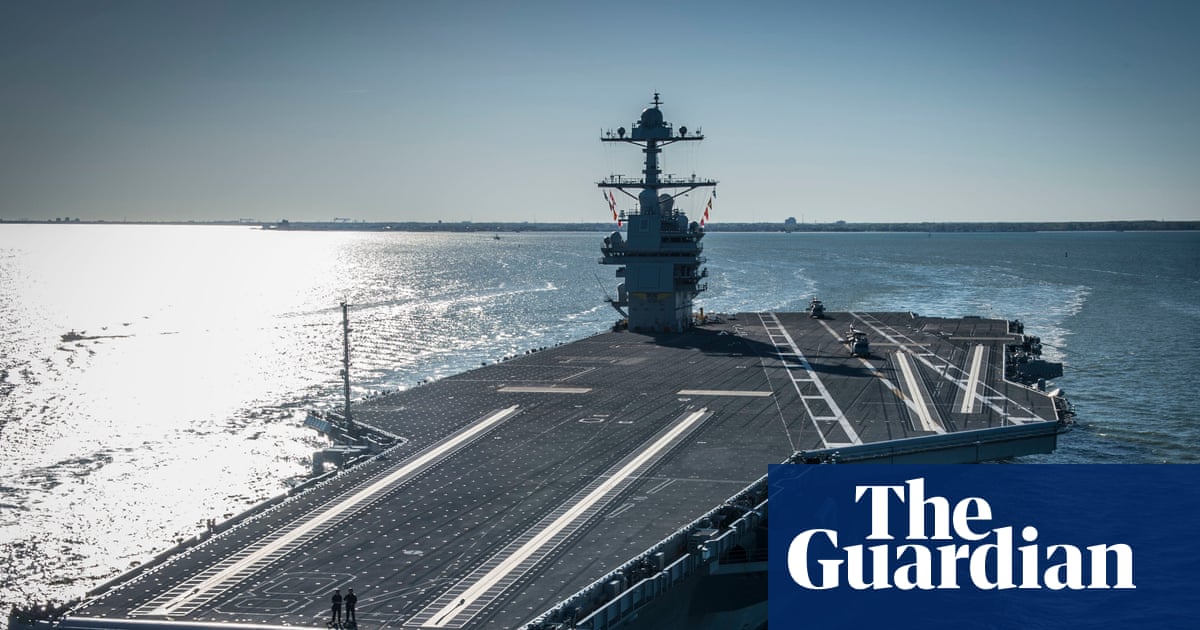
WASHINGTON — President Donald Trump has ordered the USS Gerald R. Ford, the world’s largest aircraft carrier, and its supporting warships to sail from the Caribbean Sea to the Middle East to increase pressure on Iran amid discussions over curbing Tehran’s nuclear and ballistic missile programs. The Pentagon expects the carrier strike group to take about three weeks to reach the region, where it will join the USS Abraham Lincoln.
The redeployment concentrates U.S. naval power as Washington and Tehran pursue indirect talks and as Trump signals he is considering sending a second carrier strike group. U.S. officials have not announced an arrival date or a detailed operations plan.
- Ship ordered to move: USS Gerald R. Ford and supporting warships
- Origin: Caribbean Sea
- Destination: Middle East
- Estimated transit: about three weeks
- To operate alongside: USS Abraham Lincoln
- Diplomatic channel: Indirect U.S.–Iran talks in Oman; no follow-up date scheduled
Carrier redeployment increases available U.S. firepower
U.S. media reports identified the Ford as the carrier selected to get underway, and officials said it will join the Abraham Lincoln already in the area. The Ford-class carrier is a nuclear-powered supercarrier; a U.S. carrier strike group typically deploys with a guided-missile cruiser and several destroyers to provide air defense, maritime security and long-range strike options under the U.S. Navy’s regional command structure.
The move comes as the Trump administration continues to enforce sanctions on Iran under authorities granted by the U.S. Iran sanctions program, framing the carrier deployment as reinforcement for a “maximum pressure” strategy.
In an interview earlier this week, Trump said he was “thinking” about sending a second carrier strike group to the Middle East. He has since warned Iran that failing to reach a deal with his administration would be “very traumatic.”
“I guess over the next month, something like that,” Trump said in response to a question about his timeline for striking a deal with Iran on its nuclear programme. “It should happen quickly. They should agree very quickly.”
While Trump has not detailed potential military options, Pentagon officials stress that any sustained use of force or broader campaign in the region would be conducted under existing authorizations and in consultation with Congress, within the framework of U.S. obligations under the UN Security Council’s Iran-related resolutions.
Negotiations continue via Oman channel
The United States and Iran held a round of indirect negotiations in Oman, a venue that has hosted previous back-channel exchanges between the two countries and is viewed by diplomats as a neutral facilitator in Gulf security crises. Further discussions were expected to follow, but no date has been scheduled, underscoring the gap between the intensifying military posture and the still-fragile diplomatic track.
Officials familiar with the talks say the Oman channel is focused on parameters for nuclear and regional de-escalation, rather than on a full restoration of previous agreements. For now, envoys are shuttling messages rather than sitting in the same room.
Positions on the table
Iran has indicated it is willing to curb nuclear enrichment in exchange for sanctions relief. According to officials, Iran has rejected other demands that it views as reaching beyond nuclear restrictions, including curbs on its regional activities.
Israel, which has urged Washington to keep maximum leverage on Tehran, wants Iran to limit its ballistic missile program and reduce support for Hezbollah and other proxy groups. Trump met with Israeli Prime Minister Benjamin Netanyahu in Washington as the negotiations track took shape, with Israeli officials pressing for any eventual understanding to address missile capabilities and Iranian forces operating near Israel’s borders.
European diplomats, while not directly party to the Oman talks, are watching closely, concerned that a miscalculation at sea or around nuclear facilities could outpace the slower-moving diplomatic process.
Extended deployment for the Ford
The Ford carrier strike group previously operated in the eastern Mediterranean before shifting to the Caribbean Sea for exercises and presence operations. The current move back to the Middle East extends a deployment that began when the carrier left the United States in June 2025; no return date has been set, raising the prospect of longer tours for sailors and sustained high-tempo operations in contested waters.
Defense officials say the Ford’s presence is intended both to reassure regional allies and to deter potential Iranian moves against shipping lanes and U.S. personnel. But with the carrier now committed to the Gulf region for at least several more weeks, diplomats caution that the window for talks will be shaped not only by what is said in Oman but also by what unfolds at sea.
A follow-up date for additional U.S.–Iran discussions in Oman has not been scheduled.
- Urban Infrastructure Resilience: How European and Asian Megacities Are Adapting to Extreme Climate Oscillations in 2026
- UN General Assembly 2026 Framework on Autonomous Systems: International Diplomacy Faces Algorithmic Governance
- Why Your Tire Pressure Light Comes On on Cold Mornings (daybreakwire.com)
