
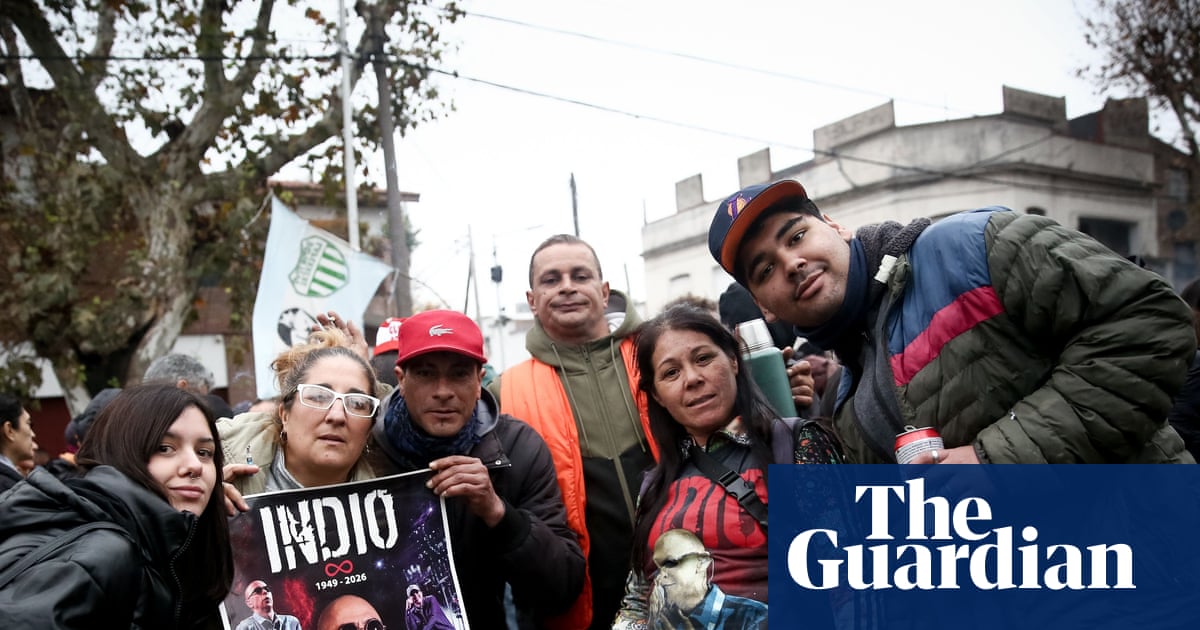
BUENOS AIRES – Hundreds of thousands of people gathered in Avellaneda on Sunday, June 7, for the public wake of Carlos “Indio” Solari, who died Friday, June 5, from a stroke at the age of 77.
The scale of the event, which saw mourning lines stretching more than 7km, highlights the tension between hyper-local cultural movements and the mechanisms of globalized entertainment distribution. Solari’s career provides a case study in the limits of cultural exportation when an artist prioritizes regional identity and independent production over the standardization required for international market penetration.
Independent Production and Distribution
Solari co-founded the rock band Patricio Rey y sus Redonditos de Ricota in 1976, building a cult following at a time when Argentina was emerging from military dictatorship and rebuilding its democratic institutions. Following the group’s split in 2002, he continued to perform with a new ensemble until Parkinson’s disease, which he made public several years ago, necessitated his retirement from live appearances.
Despite achieving massive audience reach-his final concert in 2017 drew as many as 400,000 people-Solari operated outside the traditional industry framework. He self-produced his music, retained tight control over image and rights, and refused contracts from major record labels even as streaming platforms and multinational distributors consolidated their hold on the region’s music markets.
Journalist Pablo Perantuono, co-author of a book on Solari’s band, stated that Solari rarely gave interviews and maintained an austere, working-class image that echoed the sensibilities of his fanbase. Perantuono noted that while fans viewed this as “a very strong statement of principles,” it simultaneously hampered the ability to market his music overseas, where promotional cycles and sync deals often depend on an artist’s willingness to participate in standardized publicity machinery.
Linguistic and Cultural Localization
While contemporary Latin American genres such as trap and reggaeton utilize a more standardized linguistic approach to facilitate cross-border circulation and placement on global playlists, Solari’s work remained tied to the specificities of the Southern Cone, particularly the idioms and social references of Argentina’s industrial belt.
Sociologist Pablo Alabarces attributed this lack of international travel to Solari’s “poetic and musical language,” which he described as both intensely local and resistant to export.
“It is a very distinctive style of rock that you don’t hear elsewhere in Latin America. That cryptic yet working-class poetic style is very Argentine. There is no such thing as ‘neutral’ Spanish in El Indio’s poetry, which makes it comprehensible only to a local audience,” Alabarces said.
Alabarces further noted that rock music in the region remained shaped by national political experiences, arguing that “making rock music under the PRI’s ‘perfect dictatorship’ in Mexico is not the same as doing so under Videla’s terror regime in Buenos Aires.” In that context, Solari’s lyrics-dense with allusion, irony and coded commentary-functioned as a form of localized political literacy that did not easily translate beyond Argentina’s historical memory.
Perantuono described the music as a cultural synthesis that drew from tango, the beatniks, and Anglo-American rock, calling it “an exceptional movement because it is very hard to track its bloodline.” For cultural policymakers and export offices that often frame music as a soft-power tool, Solari’s trajectory underscores how deeply rooted, place-specific scenes can resist being repackaged into generic “Latin” products.
Political Alignment, Public Ceremony and the State
Solari’s political identity influenced not only his audiences but also the logistics of his final rites. An open Peronist, he was long associated with sectors of Argentina’s Justicialist movement that frame culture as a collective right and a vehicle for social mobility. His wake therefore became a flashpoint in the broader confrontation between that tradition and President Javier Milei’s libertarian administration, which has pledged to dramatically reduce public spending on culture and scale back the role of the state in organizing mass events.
Under Argentina’s constitutional framework, funerary honors for prominent public figures in the national congress building are regulated by congressional authorities operating within the broader institutional architecture of the Constitución de la Nación Argentina. In this case, the Milei government rejected permission for the ceremony to be held in the congress, a decision critics read as both a security assessment and a political signal regarding which cultural figures are granted symbolic space at the heart of the Republic.
Consequently, the wake was relocated to Avellaneda, a district governed by Peronists on the southern edge of Greater Buenos Aires. Local officials, who have previously hosted large football and music crowds, coordinated policing, transport and emergency services, turning the municipality into a de facto national mourning ground even without a central state-organized tribute.
The event attracted a diverse demographic, particularly working-class youth who had grown up with Solari’s music as a soundtrack to economic crisis and political volatility. Mourners reported that lyrics from songs such as Ji ji ji and La gran bestia pop-the latter a critique of the music industry-served as anthems for political resistance and cultural identity, echoing debates over cultural sovereignty in an era dominated by recommendation algorithms and multinational streaming platforms. For many in line, the hours-long wait was less a farewell to a rock star than an affirmation of a shared, stubbornly local way of understanding power.
The public wake concluded on Sunday following the attendance of hundreds of thousands of mourners. For Argentina’s political class and cultural institutions alike, the sheer size and intensity of the turnout served as a reminder that some of the country’s most powerful symbols sit well outside formal party structures, rooted instead in scenes that never fully signed up to the global entertainment playbook.
Keep reading
- Interactive Storytelling and Immersive Audio: How Next-Gen Gaming Engines Are Transforming Contemporary Television Production
- Independent Cinema’s New Distribution Paradigms: How Direct-to-Consumer Micro-Premiers Are Shifting Box Office Dynamics
- Tens of thousands expected in Paris for student protests – RTE.ie (archyde.com)
