
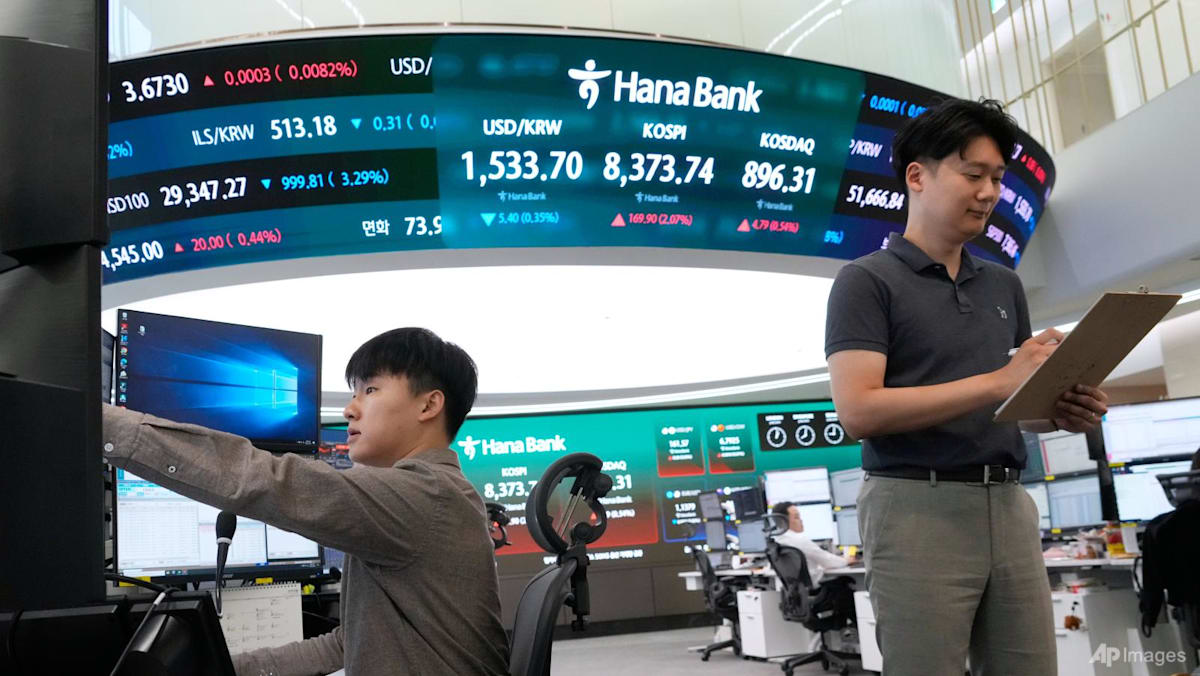
HONG KONG – South Korean equities recovered on June 24 following a sharp correction, highlighting the volatility currently gripping Asia’s semiconductor hubs as investors question the long-term return on investment for artificial intelligence infrastructure.
The volatility reflects a broader strategic shift in market sentiment. After a period of rapid appreciation driven by the hardware build-out, investors are now scrutinizing whether the massive capital expenditures by cloud hyperscalers will translate into sustainable revenue, all while facing a tighter monetary environment following a hawkish pivot by the U.S. Federal Reserve.
Semiconductor Volatility and Valuation
The KOSPI experienced a 10 per cent collapse on June 23, driven by double-digit losses in the region’s most critical hardware providers. Samsung and SK Hynix, which together dominate the global supply of high-bandwidth memory (HBM) essential for AI accelerators, saw declines of 12 per cent. The downdraft briefly pushed the benchmark well below levels reached earlier this year, before a wave of AI-related buying drove the index to multi-year highs.
Market activity on June 24 showed a tentative reversal as dip-buyers and short-covering emerged:
- Samsung: Gained more than 7 per cent
- SK Hynix: Gained more than 3 per cent
- KOSPI Index: Rose more than 3 per cent
- Nasdaq: Declined 2 per cent (previous session)
The contrast with Wall Street’s more muted move underscored how Korea’s benchmark, heavily weighted toward memory and foundry champions, has become a highly leveraged expression of global AI optimism. While the rebound suggests a degree of resilience, analysts say the sell-off exposed a vulnerability in markets where valuations have become detached from near-term earnings visibility and are instead priced off multi-year AI adoption curves.
This pressure is most acute in Seoul, Tokyo, and Taipei, where the concentration of hardware manufacturers has made these indices more sensitive to AI spending cycles than the software-heavy benchmarks of Wall Street. In those markets, even modest revisions to capex plans by U.S. and Chinese cloud operators can trigger outsized moves in local equities.
“The next-stage debate on AI investing is not whether the theme is real, but whether the scale of investment will ultimately generate the returns that investors expect,” said Christoffer Enemaerke of RBC BlueBay Asset Management.
Enemaerke noted that while the U.S. focus is on whether hyperscalers earn an adequate return on deployed capital expenditure, the risk for emerging markets is whether semiconductor memory supply growth eventually outpaces demand, leaving producers exposed to classic boom‑bust dynamics in pricing.
Strategic Importance vs. Market Leverage
The correction has sharpened a debate over whether the AI trade has become over-leveraged across both cash equities and derivatives. Stephen Innes of SPI Asset Management characterized the June 23 session as a reminder that the AI market had become one of the most “crowded expressions of over-leverage,” with positioning amplifying what began as a valuation shakeout.
However, the strategic position of South Korean firms remains a critical factor for global supply chains and for policymakers seeking to secure access to advanced chips. Seoul has leaned on targeted incentives and export controls to deepen its role in the AI value chain, even as the United States and European Union roll out their own industrial policies and security reviews for critical technologies under frameworks such as the U.S. Defense Production Act.
“The fundamental case remains intact, at least for now. Memory remains one of the critical bottlenecks in the global AI buildout, and neither SK hynix nor Samsung suddenly lost their strategic importance because the market had one violent session.”
Market participants are now looking to the earnings release from U.S. chipmaker Micron Technology on June 24. As a primary competitor to Samsung and SK Hynix in the DRAM and NAND flash markets, Micron’s financial results are viewed as a bellwether for global demand and for whether hyperscaler spending is broadening beyond a handful of flagship AI deployments.
While Seoul, Hong Kong, Sydney, Singapore, and Manila saw gains on June 24, the recovery was not uniform across the region. Markets in Tokyo, Taipei, Shanghai, and Wellington continued to decline, reflecting local concerns over export controls, currency volatility, and the risk that any moderation in AI-related capex could feed quickly into order books for upstream component makers.
Energy Markets and the Hormuz Chokepoint
Oil prices continued their descent on June 24, reaching levels not seen since the early stages of the Middle East crisis. The decline is linked to cautious optimism regarding a diplomatic resolution to the conflict with Iran, supported by data showing maritime traffic through the Strait of Hormuz reached its highest level since the war began on Monday.
Despite the price drop, diplomatic friction persists over the administration of the waterway, which handles approximately 20 per cent of global oil transit and remains one of the most closely monitored shipping lanes for energy security officials.
U.S. Secretary of State Marco Rubio stated on June 23 that Washington will not accept the imposition of tolls or fees by Iran on the strait. “It’s an international waterway. No country is allowed to charge tolls or fees on an international waterway,” Rubio said during a tour in the United Arab Emirates, echoing long-standing U.S. interpretations of international navigation rights.
In response, Iran and Oman issued a joint statement indicating they would study the administration of the trade route and the associated service costs, asserting their sovereignty over the area. Any move to formalize new charges or traffic-management rules would test existing maritime norms and likely draw in major importing nations in Asia that rely on uninterrupted flows of crude and liquefied natural gas through the chokepoint.
Mohammad Bagher Ghalibaf, Tehran’s top negotiator, stated that the strait “will never return” to the pre-war status quo, despite an agreement between the two sides to maintain open communication lines to ensure the waterway remains navigable.
For now, the energy market remains in a state of tentative decline, with traders weighing incremental progress in talks against the risk of miscalculation in one of the world’s most securitized sea lanes. Pricing remains highly sensitive to any signals from regional capitals and inspection regimes that could either normalize traffic or reintroduce the prospect of disruption to shipping and insurance costs.
Keep reading
