
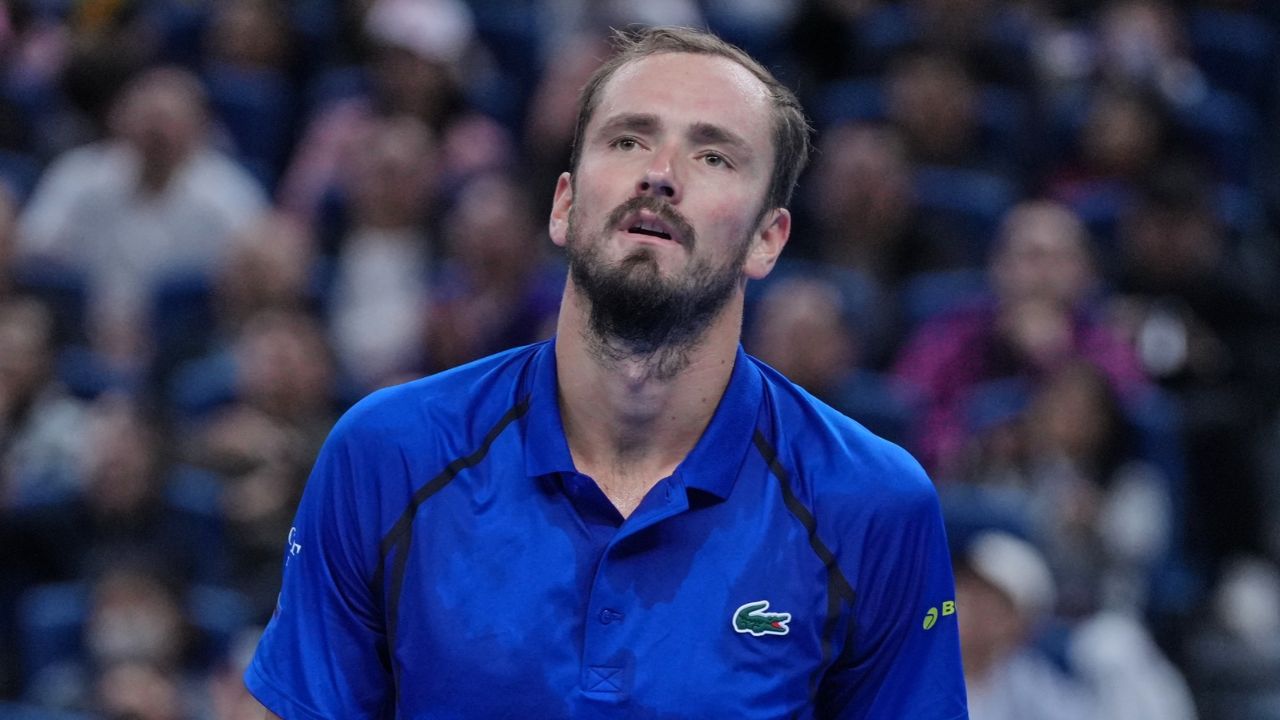
Medvedev Defaulted After Striking Spectator as Djokovic’s Perfect Beijing Record Survives Turbulent Semifinal
BEIJING – Daniil Medvedev was defaulted from his China Open semifinal against Novak Djokovic on Monday after striking a spectator with a ball, bringing a dramatic end to a high-quality contest and placing player conduct and on-court safety firmly back under the spotlight.
The incident occurred late in the second set with Djokovic leading 7-5, 5-3 and serving for the match. A spectator in the front row was hit in the left eye area and was helped out of the arena holding a hand over his face.
Semifinal halted by ball-striking incident
Djokovic had just finished a forehand volley winner when the ball bounced off the advertising boards and back toward Medvedev. In an apparent act of frustration and release, Medvedev struck a backhand that sailed into the stands and hit the spectator.
“I feel terribly sorry for him actually and I just hope he’s OK,” Medvedev said. “Hopefully I can meet him and make up for it somehow.”
The world-class Russian immediately appeared to wave his left hand in apology and remained on court as officials assessed the situation.
“It was 100 per cent an accident,” Medvedev said. “You can see that I didn’t hit the ball in anger. … The ball was bouncing back, so I tried to just hit it anywhere, so it wouldn’t go out of the court.”
When he realized the outcome, his tone changed from explanation to concern. “When I saw the result, I felt horrible,” he added. “The most important thing is I hope that he’s OK because you never know with these types of situations.”
Officials apply default rule as Djokovic advances
The chair umpire and tournament supervisor came down from their chairs to speak with Medvedev on court. After consultation, the decision was made to default the 28-year-old from the match. Medvedev did not appear to offer prolonged protest and walked to the net to shake hands with Djokovic.
The default meant Djokovic advanced to the final in Beijing while leading by a set and a break and standing three points from victory. The default also preserved his unbeaten career record at the China Open, which he extended to 33-0.
The ruling reflected long-standing enforcement standards in elite tennis: under the International Tennis Federation’s code of conduct, a player who strikes a spectator, official or ball person with a ball outside of a live point can be defaulted, regardless of intent, if officials deem the act reckless or dangerous.
Parallels with Djokovic’s own 2020 US Open default
The moment inevitably recalled Djokovic’s own high-profile disqualification at the 2020 US Open, when he accidentally struck a line judge in the throat with a ball between points and was removed from the tournament. That episode has become a reference point for how strictly the sport now interprets player responsibility for ball-related incidents.
“A bit of a shock, to be honest,” Djokovic said in Beijing. “I honestly didn’t see what happened. I hope that person is not badly injured. On the other hand, I also feel sorry for Daniil, because I know exactly how he feels to be disqualified in a big match. … I am sure that Daniil didn’t want to do this intentionally. It just happens.”
The parallel underscored a key principle at the professional level: while intent is considered, it does not override the obligation to protect spectators and officials in a tightly controlled arena environment. High-speed balls in enclosed stadiums leave little margin for error, and repeated high-profile incidents have prompted tournament supervisors to demonstrate consistency in applying sanctions.
Medvedev’s conduct in focus again
The default adds to a recent pattern of flashpoint moments for Medvedev. Earlier in the season, he was fined 6,000 euros (US$7,000) for unsportsmanlike conduct after he smashed his racket seven times during a 6-0, 6-0 loss to Matteo Berrettini at the Monte Carlo Masters.
That sequence and Monday’s default are separate incidents, but together they reinforce how behavioral issues can shape perceptions of top-level competitors and draw attention from tournament organizers and governing bodies. While there is no suggestion of a broader sanction beyond the Beijing default within this event, repeated episodes can influence how officials manage future matches, including the speed at which disciplinary steps escalate during volatile moments.
Scoreline, match dynamics and missed chances
Even before the incident, the semifinal had been a grueling contest between two former world No. 1s. Djokovic led 7-5, 5-3 and was serving when play ended, having navigated momentum swings and long rallies on the slower hard courts in Beijing.
Key match facts:
- Score at default: Djokovic leading 7-5, 5-3, serving
- Match duration at time of default: 2½ hours
- Break-point conversion: Medvedev converted 2 of 18 chances
Medvedev’s inability to capitalize on break opportunities proved critical in a match full of extended exchanges from the baseline. “It was a tough match for me,” he said. “He played really well. I felt he played like when we played our best matches. I had some opportunities, which I missed. He played incredibly, so I think he has big chances in the final.”
Djokovic also had to manage his own brush with the rulebook. He was twice called for exceeding the serve clock. After an initial warning, he was stripped of his first serve on a crucial break point midway through the second set, but still won the point and held firm under pressure.
“I was three points away from the win,” Djokovic said. “It’s always a big battle with Daniil and it’s so hard to play him when he’s feeling the ball well in slower conditions with a big serve. But we move on.”
Djokovic’s Beijing dominance and ranking context
The outcome sends Djokovic into the China Open final still unbeaten in Beijing at 33-0 and chasing a seventh title at the event. For a player whose career has been defined by Grand Slam success, this tournament carries additional weight this year.
It will be Djokovic’s second final of the season after losing to Carlos Alcaraz at the Australian Open. With his ranking down to No. 11, this is the first time in eight years that the Serb is contesting a tournament outside the world’s top 10, and his first event since a first-round exit at the US Open.
At 39, he has already shown resilience this week, rallying to defeat top-seeded Alexander Zverev in the quarterfinals. A title in Beijing would not radically alter his ranking position on its own, but in an Olympic cycle and with the indoor swing ahead, a strong week in China provides both tangible ranking points and a timely gauge of form against elite opposition.
Final set: De Minaur awaits after Hurkacz retires
Djokovic will meet ninth-ranked Alex de Minaur in Tuesday’s final. The Australian advanced when Hubert Hurkacz, who appeared increasingly limited in his movement, retired midway through the second set of their semifinal. De Minaur led 6-4, 3-2 at the time, and the exact nature of Hurkacz’s injury was not immediately clear.
For de Minaur, the walkover still delivers the practical benefits of a deep run in a prominent hard-court event: additional ranking stability and another opportunity to test his aggressive counterpunching style against a multiple Grand Slam champion in a championship match setting.
Regulation, risk and the wider tour
Monday’s default will reverberate beyond Beijing. Tournament directors and the men’s and women’s tours continue to calibrate how best to balance the intense emotions of elite competition with increasingly stringent expectations on safety and decorum.
In practical terms, the enforcement seen in Beijing reinforces a clear message across the locker room: regardless of match context, players are expected to maintain full control of the ball once a point has ended. Any lapse that endangers a spectator or official can immediately override the sporting narrative on court.
For Medvedev, already established as one of the defining hard-court players of his generation, the episode adds a disciplinary setback to an otherwise highly competitive performance against Djokovic. For the China Open and the broader tour, it underscores why officials will continue to lean heavily on the existing conduct framework rather than improvising in high-pressure moments.
Women’s draw: Gauff, Swiatek and Svitolina progress
While the men’s semifinal ended in controversy, the women’s event in Beijing moved forward with a series of notable results that reinforce the depth and generational spread at the top of the game.
In the third round of the women’s tournament, Coco Gauff defeated 16-year-old Chinese wild card Sun Xinran 7-5, 6-1. Sun, who recently won the U.S. Open junior title, pushed Gauff in a tight opening set before the American pulled away. The performance underlined the gap that still exists between junior success and week-to-week demands on the main tour, while also signalling the potential of homegrown talent in one of the sport’s largest markets.
Six-time Grand Slam champion Iga Swiatek came through a demanding contest of her own, rallying past Donna Vekic 4-6, 7-6 (0), 6-2. Swiatek will next face Iva Jovic, who beat Kamilla Rakhimova 6-1, 7-5. The matchup offers an instructive contrast between an established major champion and a less experienced opponent navigating the later stages of a high-level tournament.
Elina Svitolina also advanced with a straight-sets win, beating Maria Sakkari 6-4, 7-5. For Svitolina, these results contribute to a broader comeback trajectory and position her for deeper runs as the calendar heads toward the season-ending events.
Event impact and competitive implications
Across both draws, Beijing is functioning as a mid- to late-season measuring stick. For Djokovic and de Minaur, the final will test how their respective game styles translate in slower hard-court conditions with a major trophy on the line. For Medvedev, the default interrupts a hard-fought performance and ensures that post-tournament conversations will focus as much on conduct and regulation as on tactics and shot-making.
On the women’s side, victories for Gauff, Swiatek, Svitolina and others reinforce the importance of the China swing in structuring momentum and seeding positions heading into the final stretch of the season. In a year shaped by tight ranking clusters and demanding travel schedules, every result in Beijing feeds into selection choices, confidence levels and the competitive map for the months ahead.
