
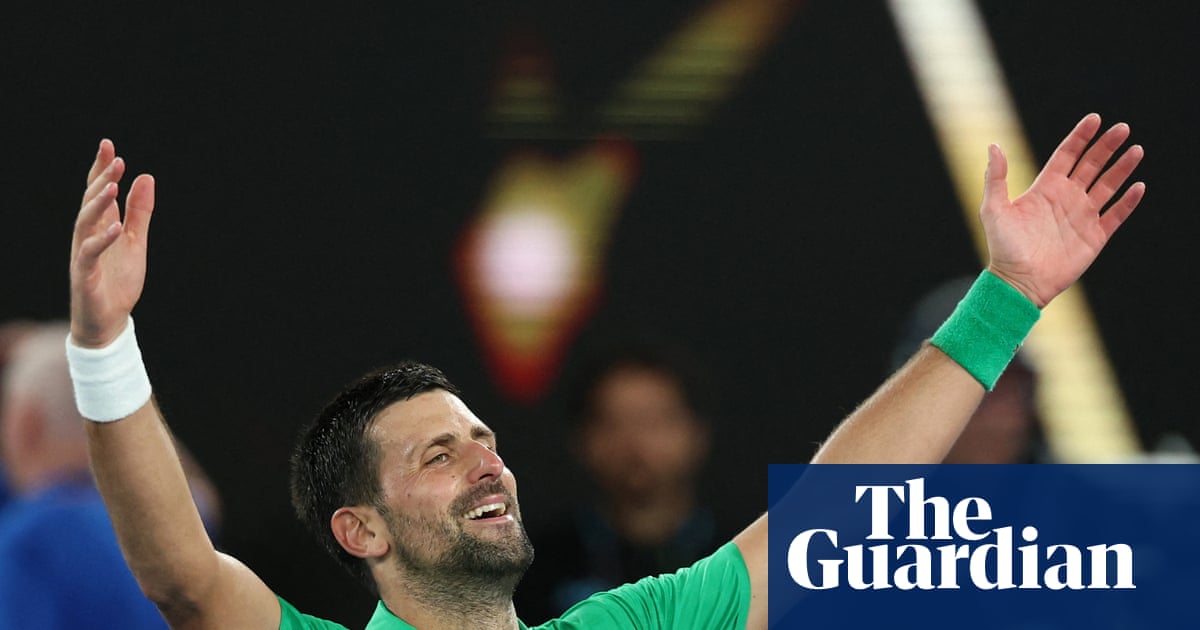
Novak Djokovic outlasts Sinner at 1.33am to reach a record 11th Melbourne final
A late finish, a historic return
Novak Djokovic was flat on his back at 1.33am on Saturday in Melbourne, arms raised and eyes fixed skyward after four hours and nine minutes that re‑ordered expectations of what is possible at 38. On Rod Laver Arena he rallied from two sets to one down to defeat Jannik Sinner, the two‑time defending champion and No 2 seed, 3-6, 6-3, 4-6, 6-4, 6-4 and return to the Australian Open final. The fourth seed becomes the oldest man in the Open era to reach the championship match in Melbourne, advancing to a men’s‑record 11th final here and the 38th major final of his career. In a tournament that has increasingly become a barometer of longevity in elite sport, his win extends an era he was widely expected to be exiting, not redefining.
Pressure points define the night
Sinner’s ball‑striking was as brutal as advertised: 72 winners against 42 unforced errors and a career‑high 26 aces. Yet the match turned on Djokovic’s defiance in crisis. He faced 18 break points and saved 16 of them, including all eight in two early service games of the deciding set. From a fixed position atop the baseline he took time away, redirected pace off both wings and served with precision when the scoreboard squeezed. His return of serve, long the most disruptive shot in the men’s game, repeatedly forced Sinner to play an extra ball on points the Italian appeared to control. It was not dominance so much as refusal-winning the rallies that decided the sets, then the match.
Form questions meet a definitive answer
Doubts surrounded Djokovic’s level as this tournament tilted into its second week. In the fourth round the No 16 seed Jakub Mensik withdrew, and in the quarter-final the No 5 seed Lorenzo Musetti led by two sets before retiring. Djokovic had not completed a full match or won a set since the third round. The paradox was rest; last season, the physical load of four major semi-finals told on him, but here he arrived in the final four with comparatively fresh legs and made them count.
That context mattered against Sinner, who had built a five‑match winning streak over Djokovic in recent months and arrived in Melbourne as the informal favourite on hard courts. The Serb’s ability to play his cleanest, most disciplined tennis under genuine scoreboard pressure-rather than in the procession of earlier rounds-answered questions that neither withdrawals nor retirements could resolve.
The veteran versus the prodigy, again
The final brings a renewal of the Djokovic-Carlos Alcaraz rivalry after the world No 1 came through his own five‑setter against Alexander Zverev. The stakes are generational. Djokovic is pursuing a record 25th men’s singles major and, with it, the mark of the oldest men’s grand slam champion. Alcaraz, 22, is chasing a career Grand Slam at the earliest age of the Open era’s elite.
Grand slam events are sanctioned and governed within the framework of the sport’s global rulebook, with the International Tennis Federation responsible for the Rules of Tennis and the regulations that define major records, rankings points and eligibility across the professional pathway. That framework underpins the sport’s four majors and the pathway to records that resonate beyond any single season, setting the terms under which this Djokovic-Alcaraz rivalry will be measured for decades. International Tennis Federation
Scheduling and the sport’s broader conversation
The finish time-well past midnight local-will again spotlight a long‑running tension at this tournament between player welfare, broadcast windows and packed day-night schedules. Melbourne Park’s atmosphere thrives under lights, yet matches tipping into the small hours increase recovery demands for finalists and can shape the spectacle two days later. It is a competitive variable as real as serve speed or string tension, and one the event has wrestled with before as organisers weigh commercial imperatives, international television slots and commitments to athlete health.
Tennis Australia, which stages the Australian Open, has previously indicated it is reviewing scheduling after a series of late‑night finishes in recent editions. Any further reforms-whether to start times, number of matches on the night session card or use of outside courts-would sit at the intersection of sporting integrity, labour conditions for players and staff, and the public‑interest role of a nationally significant event. The debate over when play should end is no longer just a talking point for players; it is edging into questions that ministers, regulators and tournament executives will be expected to answer as part of broader sports‑governance conversations. Australian Open
Match facts
– Venue: Rod Laver Arena, Melbourne
– Time and duration: Finished at 1.33am local; 4 hours 9 minutes
– Result: Novak Djokovic [4] def. Jannik Sinner [2] 3-6, 6-3, 4-6, 6-4, 6-4
– Key numbers: Sinner 26 aces (career high), 72 winners, 42 unforced errors; Djokovic saved 16 of 18 break points, including eight early in the fifth set
– Milestones: Djokovic is the oldest man in the Open era to reach the Australian Open final; this is his 11th Melbourne final (men’s record) and 38th major final overall
– Final: Djokovic to face world No 1 Carlos Alcaraz, who advanced via a five‑set win over Alexander Zverev
What it means for the title
For Djokovic, the semi-final was not only a comeback on the scoreboard but a restoration of competitive certainty: the baseline geometry held, the serve answered every interrogation, and the legs endured at 1.30 in the morning. The win restores the sense-familiar across his career-that at full stretch, on the sport’s biggest stages, he still controls the terms of engagement.
For Sinner, the loss halts a five‑match winning streak over the Serb and ends a title defence shaped by first‑strike tennis that very nearly pierced through again. His performance confirmed that his aggressive game translates under the heaviest possible spotlight, even if the margins that decide major semi-finals remain unforgiving.
Two days from now on the same court, a 38‑year‑old with 38 major finals will meet the sport’s leading 22‑year‑old. One seeks to stretch the record book; the other to redraw it.
