
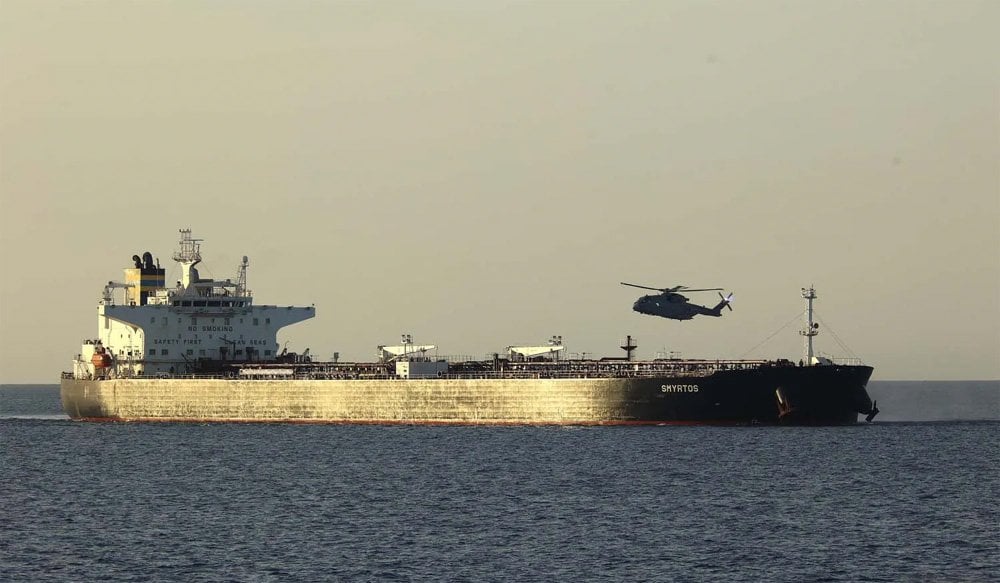
LONDON – A British court has set a December 15 trial date for Ajay Pant, the captain of the Smyrtos, the first “shadow fleet” tanker to be detained by the United Kingdom in a crackdown on the illicit transport of Russian oil.
The proceedings mark a critical escalation in Western efforts to dismantle the clandestine maritime networks used by Moscow to bypass international sanctions. The case serves as a high-stakes legal test to determine whether the masters of these vessels can be held criminally liable for the geopolitical directives of their owners.
The Smyrtos, a 106,969 dwt tanker built in 2009, was interdicted by UK forces in the English Channel on June 14. At the time of its seizure, the vessel was carrying approximately 98,000 tonnes of Russian oil intended for a third-party destination.
The ship had claimed to operate under the flag of Cameroon, but the registration was revoked under pressure from European authorities, rendering the vessel “stateless” under international maritime law. The Smyrtos currently remains anchored off Weymouth.
The Legal Threshold of Liability
Pant, a 38-year-old Chinese national, faces charges of “directly or indirectly supplying or delivering by ship prohibited oil or oil products from Russia to a third country” under the UK’s Russia sanctions regime, which is implemented domestically through regulations made under the Sanctions and Anti-Money Laundering Act 2018. If convicted, he faces a maximum sentence of 10 years in prison.
During his second court appearance on July 16, judges denied Pant’s request for bail, citing a significant flight risk and the possibility that Russian interests might facilitate his escape. The court also noted that, as captain of a stateless vessel already subject to sanctions, Pant had both the expertise and international connections to evade future proceedings if released.
The defense has centered its strategy on the hierarchy of maritime command.
“Simply following orders,”
lawyers representing Pant argued, asserting that he was merely an employee of the vessel’s owners and not the architect of the shipment. They contend that decisions on cargo, routing, and compliance with sanctions were taken at a corporate level, leaving the master with limited discretion once at sea.
Conversely, UK prosecutors allege that Pant possessed specific knowledge of the cargo and understood that the operation violated international sanctions. The Smyrtos had been explicitly sanctioned by the European Union in June 2025 and by the United Kingdom in October 2025, and prosecutors say the vessel’s subsequent movements, including course changes and ship-to-ship transfers, demonstrate deliberate efforts to conceal the oil’s origin.
Legal analysts say the case will help define how far individual criminal liability can extend down a shipping company’s chain of command – a question closely watched by shipowners, charterers and insurers across Europe. A conviction could harden enforcement practice by making masters of sanctioned cargo personally accountable even where beneficial ownership is obscured.
The Mechanics of the Shadow Fleet
The detention of the Smyrtos is a direct response to the proliferation of the “shadow fleet” – a global network of aging tankers with opaque ownership and minimal insurance designed to circumvent the G7 price cap on Russian crude and EU embargo measures. Western officials estimate that hundreds of vessels now operate largely outside conventional maritime insurance and classification systems.
To avoid detection, these vessels frequently employ several deceptive tactics:
- Flag hopping: Rapidly changing vessel registries – often to jurisdictions with limited enforcement capacity – to avoid regulatory scrutiny.
- AIS spoofing: Manipulating Automatic Identification System signals to hide their location, create “dark” gaps in tracking data, or fake their destination.
- Ship-to-ship (STS) transfers: Moving oil between tankers in open water, sometimes just outside EU or NATO territorial seas, to obscure the origin and final buyers of the cargo.
The G7 price cap, implemented to limit Russian revenue while preventing a global energy shock, relies on the cooperation of Western shipping and insurance firms. The shadow fleet bypasses this entire ecosystem by utilizing non-Western insurance, shell companies and “dark” registries, creating what regulators describe as a parallel logistics system that is harder to police and more prone to accidents.
Maritime safety advocates warn that many of these vessels operate with outdated equipment and limited oversight, raising the risk of spills in congested sea lanes such as the English Channel and the Baltic Sea. For governments, the challenge is to enforce sanctions without triggering energy shortages or maritime safety crises.
International Enforcement Disparity
While the UK pursues a criminal trial, other European nations have struggled to secure convictions against shadow fleet operators. France, Belgium, Germany, Latvia, Sweden, and Finland have all detained similar vessels, but the legal outcomes have varied widely, reflecting differences in national law and prosecutorial appetite.
Sweden has released several vessels with fines after prosecutors admitted that proving a captain’s subjective knowledge of a sanctions violation is a formidable evidentiary hurdle. In Finland, a case against a captain and officers for damaging subsea infrastructure was dismissed due to jurisdictional complexities and disputes over where the alleged offense legally occurred. France successfully prosecuted one captain, though the proceedings were conducted in absentia, limiting the judgment’s deterrent effect.
The United States has taken a more aggressive stance. In June 2026, Avtandil Kalandadze of Georgia pleaded guilty to charges involving a shadow fleet tanker that attempted to evade the U.S. Coast Guard while transporting oil from Venezuela, underscoring Washington’s willingness to use criminal enforcement and extraterritorial jurisdiction to target sanctions evasion networks.
The European Union has provided member states with expanded authorizations for searching and seizing such vessels through its successive Russia sanctions packages, which empower authorities to board, inspect and, in some cases, confiscate ships suspected of breaching restrictive measures. However, implementation remains inconsistent across the bloc, as many nations cite the legal risks of seizing cargo, potential compensation claims from third-country buyers, and the difficulty of establishing jurisdiction over stateless ships under instruments such as the UN Convention on the Law of the Sea.
Twenty-four crew members from Georgia and India remain aboard the Smyrtos. Although they have not been charged, they have been confined to the vessel for over a month as the UK government explores the legal feasibility of seizing and selling the cargo and determines whether the crew can be safely repatriated without undermining the wider investigation. Human-rights groups and seafarers’ unions are monitoring the case, warning that frontline crews – often recruited through contractors – risk becoming collateral in a sanctions enforcement regime increasingly focused on individual accountability.
If the December trial results in a conviction, UK officials are expected to argue that it will set a clear precedent for future interdictions in European waters. If Pant is acquitted, governments may face renewed pressure to redesign sanctions enforcement tools so that responsibility falls more squarely on shipowners, financiers and state actors driving the shadow fleet from behind the scenes.
Keep reading
